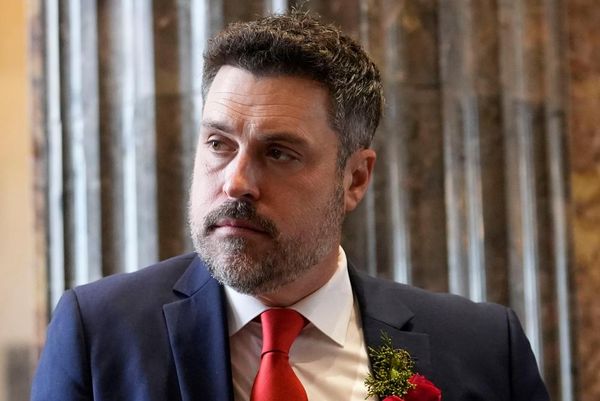
Maps of the US and Canada dot the wall above Steve Ahearne’s desk at Pinpoint Manufacturing Ltd in Swansea, south Wales.
The company, which produces tough, high-quality bags used for lifting tools and components mainly for the wind turbine industry, has ambitions of expanding into North America.
“In an unhindered world we’d be looking to crack on and truly go global,” he said. “As it stands we’re a bit unsure, nervous about how we should be investing. We want to expand but we may have to delay. Our order books are a bit quieter than we’d like them to be and our investment plans are up in the air.”
The reasons for the hesitancy are twofold: uncertainty over what shape Brexit will take, of course, but also the growing concern that recession could be just around the corner.
“It’s got quieter of late, especially last month,” said Ahearne, the general manager of Pinpoint. “But there’s historically a lull for us in July. August is better but it’s not where we’d like to be.
“We had a rush prior to the original Brexit date [29 March]. We did see more EU customers coming in the month before that, stockpiling. We did the same. We were stockpiling raw materials.”
13%: The drop in manufacturing output in real terms during the 2008-09 recession (compared with 6% for the whole economy)
£33,000: The average gross annual pay in manufacturing
9th: The UK’s place in the league table of leading manufacturing nations
Number employed in sector: 2.7 million
Percentage of GDP for the sector: 10%
Brexit impact? The UK’s decision to leave the EU could have a major impact on the manufacturing industry. For example, changes in the trading relationship between the EU and UK could increase the complexity of trading with European countries, but the ability of the UK to negotiate trade deals with third countries could help open markets that are currently unavailable to UK manufacturers
But the company has not seen the same rush before the 31 October deadline. “I don’t know if it’s because customers already have what they needed. Part of the problem may be the boy who cried wolf syndrome. Are people thinking: does this date mean anything? Or are they thinking that recession could be coming?”
Ahearne is pretty certain an official recession is on the way as the pound weakens and economies struggle across the world. “It looks like global recession is looming,” he said. “We sell a lot to renewable energy in particular. Any reduction or delay in investment in that sector has a knock-on effect for us.”

Ahearne estimates that if there is a no-deal Brexit, tariffs could push the price of goods up. “That’s very difficult. We’re not in a position to swallow that. We certainly don’t want to reduce the quality of our goods, that’s not the point of what we do. We don’t want to be saying we make the second best product on the market.
“If we didn’t have Brexit coming, the government would be more focused on the climate emergency, the drive to be more green.”
Pinpoint was created in 2006 when one of its founders with a background in the leather industry spotted a gap in the market for strong, safe, long-lasting bags in the renewables industry.
The bags are used to move around anything from tools to generators and sections of wind turbine blades. Pinpoint is also sometimes asked to make canopies for shops and covers for golf buggies, and even to mend awnings after particularly windswept camping trips on the nearby Gower peninsula.
The company remains relatively small, with just 13 employees. Half of its workers are citizens of other EU member states – it is hard to find people with industrial sewing skills – and half are local.
The company is based on the Crofty industrial estate on the banks of the River Loughor. Sheets of brightly coloured polyester are cut in one of the buildings and sewn by a team in another.
Two-thirds of the bags remain in the UK and almost all the rest head to the EU, mainly Denmark and Germany. A few are also sent to the Caribbean. When the Guardian visited, two lots of bags were about to be sent off to Great Yarmouth in Norfolk and Trinidad and Tobago.

High-quality materials are used and each bag has a serial number for traceability. One problem is that its bags tend to last, which means there is a need to find new markets for them – hence the maps on Ahearne’s office wall.
The company has been conducting research funded by the Welsh government, with the help of EU cash, to investigate those possible new markets. “We’re looking for a route into North America but we don’t just want to flap at it. We’re too small to be able to throw a large amount of money and hope into it,” said Ahearne.
One option might be to set up a base in Canada to try to take advantage of free-trade agreements betweenit and the US and Mexico. But the company may also have to move some operations to Europe to tackle the problems a hard Brexit could create. Donald Trump’s scepticism towards renewable energy is also worrying. “He’s so capricious – you never know what’s coming next,” said Ahearne.
“We’re trying to be as resilient as we can. Being small we can be relatively flexible. We can react to the market quicker than bigger companies. On the other hand we are limited in the amount of storage space we have.”
The Crofty estate, originally built as an ammunition dump during the second world war, has been doing well since the last recession. Six or seven years ago most of the units were empty but now the estate is thriving, with goods ranging from surfboards to oak flooring being built here.
But businesses are tightening their belts, not expanding nor taking on new staff. Local hoteliers report that bookings from EU nationals are down, and sheep farmers who rear lamb on the salt marshes are concerned that Brexit and recession will hit their markets.
Ben Cottam, the head of external affairs for the Federation of Small Businesses in Wales, said confidence in manufacturing had slowed.
“We’re seeing a dip in confidence as the quarters go past,” he said. “It’s not entirely as a result of Brexit; it’s fuelled by concerns about the global economy. People are putting off capital investment, people are putting off recruitment for new roles. People are waiting to see how things play out.
“They want to see if they there is a shift back in the global economy before they commit significant expenditure. Businesses are being cautious. It’s more about what people think is coming rather than what is there now.”
Cottam pointed out that almost two-thirds of Welsh manufacturing exports went to the EU but the rumblings over a possible recession in the US – were also hitting confidence. “It’s an uncertain future. It takes a big leap of faith to do something dramatic.”
Back at Pinpoint, there was a pause in the clatter of the sewing machines. The workers were not taking a tea break but meeting to find out how they could become more efficient.
Ahearne believes the Welsh government and business have worked hard to promote the country on the global stage. “There’s evidence there’s a real will and desire to push Wales on to the global scale but things like recession and Brexit put us back again. People are spending time consolidating rather than growing.
“We should be focusing on these things. There’s a lot of other stuff, social issues we could have been dealing with rather than looking into the jaws of recession and Brexit.”
Pinpoint may be tucked far away in a westerly corner of the UK and have a neat, tight operation, but it is not immune to recession. “We’re all beholden to global shifts and government changes and regulations,” Ahearne said.