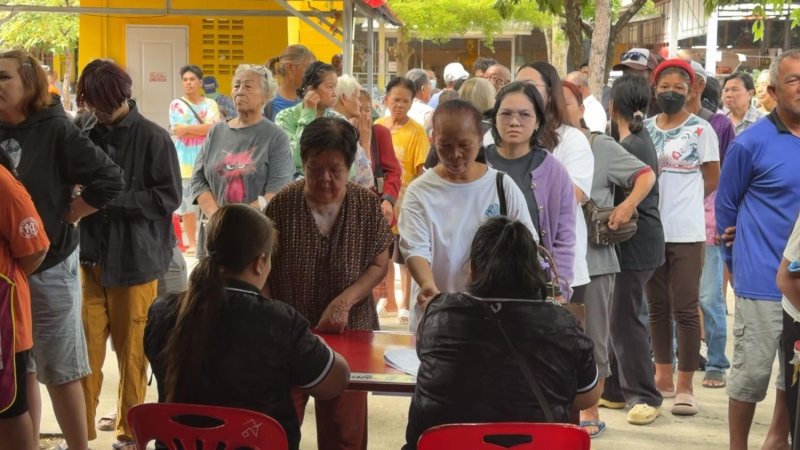
Public anger over excessively strict eligibility criteria for the state welfare card scheme, which left millions of impoverished people out in the cold, is the latest issue draining support for the Anutin government. Faced with criticism from all sides -- not to mention heartbreaking reports of poverty-stricken people being disqualified from the programme -- the government quickly backpedalled.
It was found that unrealistic rules and a flawed verification system resulted in more than nine million people being excluded from the scheme. Worse, the blunder reflects poor policy coordination, bureaucratic inefficiency and the lack of a comprehensive and reliable state database.
On top of that, it shows that poverty in the country is worsening while state efforts to narrow the wealth gap and improve people's quality of life remain inadequate.
Critics allege that the strict rules were initially designed to reduce the number of beneficiaries, regardless of their hardship. What followed was even greater suffering for vulnerable people as they struggled to prove their eligibility.
There have been reports of poor people suffering accidents or health problems while travelling to government offices to reclaim their rights. One elderly woman who came down from the hills reportedly died of cardiac arrest while queuing for verification at the Bank for Agriculture and Agricultural Cooperatives (BAAC) in Nan province. An elderly couple were also killed after a pickup truck rammed into their motorcycle before they could reach a bank to verify their eligibility for the scheme.
There have been numerous chaotic cases. Unsuccessful applicants are required to travel to various state agencies to verify their eligibility. Data discrepancies have caused many problems. For example, some people who do not own a vehicle had their eligibility revoked because official records incorrectly listed them as vehicle owners. It is hard to believe that the Thai government describes itself as an "e-government".
In fact, inconsistent databases are the main cause of the turmoil. Worse still, the burden of proof rests with applicants -- most of whom are vulnerable people. Those with limited mobility or those working for daily wages have had to sacrifice both time and income to complete the verification process.
Eligibility is based on nine criteria, including Thai nationality, being over 18 years old, earning no more than 100,000 baht annually, holding savings or savings lottery deposits of no more than 100,000 baht, and not being employed as a civil servant.
The welfare card database has been updated several times since the scheme was introduced in 2017 by the Prayut Chan-o-cha administration to help low-income people. There were 13.5 million cardholders in 2017. Five years later, when the government opened a new application round, 12.5 million of 22 million applicants were approved. This time, 18.8 million people applied, but only 9.5 million were deemed eligible.
As mentioned above, many verification failures stem from the lack of connectivity among databases maintained by different agencies. Some records were outdated, particularly those relating to vehicle ownership, leading many applicants to lose their eligibility. The fact is that this problem is not new. What a shame.
Even worse, the blunder highlights an irony within the system. The stricter the screening measures become, the more likely it is that genuinely poor people will be deprived of welfare benefits.
There is also evidence that some people who falsely claimed to be poor have benefited from the scheme. This, too, can be blamed on poor data management.
The bigger problem lies in the populist policies that have dominated Thai politics for more than two decades. Most political parties court voters with such policies, creating expectations that come with a heavy fiscal burden. Yet once these programmes become key campaign pledges, it becomes politically difficult to scale them back.
Moreover, welfare schemes of this kind are little more than a band-aid. They do not address the root causes of poverty. As long as the country's longstanding socio-economic structure remains unchanged, and educational inequality and unequal access to natural resources persist, millions of people will continue to depend on such programmes.
The major challenge for every administration is to narrow socio-economic disparities and promote a more open economic system so that people can stand on their own feet.
At the same time, the system must be overhauled to ensure fair competition between large corporations and SMEs, as well as equitable access to resources and employment opportunities.
Without meaningful structural reform, and while populism continues to be packaged as welfare, people will have little choice but to remain trapped in dependence on state assistance.
Chairith Yonpiam is assistant news editor, Bangkok Post.