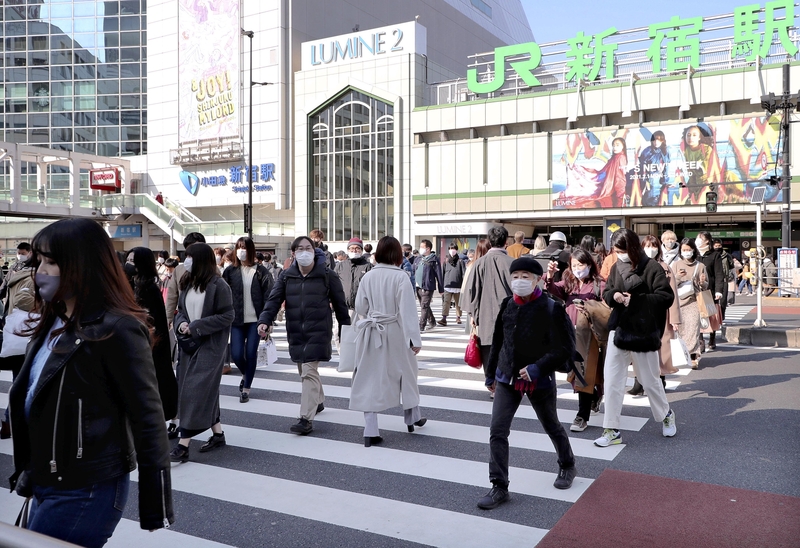
Feb. 7 marked one month since the latest state of emergency was declared for Tokyo and its three neighboring prefectures, following the resurgence of COVID-19 over the year-end and New Year holiday season. Yet as the number of newly confirmed cases gradually decreases by the day, the number of people venturing out to downtown areas has also been steadily increasing on the weekends, accompanied by a rise in cross-prefectural travel.
On Sunday, as Tokyo's balmy weather reached temperatures not usually seen until early April, the area around the east exit of JR Shinjuku Station was bustling with young people and families enjoying their weekend shopping.
"I wear a mask and disinfect my hands frequently. As I haven't gotten infected so far, I think it should be fine to go out, just for a little while," said a 20-year-old male university student from Saitama City, who traveled to Tokyo to buy shoes.
However, a 23-year-old clerk at a handicraft store run by Okadaya Co., expressed her concern while looking at the crowd. "I feel like I see almost twice as many people out and about on weekends than I do during the daytime on weekdays," she said. "I think that we still have a long way to go before the pandemic comes to an end."
On Enoshima, a scenic spot in Fujisawa, Kanagawa Prefecture, a path near Enoshima Shrine lined with souvenir stores was crowded on the weekend to the degree that people were brushing shoulders.
"I'm glad that customers visited when businesses are struggling, but it does make me worry when I think about the coronavirus," said Hirokazu Yuasa, 70, chairman of the Fujisawa City Tourist Association.
-- Footfall up 20% in Yokohama
On Jan. 8, the day when the state of emergency actually went into effect for Tokyo, Saitama, Chiba and Kanagawa prefectures, the daily number of new infections nationwide hit a record high, exceeding 7,800 cases. By Feb. 2 -- when the government signaled that they would extend the emergency period -- the daily tally had dropped significantly, down to about 2,300 cases. However, they continued to call on eating and drinking establishments to shorten their business hours, stating that the medical system was still under-equipped to sufficiently handle the virus.
When extending the state of emergency to March 7, the government's subcommittee on COVID-19 proposed that measures against the virus be implemented thoroughly, saying that there has not yet been a reduction in the flow of people during the daytime, especially on weekends. The government has also added to its basic policy to combat COVID-19, clarifying that their request for people to refrain from non-urgent, non-essential outings also applies "during the daytime."
According to data from Agoop Corp., an international technology firm affiliated with Softbank Corp., the number of people in the area around Shinjuku Station from 3 p.m. to 4 p.m. was up 15% on Saturday, compared to the same hourlong timeframe on Jan. 9 (the first Saturday after the state of emergency was issued). A 10% increase in foot traffic was observed around Shibuya Station, as was a 4% uptick in the Ginza district. Yokohama Station and Matsudo Station in Chiba Prefecture each saw an increase of about 20%.
-- On par with Osaka, Fukuoka
Although the government has urged restraint from non-urgent and non-essential travel across prefectures "as much as possible," the flow of people has not stopped. According to data from NTT Docomo, Inc., over the same hourlong period from 3 p.m. Saturday, the increase in people visiting Tokyo from Saitama, Chiba and Kanagawa prefectures ranged from between 8% to 14%, compared to Jan. 9. The number of people traveling in the opposite direction, from Tokyo to the three prefectures, also climbed from between 5% and 10%.
There has also been a conspicuous increase in the number of people out and about in Osaka and Fukuoka prefectures. A state of emergency was issued in both prefectures on Jan. 13.
In the vicinity of JR Osaka Station, many young people were seen flocking around shopping centers on Sunday.
"I have friends who've been taking trips," said a 24-year-old company employee from Osaka City, who visited the area to buy clothes.
"If we're just going out in small groups during the daytime, I don't think we have to worry too much about getting infected," he added.
Dazaifu Tenmangu, a shrine known for the deity of learning in Dazaifu, Fukuoka Prefecture, also experienced a spike in visitors at the height of the entrance exam season. Many parking lots near the shrine were full.
"I've been extra careful about hand washing and disinfection, as I'm visiting from a different prefecture," said a 36-year-old male company employee, who traveled by bus from Toyota, Aichi Prefecture.
"I think we're seeing increased movement as a result of the good weather and people getting tired of self-restraint as the state of emergency drags on," said Koji Wada, a professor of public health at International University of Health and Welfare. "The number of infections has decreased, [the state of emergency] has been effective to some extent. But we still need to continue reducing person-to-person contact."
Read more from The Japan News at https://japannews.yomiuri.co.jp/