
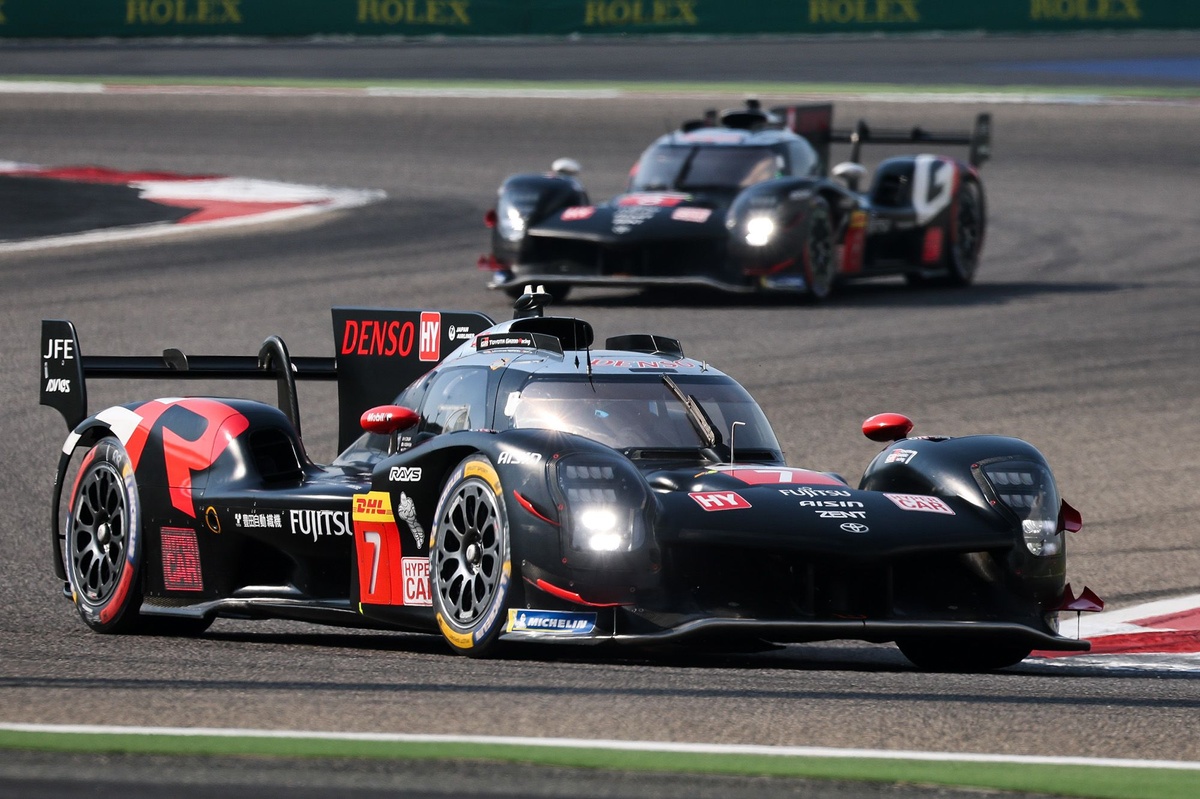
Perhaps Toyota was simply too honest. There is hardly any other way to explain its Balance of Performance numbers for the 2025 World Endurance Championship.
It is also possible that Rob Leupen’s leadership after his shock exit before the 2024 season finale had been missing. Throughout 2025, Toyota made several uncharacteristic mistakes.
After another world championship in 2024 when Toyota snatched the manufacturers' crown from Porsche in spectacular fashion, it was to be expected that the GR010 Hybrid would not exactly be favoured by the BoP for the "greater good" of the WEC.
It’s truly hard to believe that the problem Ferrari is facing today was a Toyota problem just twelve months ago.
At the start of the season, the Toyota GR010 Hybrid was the fastest hypercar behind the Ferrari 499P. However, unlike Ferrari, Toyota hadn’t made a significant step over the winter with a car that has remained largely unchanged since the 2023 season opener.
Furthermore, competitors who joined in 2024 had made significant progress with their machinery, and Cadillac was much more competitive from the get-go with its new partner Jota. None of this was reflected in the initial BoP.
Worst power-to-weight ratio in the first three races
Consequently, Toyota started in both Qatar and Imola with the least favourable power-to-weight ratio of all hypercars. In both races, the Toyotas were still surprisingly competitive, but in Imola, the strategy wasn’t ideal for how the race unfolded.
What happened next is symbolic of Toyota's struggles this season: Before the 6 Hours of Spa, the GR010 Hybrid’s power-to-weight ratio below 250 km/h suddenly shot up to a record 2.227 kg/kW — the worst rating ever seen in the WEC. It wasn't until after Le Mans that the Ferrari 499P would receive a similar BoP.
In the early races, Toyota combined the worst of both worlds: the team's pure pace could not be converted into podium results, yet in the performance indicators that determined the BoP (the 60% fastest laps and the ten best single laps), the GR010 Hybrid looked simply too good for its actual results, leading to more BoP punishment.
Lacking top speed at Le Mans
The special BoP for Le Mans didn’t suit the GR010 Hybrid either. While the Toyota’s BoP was similar to the Ferrari 499P below 250km/h, it received a mediocre rating of 2.052 kg/kW above 250 km/h.
The problem for Toyota was that almost all other hypercars got a significantly more favourable BoP above 250 km/h for Le Mans, while the GR010 Hybrid remained at its usual level. On all other tracks, the GR010 Hybrid enjoyed a good BoP above 250 km/h because it generates relatively high drag.
At Le Mans, however, the 2.052 kg/kW was the third-worst rating of all hypercars above 250 km/h. Promptly, the Toyotas plummeted down the top speed charts to 15th and 17th. On average, only Aston Martin looked worse in this statistic.
Despite this, Toyota fought behind the superior Ferraris and the #6 Porsche for the title of 'best of the rest. The loss of the faster #8 car due to a lost wheel was a bitter blow; the #7 eventually finished fifth. Given the disqualification of the #50 Ferrari, this was likely the best possible result for Toyota.
Breakthrough at the finale
In the races following Le Mans, Toyota's BoP stagnated at a consistently unfavourable level above 2.2 kg/kW. From Sao Paulo to Fuji, Toyota collected only two championship points during the rain-affected race in Austin, yet these results were still not reflected in the BoP.
At Fuji, the team suffered a faux pas by forgetting the compulsory pit stop following an emergency service under FCY, resulting in a three-minute stop-and-go penalty.
"I don’t think we extracted the maximum. We had problems and made mistakes. In some races, there was room for improvement," analysed technical head David Floury.
Everything finally changed in Bahrain, where Toyota returned to its old form. The track suited the car, and there was finally a marginally better rating of 2.172 kg/kW.
However, the true key to success in Bahrain was the relative shift in the field: while Toyota was allowed a minimal gain in its power-to-weight ratio, several direct competitors were massively slowed down.
This allowed Toyota to make a much larger leap forward than the mere change in its own rating would suggest. At Bahrain, the BoP finally accounted for the progress made by the competitors, while the five year-old Toyota had peaked in terms of performance for a long time.
When asked if Toyota had done anything differently compared to previous races, Sebastien Buemi replied after the 8 Hours of Bahrain: "Not really. The car was just lighter and had more power."
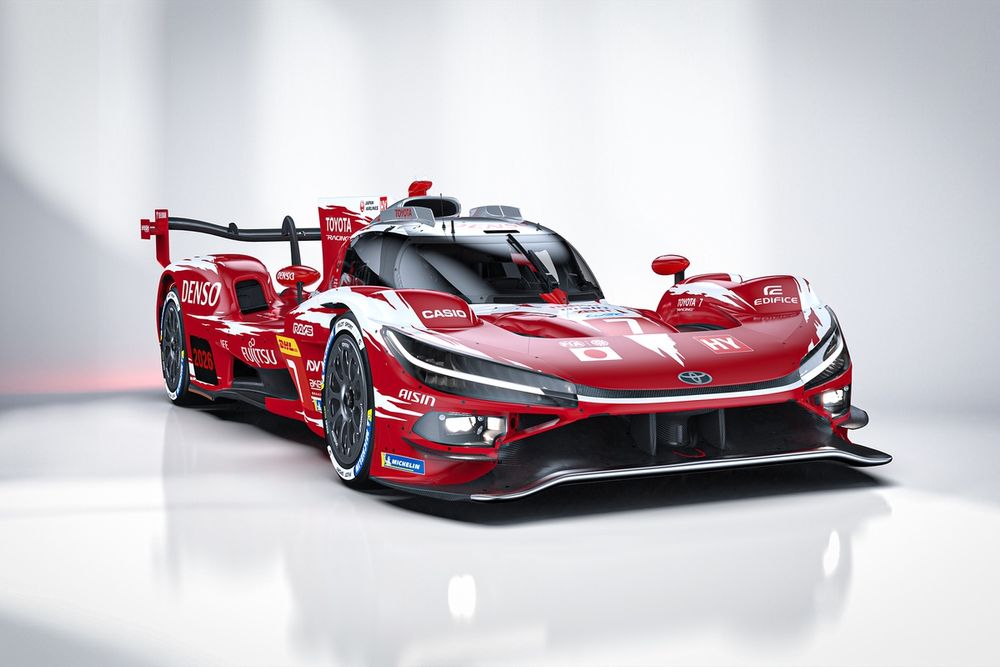
New look, new success?
With a comprehensive update, the rebranded Toyota TR010 Hybrid will be visually almost unrecognisable this year. Toyota is expected to focus primarily on reducing drag to become more competitive at Le Mans. Floury has made winning Le Mans the absolute top priority.
As for the rest of the races, much will depend on how the BoP is calculated next year. Under the 2025 system, Toyota's problem was that the team's performance in the relevant numbers often looked better than it actually was.
However, Toyota has also proven that its LMH prototype is still capable of winning races.













Read and post comments