
The Balance of Performance graph for Cadillac tells a clear story: Within just four World Endurance Championship races, the V-Series.R’s power-to-weight ratio deteriorated by 0.171 kg/kW. Not even Ferrari experienced such a drastic shift this season. It was evidence that Cadillac made big steps throughout 2025.
This leap was a consequence of both an electronics update over the winter and the high-profile switch to Jota Sport.
Jota took over the operation of the American LMDh challenger from Chip Ganassi Racing before the 2025 season, and the performance gain was visible from the very first race.
Traditionally, the Cadillac was one of the most favourably-rated cars in the WEC. Accordingly, the V8-powered LMDh entered the season opener in Qatar with the second-best rating in the critical sub-250kph range with 2.048 kg/kW, trailing only the Peugeot 9X8.
That led to an immediate impact by the Jota entries: At Qatar, the V-Series.R was the second-strongest force behind Ferrari and even took the lead during the first Safety Car through a strategic masterstroke.
That was until both cars eliminated themselves from contention through the infamous intra-team collision at the following restart. In hindsight, this blunder cost the #12 Cadillac at least third in the drivers' championship and Cadillac a top three spot in the manufacturers' standings.
Perhaps the strong start was even counterproductive. "We were still at the very beginning of our learning curve, despite the testing we had completed," Jota team principal Dieter Gass told Motorsport.com in Bahrain.
"In motorsport, it’s all about blind trust within the team, ensuring one hand knows exactly what the other is doing. In Qatar, we were still relatively far from that point."
This specifically refers to the integration of Cadillac's performance engineers into the existing Jota structure. The collision was likely a symptom of communication procedures that hadn't been fully optimised yet.
Imola: The great weakness
With a slightly improved power-to-weight ratio of 2.041 kg/kW, the team headed to Imola—traditionally Cadillac's weakest track.
That didn't change in the second race of the Jota-Cadillac alliance. Even Jota couldn't solve the car’s core issues, particularly its struggle over the high kerbs.
A crash in practice for the #12 didn't help either, and the Jota cars experienced their weakest race of the season, unable to play a role in the strategic chess match at the front.
For Spa-Francorchamps, the V-Series.R received a slightly weaker BoP for the first time, although it remained favorably rated relative to other Hypercars.
It was therefore surprising that the Jota cars lagged slightly behind Ferrari and Alpine on pure pace, but still secured a solid fifth and sixth as the third-best force.
The special BoP for Le Mans remained the second-best below 250kph at 2.006 kg/kW, although the gap to other Hypercars (including Ferrari and Toyota) was much smaller than at other venues.
Above 250kph, which is really relevant only at Le Mans, Porsche, BMW and Aston Martin were rated more favourably than Cadillac’s 2.022 kg/kW.
Overall, Cadillac was slightly better off here than in 2024 (2.035 kg/kW)—both in absolute numbers and relative to the competition.
However, the rating is noteworthy because, in the first three races, the Cadillac had been the most favourably-rated car in the high-speed range by a wide margin. This advantage was neutralised by the special Le Mans BoP.
From Le Mans onwards, two trends emerged: First, Cadillac became a qualifying powerhouse. Jota found something before Le Mans to turn the V-Series.R into a one-lap rocket.
Second, the #12 was consistently faster than the #38 from this point on, so we will focus on the #12 here. Meanwhile, the American-run Cadillacs from Wayne Taylor Racing and Action Express played no significant role at Le Mans.
In terms of race pace, Cadillac was the third-strongest force behind Ferrari and the over-performing #6 Porsche 963. Given its BoP relative to the field, it was a strong showing, but also proved that Le Mans follows its own set of rules and that the special BoP was justified.
Massive progress during second half of the season
For Sao Paulo, Cadillac received a rating of 2.016 kg/kW. While slightly worse than Le Mans, it was its best relative rating of the season compared to the field.
That was a chance that couldn’t be missed and Jota converted, delivering the most dominant performance by any manufacturer all season. The #12 had the potential to lap the entire field.
With this, Jota maintained an impressive statistic: Sam Hignett’s squad has won at least one race in its class every year since joining the WEC back in 2016.
It took some time for this victory to have a real impact on Cadillac’s BoP, but the numbers highlight the immense progress Cadillac and Jota had made.
The V-Series.R’s power-to-weight ratio skyrocketed past Alpine, BMW, and finally Toyota for the final race, ending the season at an incredible 2.187 kg/kW.
Such a leap over just three races is remarkable. "We’ll take that as a compliment," was Gass’s brief comment in Bahrain.
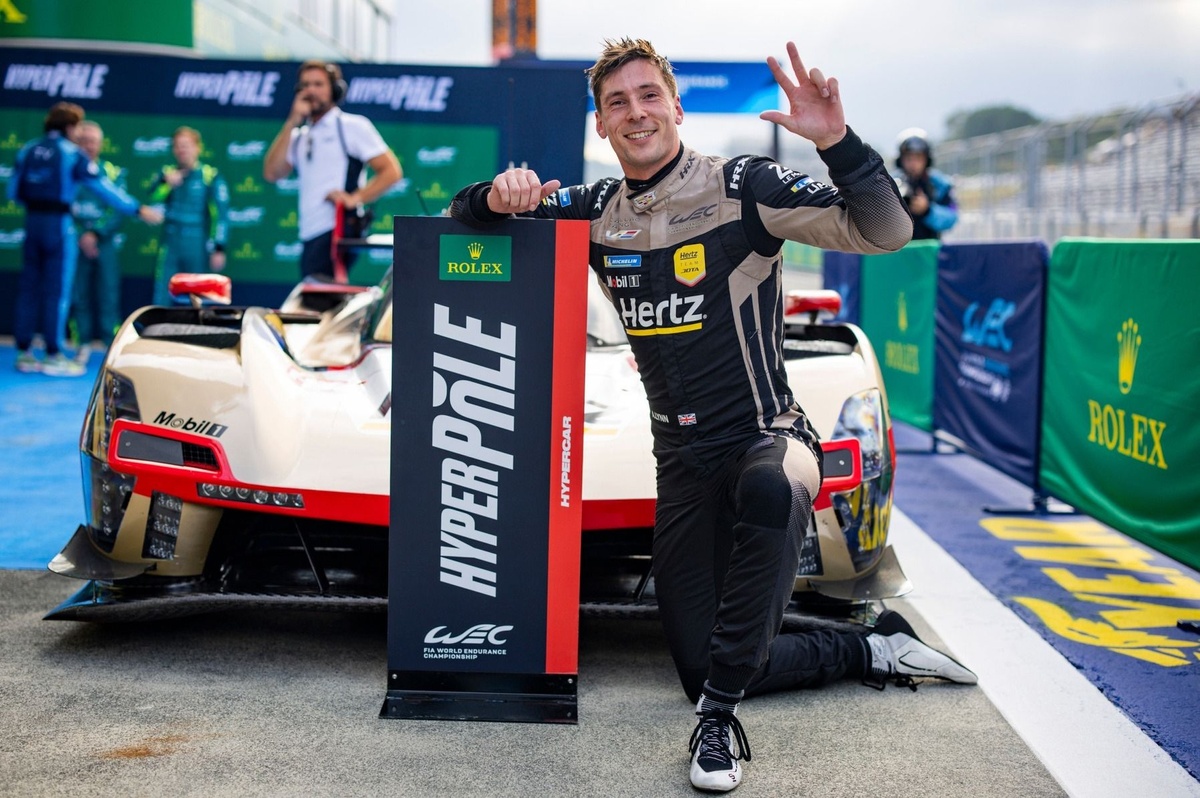
It wasn’t only a consequence of the victory in Brazil. At Fuji Speedway, the second win of the programme was within reach after a pole position and an early 1-2 lead.
However, Cadillac hit the worst possible luck with the timing of the safety cars and full-course yellows, costing Jota any chance of what looked like a certain second victory.
In Bahrain, Cadillac suffered under a BoP the V-Series.R had never even come close to before in the WEC.
The #12 made all the right strategic calls to salvage sixth place, while the #38 unceremoniously sent Jenson Button into retirement with a heavy penalty.
Aiming high with bold update
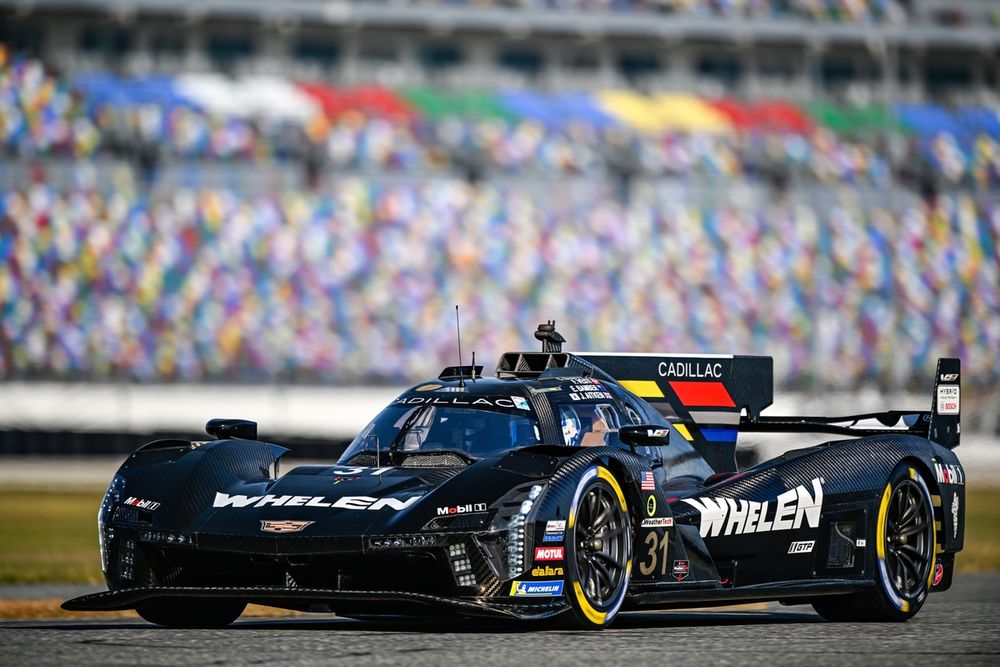
All huge steps aside, there are still some weaknesses in the package. Austin showed that the Cadillac still has room for improvement in the wet, and the widening performance gap between the two Jota cars since Le Mans was striking.
Gass identifies another area for improvement: "The car is very good when running in clean air. But as soon as you have another car in front of you and need to deal with dirty air, it becomes difficult for us. That obviously makes overtaking hard, even if we have the pace in theory."
Nevertheless, Jota has finally shown the true potential of the Cadillac V-Series.R. With a spectacular update featuring an extremely low rear wing and a braking upgrade, Cadillac aims to eliminate these weaknesses.
After its first WEC win, a Le Mans victory and the overall title are the only remaining targets for 2026.