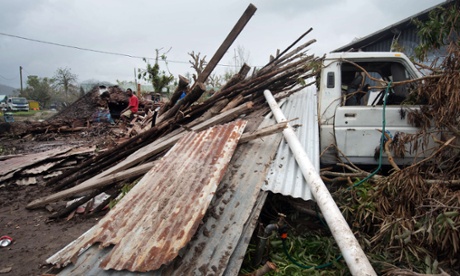
While media attention has focused on cyclone Pam because of the damage to Vanuatu, it is only one of four such weather systems at present.
Cyclone Nathan is bringing wind and rain to Northern Queensland and tropical storm Bavi is located east of Guam, while cyclone Olwyn has flattened banana plantations in Western Australia.
Cyclones are areas of low pressure forming over warm water. The rotation of the earth shapes the resulting winds into a circular pattern. If the wind speeds are comparatively low, the cyclone is classed as a tropical depression. When they reach 34 knots (39mph) it is a tropical storm, and if the wind rises to over 64 knots (74mph), the cyclone is classed as a typhoon. This is the Pacific equivalent of a hurricane in the Atlantic.
It is unusual for there to be four powerful cyclones at the same time. The current crop were produced by a particularly strong Madden-Julian oscillation or MJO.
This is a weather pattern, discovered in 1971 by the American researchers Roland Madden and Paul Julian, which moves eastwards over the Indian and Pacific oceans over the course of 30-60 days. The MJO is characterised by alternating bands of thunderstorms and dry weather.
The storms can spin off to form cyclones, as we have seen with cyclone Pam and the others. The MJO continues to be powerful, and another round of cyclone formation or cyclogenesis may follow soon. The typhoon season continues until the end of April.