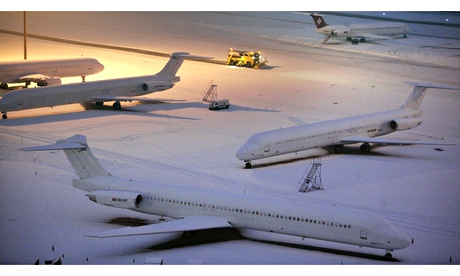
Several thousand US flights were cancelled this week due to wintery weather. It may seem strange that aircraft should have problems with the cold when their natural habitat is the stratosphere where temperatures are routinely as low as -30C.
Commercial airliners typically have systems to divert hot air from the jet exhaust through tiny pipes in the wings, fuselage and tail; this warms them up and stops ice from forming.
The pipes cover areas that get iced-up in flight, such as leading wing edges, but more surfaces are affected by ice on the ground. Even a little ice can cause big problems. Frost the thickness and texture of sandpaper can ruin aerodynamics, decreasing lift and increasing drag by 30%.
This is countered by spraying planes with de-icing fluid from special tenders. The fluid is usually a glycol, like the antifreeze used for cars, which lowers the freezing point of water.
Two types are applied: a thin, heated, liquid to melt the existing ice, followed by a viscous, unheated, version which sticks and prevents further yet ice from forming. However, in bad conditions, especially if there is freezing rain, ice build-up may be too rapid to be stopped by this method.
Even if the plane is kept ice free, snow and ice on the runway can make both take-off and landing hazardous. Aircraft may skid on a slippery surface, or be hampered by the drag of deep snow.
When snow falls faster than it can be removed by snowploughs, it’s time to close the airport.
• This article was amended on 20 February 2015. An earlier version said that antifreeze raises, rather than lowers, the freezing point of water.