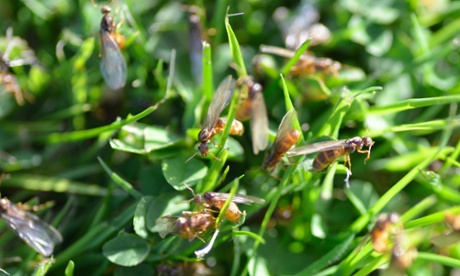
Ants swarm on hot humid days when thousands of males and females take the one flight of their lives and find a mate on the wing.
The warm conditions seem to give ants the best chance to get airborne, and find a partner. When the females fall back to earth after mating and seek a home in which to found a colony the humidity is supposed to help soften the earth so the queens can disappear underground and avoid predators.
These new queens live for a decade or more producing hundreds of thousands of workers while the male, having done his duty, drops dead.
How this mating ritual is coordinated between otherwise unconnected ant nests of the same species on the same day remains a mystery. There must be some method of mass communication but it has yet to be understood and it clearly is not foolproof. A large number of nests can swarm and then a few days later when the same weather conditions recur other sets of colonies, apparently of the same species, go through the same routine.
The ants’ mating flights do not go unnoticed by other species and provide a spectacular feeding opportunity for some birds, particularly insect eaters like martins, anxious to fatten up their second brood for the long autumn migration.
One surprising group of predators last week was dozens of seagulls. They were swooping through the swarming ants eating as many as possible. These birds, 80 miles inland, had probably never seen the sea, but will apparently eat anything, including ants.