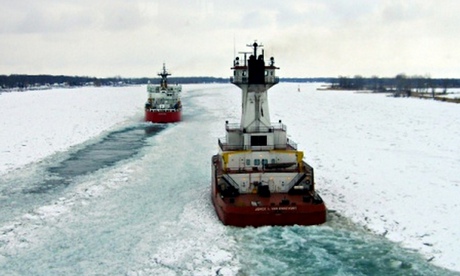
It’s the ice breaking season again. The annual Operation Coal Shovel is under way on the Great Lakes, with breakers from the US and Canadian Coast Guards keeping routes open for traffic.
Without their work, several million tons of iron ore, coal, grain, cement and salt would be trapped by ice jams.
The winter of 2011-12 was so mild that no breaking was needed, but the winter of 2013-14 was one of the worst on record, and Coal Shovel had to start in December.
Crews faced sheets of ice three feet thick, which is close to the limit for smaller icebreakers.
As well as assisting shipping, the Coal Shovel icebreakers clear ice jams in river mouths. Unless a channel is cut, ice can pile up and dam the river, causing flooding.
Traffic continues to flow freely on the Great Lakes, but there is less shipping traversing the Northern Sea Route on the other side of the Arctic.
Also known as the Northeast Passage, this connects the Atlantic with the Pacific via the coast of Russia. Receding Arctic ice made the route feasible in recent years, and Russia has been promoting it as a short alternative to travel via the Suez Canal.
However, in spite of the reduced ice cover, traffic on the Northern Sea Route is actually declining. Russian oil and chemical tankers still use it, but there are fewer foreign vessels in evidence this year.
It takes a different type of ice breaker to deal with the political chill of trade sanctions.