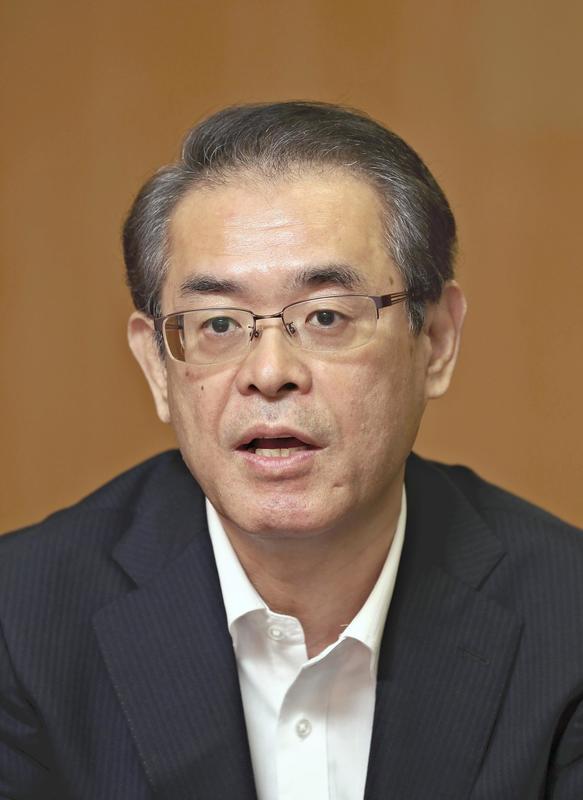
The summer this year has been abnormal. In early July, more than 200 people died or went missing as a result of the western Japan downpours. In the heat wave that followed, in a complete turnaround, Japan recorded its highest temperature ever observed, at 41.1 C. The number of typhoons was also the second-highest since statistics began being kept. Will this strange weather continue? What will be done to prepare for increasingly intense disasters? The Yomiuri Shimbun asked these questions to Toshihiko Hashida, head of the Japan Meteorological Agency. The following is excerpted from the interview.
The Yomiuri Shimbun: The Japan Meteorological Agency issued the first emergency warnings for heavy rains on July 6 at the time of the western Japan downpours, urging strong caution at a press conference the day before. While this was unusual, how was the determination made?
Toshihiko Hashida: Unprecedentedly warm and humid air was flowing into stagnated seasonal rain fronts, resulting in a higher certainty of record-setting heavy rains over a wide area. We also received suggestions from officials on the front line of weather forecasting and thinking that it would be good to clearly explain things to citizens, we held a press conference.
Q: In spite of this, there ended up being many casualties and missing persons.
A: We have felt for years the importance of letting people know the information in advance. We intended to raise the alarm as much as we could this time. We want to examine further to see where the problems lay.
Q: What will you examine?
A: We will conduct joint investigations with the relevant bodies into how the Japan Meteorological Agency conveyed its sense of urgency to the public and local governments, how local governments issued evacuation notices, and whether they were effectively utilized for the evacuations. For the investigation, we will cooperate with the Cabinet Office and related ministries. It is necessary to reconsider effective means of distributing information.
Q: The local governments were responsible for things such as issuing the evacuation notices. Did the Japan Meteorological Agency provide support?
A: Not only did the meteorological observatories of various areas convey the information to officials in charge at each city, town and village, hotlines enabling direct communication between observatory heads and local government leaders were established. This time, we conveyed the information to heads of 213 cities, towns and villages of 19 prefectures.
Q: The special heavy rain warnings expanded to 11 prefectures.
A: With our current forecast accuracy, it is difficult to make predictions at the early stages. The special warnings were issued in three prefectures in the Kyushu region, then in the Chugoku region; we thought it might spread further.
Q: Last year there was a downpour in the northern part of Kyushu. It seems that these downpour disasters occur every year.
A: The way the rain falls changes. The number of instances of heavy rain has increased, as well as the amount of precipitation each time. The frequency of short-period strong rain in which over 50 milliliters falls in the space of an hour has increased by 1.4 times since 30 years ago. Global warming lies behind it. There is a possibility it will continue to increase.
Q: What do you intend to do with regard to observation and forecasting?
A: In August, the weather subcommittee of the transport policy committee of the Land, Infrastructure, Transport and Tourism Ministry -- formed by experts -- proposed goals to accomplish by 2030. They included goals like being able to forecast line-shaped rain systems that will release concentrated downpours a half-day earlier, and forecast typhoons three days ahead with the same level of accuracy as we have now at the one-day-ahead stage. We would like to make efforts to meet these goals.
Heat waves are disasters
Q: After the downpours this summer, there were record-breaking heat waves.
A: We are aware of the fact that these heat waves constituted disasters. There were heatstroke victims as well as damages to agricultural products.
Q: What is the cause of the heat waves?
A: There was a discussion on this at the investigative commission for the analysis of abnormal weather held on Aug. 10. In various parts of the world, [high-altitude] westerlies were largely crawling northward, and the high temperature area expanded from the south. As a result, the mid-latitudes of the northern hemisphere were experiencing higher temperatures. There are also rising temperatures associated with global warming.
Q: Even with precautions, some people die from heatstroke. Do you have any thoughts on issuing warnings about high temperatures?
A: I would like to implement high temperature warnings whenever the high temperature is forecast to go around 35 C or above. Finding ways to fight heatstroke is an important issue for the Japan Meteorological Agency. That will require thinking about more effective ways of raising the alarm.
Q: How do you think we should live, being in a country with a large number of natural disasters?
A: I would like people to be on guard and understand that disasters could occur anywhere, at any time. The Japan Meteorological Agency would like to work closely with various regions to deal with such disasters.
-- This interview was conducted by Yomiuri Shimbun Senior Writer Masashi Yoshida
(From The Yomiuri Shimbun, Aug. 25, 2018)
Read more from The Japan News at https://japannews.yomiuri.co.jp/