A widening gulf between rich and poor parents is skewing opportunities available to their children, according to a new report that warns the young are paying a high price for rising inequality around the world.
Children from richer families have better health, higher skills and better relationships with parents and peers, according to research by the Organisation for Economic Co-operation and Development (OECD).
The report found that in most of the 34 OECD member countries the gap between rich and poor households was now at its highest level in 30 years. The authors highlight a link between this rising inequality of living standards among adults and inequality of opportunity among their children.
“Children from less well-off families find fewer of their classmates to be kind and helpful and are more likely to be bullied at school. Life satisfaction, reading and problem-solving skills, communication with parents and intentions to vote in national elections in later life are all lower among children from less affluent backgrounds,” the thinktank said as it published its latest report into wellbeing.
“Growing inequality among parents ends up sapping opportunities available to their children.”
Launching the report in Mexico, the OECD secretary general, Angel Gurría, urged policymakers to focus on the needs of the very young.
“The fight against inequality begins by ensuring that everyone enjoys opportunities to thrive in life, especially from an early age,” he said.
Child poverty rates
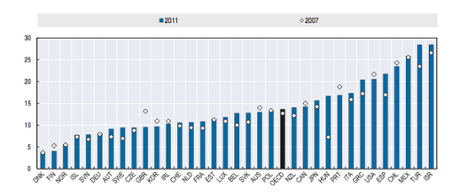
The How’s Life? report also highlighted that in most of the OECD countries the poverty rate for children was higher than for the population in general.
Similarly, it found disparities between young and older workers in terms of long-term unemployment rates.
“In two-thirds of OECD countries, younger people, aged 15 to 24, are more likely than prime-aged workers (25 to 54 years old) to be unemployed for one year or more – and in the worst cases, the long-term unemployment rate is more than double among younger workers,” the report said.
The research, which marks the first time the OECD has looked into child wellbeing, found that since the financial crisis, child poverty rates had risen in two-thirds of the 34, mainly rich, OECD member countries.
Sine 2007, the biggest rises in child poverty were in Hungary, where the rate has more than doubled, followed by Turkey and Spain, the OECD said. The UK recorded the largest drop in the child poverty rate, defined as the percentage of under-18s living in households whose disposable income was below 50% of the median.
But overall, the UK’s performance on child wellbeing was “mixed”, according to the How’s Life report, which is released every two years. At 15.5%, the proportion of British children living in households where no one worked was one of the highest in the OECD. In the UK, 3.1% of children were obese, compared with an OECD average of 2.7%, and the UK’s teenage birth rate was also above the OECD average.
The analysis on child wellbeing and income gaps adds to a growing body of research into inequality and its impact. There have been repeated warnings from policymakers and economists that the fruits of economic expansion must be more evenly shared and that the gap between rich and poor could actually serve to curb growth.
A report earlier on Monday also found global inequality was growing, with half the world’s wealth in the hands of just 1% of the population. The analysis by Credit Suisse also highlighted a slowdown in the growth of the wealth of the middle classes compared with that of the very richest.