Eurozone cheer and China hopes boost markets
European markets have now closed and it’s time for a quick summary to finish off a day that saw some good news from the eurozone (with the notable exception of France), renewed hopes of Chinese stimulus after its imports fell again and warnings about pricier lattes.
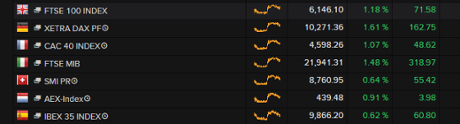
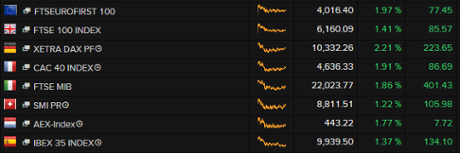
Here is how things looked at the close for the European bourses, helped by that news this morning that eurozone GDP increased by 0.4% in the April-June period, not the 0.3% first estimated three weeks ago.
As reported earlier, the top loser on the FTSE 100 was Whitbread, after the owner of Costa coffee shops and Premier Inn hotels said it expected to cut spending and increase some prices to counter the “substantial” cost of the “national living wage”, as it posted slowing second-quarter sales.
Over on Wall Street, shares are also higher as traders return from the long Labor Day weekend.

On commodity markets, copper has climbed to a four-week high as US traders caught up with announcements about mine closures made on Monday that look set to dampen supply. Oil prices are also higher, up 3.7% to $49.4 for a barrel of Brent crude, but that was not enough to wipe away a 6% drop in Monday’s session.

On Wednesday, the UK will be in focus early on with official figures due out on industrial production and on trade in July.
They will be scrutinised for clues as to how the Bank of England’s committee of interest rate setters is feeling about the UK outlook ahead of their latest policy announcement on Thursday. No-one expects a hike, but minutes from the meeting, also released on Thursday at noon, are expected to show at least one of the nine monetary policy committee members voting for a rise from the current 0.5% record low.
Ahead of the data, here’s a little reminder of where the various sectors of the UK economy stand relative to their pre-crisis peaks. The vast service industry, which covers a host of activities from hairdressing to banking, is the only part of the economy in which output has exceeded pre-downturn levels.
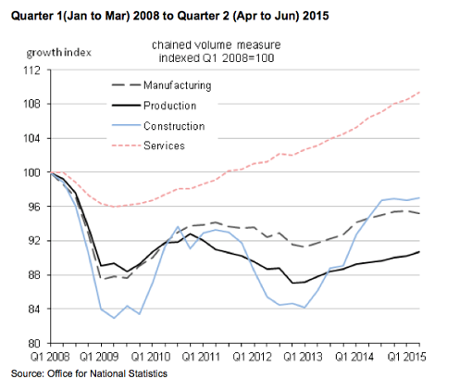
Victoria Clarke, economist at Investec, says the industrial production data, and the breakdown on the manufacturing sector, could well bring more downbeat news on the nature of the UK recovery:
The UK economy looks to be firmly in two speed mode with the services sector looking to be expanding solidly whilst manufacturers suffer a tougher ride, dragged down, in particular, by sterling strength.
On that note, the export figures in Wednesday’s trade data will also be studied for signs the strong pound and shaky business confidence from the eurozone to China are hurting overseas sales.
That’s all for today. Thanks for reading and the comments, as ever. We will be back in the morning to cover whatever stock market swings the next session brings for China, those UK figures and other business and economics news from around the world.
Talking of Whitbread’s complaints about the “national living wage”, the chancellor has been answering questions about his new minimum pay rates this afternoon.
Osborne, announced a bumper pay increase in July, with the current £6.50 minimum wage set to rise to £7.20 for those aged over 25 from next April. The rate will grow steadily over the following four years to about £9.35 an hour.
Osborne is currently appearing in front of the Lords economic affairs committee where there have been questions about changes and their potential impact on employers and employees.
My colleague Andrew Sparrow is covering the committee hearing in his politics live blog, but here’s a flavour of the exchange on the “national living wage” - which, by the way, is not to be confused with the (higher) living wage as advocated by the Living Wage Foundation and paid by some employers.
Q: How will you ensure people losing money from the cuts to tax credits have time to get used to their lower income?
Osborne says he is proposing a compact to the country. To business, he is saying their taxes will be low, but they have to pay higher wages. And to families he is saying welfare will be less generous, but wages will be higher.
He says current welfare spending is unsustainable.
Ramping up tax credits in a way that made them unaffordable was irresponsible. Originally they were supposed to cost less than £1bn. But they ended up costing £30bn.
Q: How will the social care sector be able to cope with the higher national minimum wage?
Osborne says he is aware of this issue. He plans to address it in the spending review.
Osborne has also been responding to questions about plans to build new nuclear power generating capacity at the Hinkley Point power station. He said told the committee:
“I am pretty confident that we are going to be able to do a deal, but we are still in the negotiations.”
FTSE climbs again on eurozone cheer
The FTSE 100 has now closed and has managed to clock up another day of gains. Building on Monday’s mosest o.5% rise, the index of London-listed bluechips has ended today’s session up another 1.2%, or 72 points, at 6,146.1.
Traders say this morning’s upgraded growth figures for the eurozone brought a much needed boost to market sentiment after the turmoil of recent weeks.
Glencore was the top riser as investors continued to welcome Monday’s announcement of a big shake-up and debt-slashing plans from the commodities trading platform and mining company.
Glencore shares closed up 4.4% at 136p.
Whitbread, the coffee and hotels chain, was the biggest loser of the day. The shares lost 1.6% to £46.36 after it said expected to cut spending and increase some prices to counter the “substantial” cost of the “national living wage”, as it posted slowing second-quarter sales.
S&P bounces out of correction territory
Although the Dow hogs the headlines, the S&P 500 is a better measure of the health of the US stock market.
And it’s gained 1.5% today, meaning the index has burst back out of correction territory (defined as being 10% below the recent high).
That underlines that US investors are less gloomy; partly on hopes of more Chinese stimulus measures to shore up its economy.
We should remember that US stocks fell pretty heavily on Friday, as Jasper Lawler of CMC Markets points out:
The near 2% surge in US markets is mostly a bounce back from Friday’s sell-off but weak Chinese trade data possibly sets the tone for more stimulus from China.
The logic is that the PBOC won’t want to rock markets with one-off currency devaluation. More likely, China will be more incremental in weakening the exchange rate with more cuts to bank reserves and interest rates if the economy still shows signs of slowing.
Shares of Apple jumped over 2.5% on the open, taking the tech sector higher with it, though in a notable sign of weakness, shares of Twitter and Netflix were both trading lower.
Dow jumps 200 points at the open; S&P, Nasdaq out of correction territory » http://t.co/xH2LQFzgtr pic.twitter.com/EVud8ODqSN bit.l…
— Money News 24h (@MoneyNews24h) September 8, 2015
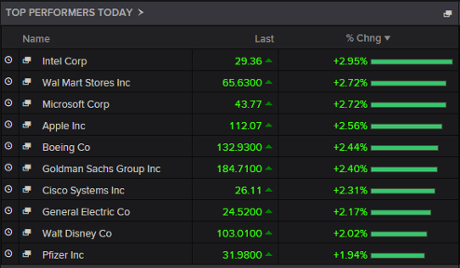
Here are the stocks leading the rally in New York today:
Updated
The wave of optimism on Wall Street has pushed every share on the Dow Jones industrial average higher, after one hour’s trading.
The Dow is up around 235 points, or 1.46%, while the tech stock-heavy Nasdaq has gained almost 2%.
Traders are taking heart that the Chinese stock market didn’t crash while they were away for Labor Day on Monday (reminder, the Shanghai Composite index jumped by 3% today).
And although today’s trade data was ugly, that raises the chances that central bankers will maintain very loose monetary policy for longer. And that’s invariably good for stock prices.
Markus Huber, a senior analyst at Peregrine & Black, says fears of a Chinese implosion have eased:
“With volatility having receded somewhat during the past few days it appears that investors have been reassessing the potential negative fallout from the slowdown in China.”
European stock markets are also holding onto their earlier gains, with around 45 minutes trading to go.
Updated
And they’re back! Moscow’s bourse is up and running again, and the stock market has dipped slightly.
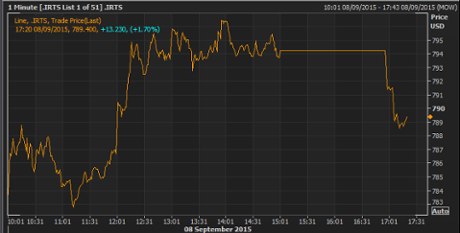
No word on what caused the outage, though.
Moscow’s stock market is nearly ready to open after that glitch:
UPDATE: Russia's Moscow stock exchange says it will resume trading on its main market at 9:50a ET after earlier technology failure.
— CNBC Now (@CNBCnow) September 8, 2015
Shares on Wall Street are rising at the start of trading, as New York traders catch up with events since the weekend.
The Dow Jones jumped by 304 pints, or nearly 2%, with talk that today’s weak Chinese trade figures might prompt more stimulus measure from Beijing.
Microsoft, Apple, Walmart and Intel are among the big names gaining 2%, in the first session after Monday’s Labor Day break.
Wal-Mart and Microsoft lead big jump on the Dow http://t.co/fUmplWfG8a pic.twitter.com/Oo7Bj1B6K4
— MarketWatch (@MarketWatch) September 8, 2015
Updated

Back in Greece, anti-austerity rebels have won the support of the legendary leftist Manolis Glezos in what some say will be a major endorsement for the anti-euro Popular Unity party.
Helena Smith reports
Glezos, whose first act of resistance was to remove the Swastika from the Acropolis days after German soldiers marched into Athens in 1941, has finally broken his silence announcing he will back the MPs who rebelled against Syriza leader Alexis Tsipras after he caved into the demands of creditors.
In a speech aired in the last 20 mins as Popular Unity leader Panagiotis Lafazanis addressed reporters at the country’s annual trade fair, Glezos said the time had come to “open the door so that visions and hope can pass.”
“History is now calling on citizens to take fate their hand,” added the nonagenarian appealing to “old fighters” who had been on the frontline of battles for freedom and justice to join the party.
“These elections are decisive, they provide the opportunity for the rotten status quo to be destroyed and for the fighter to prove himself.”
Glezos’ decision to back the dissidents will be tough for Tsipras whom he mentored during his early days in office. The move comes as Popular Unity launches its tongue-in-cheek TV adverts, with Lafazanis heading to the National Mint to get Grexit underway.
Updated
Here’s one for the daredevil bond traders among you - Iraq is getting ready to issue sovereign debt for the first time in nine years.
Officials from the Iraqi government will meet with City bankers on Thursday to gauge interest. They want to raise funds to cover its budget deficit, triggered by the cost of fighting Islamic State militants and the falling oil price.
Reuters says the roadshow should be successful, but at a price...
Despite the political risks in Iraq, its status as OPEC’s second biggest oil producer is expected to ensure buyers for its debt; its huge southern oil fields have not been directly touched by the fighting, and it has embarked on an ambitious multi-year plan to raise crude output.
Baghdad is expected to pay a high price for its borrowing, however; Iraq’s outstanding US dollar bond maturing in 2028 is trading at a yield of 10.37%.
It’s a tricky time for Iraq to be selling debt, given the shake-out in the emerging markets.
Neither ISIS, the oil price nor EM shakeout can stop the machine. Iraq bringing bonds to market.
— Burnett Tabrum (@BTabrum) September 8, 2015
Updated
Staff at the Moscow stock exchange are racing to restart trading using a back-up system, CNBC reports:
Moscow stock exchange says it halted trading 1 hr ago after "network equipment" failure, preparing to restart trading on backup system.
— CNBC Now (@CNBCnow) September 8, 2015
Moscow’s stock market appears to have suffered an unexpected problem.
Trading on the bourse was temporarily suspended a few minutes ago, with reports of an “emergency situation”.
FastFT reckon it’s due to a fault with network equipment at the exchange’s data centre, leaving people unable to trade shares, bonds, currencies or derivatives.
Moscow Stock Exchange has closed due to emergency situation,, wonder what that can be #stockmarket #forextrading #investing #moscow
— Vision Economics (@VisionEconomic1) September 8, 2015
The MICEX index had risen by around 1.2% before the sudden halt.
Updated
Stock markets boosted by eurozone growth
European stock markets have pushed higher today, thanks to the upgraded eurozone growth figures.
Germany’s record-breaking trade figures also cheered investors, following the news of China’s slumping imports.
This has driven the German DAX up over 2%, with other markets close behind:
Wall Street is expected to gain around 1.5% when trading begins, in an hour’s time.
Ipek Ozkardeskaya, market analyst at London Capital Group, says traders are anticipating further stimulus measures from central banker, especially given China’s weakness.
Following further contraction in Chinese trade terms in August, the European and the US stock indices painted the equity picture in green on strengthening belief that central banks’ would not dare taking their hands off the blurry financial markets in the immediate future.
Tensions in Greece as election looms

Almost every poll in Greece now shows former ruling Syriza neck and neck with centre right New Democracy.
And as the snap ballot on September 20 draws nearer, uglier, as our correspondent Helena Smith explains:
There were extraordinary scenes this morning on state-run TV between erstwhile Syriza minister Panos Skourletis and the New Democracy MP Manolis Kefaloyiannis. Accused of being “a liar and ignoramus” by Skourletis, the conservative shot back:
You are stupid. I have studied at the London School of Economics, what shit have you done?”
In protest, Skourletis then interrupted the morning chat show by fleeing the studio.
If that wasn’t enough, former Syriza cadre and president of the parliament Zoe Konstantopoulou has upped the ante by accusing former prime minister Alexis Tsipras of destroying Syriza by embracing policies it had vowed to oppose.
The fiery Konstantopoulou, who has now thrown her weight behind the breakaway Popular Unity party, challenged her former friend and comrade to a debate. Thus far, there has been no response from the Syriza leader.
Konstantopoulou may have her detractors but she is as sharp as a whip and, without doubt, one of parliament’s most articulate MPs.
With just 12 days until the Greek general election, political parties are releasing unusually light-hearted TV ads.
A prime example is the 37-second ‘campaign’ trailer put out by the anti- austerity anti-euro group Popular Unity this morning.
It shows leader Panagiotis Lafazanis hailing a taxi, and asking to be driven straight to the National Mint -- to start work producing fresh drachma. Very droll....
Behind the winning (?) smile, Lafazanis’s message is that Popular Unity can extract Greece from its current bailout deal:
See p/t - Where to, mister? - The national mint. - Don't listen to their shouting. We have anti-memorandum solutions. Learn about them.
— Damian Mac Con Uladh (@damomac) September 8, 2015
That message worked well for Alexis Tsipras in January’s election; implementing the promise proved harder than he expected, though.
Updated
Timo del Carpio, European economist at RBC Capital Markets, sees “rather encouraging” signs in today’s GDP figures:
As we had expected, private consumption provided an important impulse behind the recovery in the second quarter of 2015 (as it has for the last nine quarters). But this time around, it was also accompanied by a measurable boost from net trade, which added +0.3pp to top-line growth.
At first glance this might seem somewhat out of whack with the signs of weakness in certain emerging market trading partners. However, we think it is consistent with the view that, in the short-term, that weakness should be offset by the growing recovery in other advanced economies.
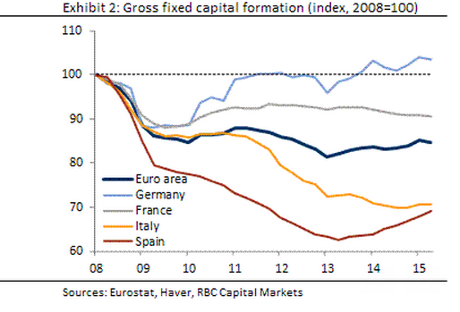
However, eurozone companies did cut back on investment last quarter. This ‘gross fixed capital formation’ is still around 15% below its pre-crisis levels.
Today’s growth data is “a double dose of modest good news” for the eurozone, says Howard Archer of IHS Global Insight.
He points out that year-on-year eurozone growth hit a four-year high of 1.5% in the second quarter, up from from 1.2% in the first thee months of 2015.
Archer explains that the drama over Greece’s bailout this summer may have held back growth:
The euro and oil prices remained at highly supportive levels to Eurozone growth in the second quarter, although they were above their first quarter lows.
However, the Eurozone’s ability to kick on may well have been hampered by heightened uncertainty weighing down on business and consumer confidence as the Greek crisis came to a head and concerns over global growth increased.
Updated
Even with today’s upward revisions, the eurozone’s growth rate remains somewhat modest.
Growth rates of 0.5% in Q1, and 0.4% in Q2, are still modest by international standards, especially given the boost from cheap energy prices and the ECB’s QE programme.
Today’s data revisions show the eurozone’s recovery is on stronger foundations, argues Bloomberg’s Maxime Sbaihi.
Euro area GDP revised up in both Q1 & Q2. Carry-over growth now at 1%. Domestic forces look strong enough to keep region on recovery course
— Maxime Sbaihi (@MxSba) September 8, 2015
More good news: The eurozone’s growth in the first three month of 2015 has also been revised higher, from 0.4% to 0.5%.
Eurozone growth rate revised up
The eurozone is growing faster than thought, after statistics body Eurostat revised its GDP figures for the last quarter.
GDP increased by 0.4% in the April-June period, not the 0.3% first estimated three weeks ago.
It’s partly due to stronger growth in Italy, whose growth rate was revised up from 0.2% to 0.3%.
It’s a much-need dose of good news for the euro area, five days after the European Central Bank cut its growth forecasts. It may calm some worries over Europe’s ability to withstand a slowdown in emerging markets as China tries to rebalance its economy.
However, France remains a big concern, reporting no growth during the quarter.
Euro area GDP +0.4% in Q2 2015, +1.5% compared with Q2 2014 #Eurostat http://t.co/E6qgq5NMIK pic.twitter.com/cADkTm5L43
— EU_Eurostat (@EU_Eurostat) September 8, 2015
Eurostat reports that household spending drove the recovery, by increasing by 0.4% in the eurozone.
Trade also made a positive contribution, with exports up by 1.6% and imports up by 1%.
Reaction to follow....
Germany is calming some of the worries about China, by reporting record-breaking trade figures for July.
Seasonally adjusted German exports climbed by 2.4% month-on-month, to €103.4bn, while imports grew 2.2% to €80.6bn. That’s the biggest readings since 1991 (after reunification) when the survey began, and much stronger than economists expected.
More here.
Whitbread warns living wage will push up prices
Back in the UK, hotels and coffee chain Whitbread has warned it may raise prices to cover the cost of implementing the new “national living wage”.
Chancellor George Osborne announced in July’s budget that the £6.50 minimum wage (for over 25s) will rise to £7.20 from next April, and reach £9.35 an hour by 2010.
This means a “substantial cost increase”, Whitbread told investors this morning, meaning it will increase prices, cut costs and increase productivity.
£7.20 per hour works out at just under £15,000 per year (before tax), so low-paid Whitbread employees won’t be buying many racehorses next year.
Some customers might even welcome the change:
GOOD! I don't want cheap coffee if = someone not paid properly. Whitbread plans price rises to pay for living wage http://t.co/Umzp6GfCFY
— Derek du Preez (@Derek_duPreez) September 8, 2015
Whitbread isn’t alone, though; all UK companies must be making the same calculations.
Recruitment firm Manpower has warned today that firms could try to dodge paying workers more, by taking on younger or self-employed workers, who are not entitled to the living wage.
Updated
The decline in China’s imports will have serious consequences for other countries, points out FXTM Research Analyst Lukman Otunug:
The China trade figures released overnight continued to highlight further weakness in the China economy, with both exports and imports declining.
The continual decline in imports suggests that China is shifting away from an import dependent nation to one which is encouraging consumers to look more within the domestic market for its products and services. This change in approach will translate to further weakness for economies that have become dependent on demand from China.
Iron ore imports contracted by around 14% last month; bad news for mining giants in Australia and Brazil.
Updated
Fact of the morning: Beijing has now spent some $236bn supporting its stock market since June.
That’s according to Goldman Sachs analysts, who say China’s “National Team” pumped $94bn into shares in August alone, in an attempt to manage the selloff.
Since Chinese market started falling out of bed, govt has splashed $236b trying to prop it up = @GoldmanSachs . >Peru or Portugal GDP/year
— Caroline Hyde (@CarolineHydeTV) September 8, 2015
China also banned large shareholders from ditching their assets, and ordered state-owned companies to buy shares - and still saw the market plunge last month.
In the City, shares in insurance firm Amlin have surged by 32% after Japan’s Mitsui Sumitomo Insurance announced a £3.46bn takeover deal.
Amlin shares are trading at 655p, close to the 670p offer price, suggesting the deal is expected to go through.
Bloomberg reckons that the announcement sent sterling rallying against the yen. Traders may be calculate that more Japanese firms will start buying up foreign assets, in a search for growth.
Pound surges against yen after Japanese firm said it would buy U.K. insurer Amlin http://t.co/frUZA2T00f pic.twitter.com/s7C64JLtUt
— Bloomberg Business (@business) September 8, 2015
Updated
Another wild day’s trading in Shanghai has ended, with the stock market up 3%.
Quite a turnaround.
Shanghai stocks now up 3% Shenzhen +4% Earlier: Shanghai: -2.3% Shenzhen: -1.8%
— Patrick McGee (@PatrickMcGee_) September 8, 2015
European stock markets aren’t too bothered by the Chinese trade data.
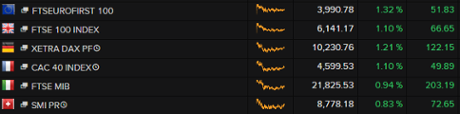
The main indices are all up around 1% in early trading:
Maybe investors have already ‘priced in’ the slowdown:
Over to Tony Cross of TrustNet:
It’s been another positive start for trade in London this morning with traders clearly not feeling too unnerved by those weaker than expected trade figures out of China.
Perhaps most worrying is the 13% slump in imports, but with commodity prices seeming to have found something of a floor of late, many mining stocks are once again floating towards the upper end of the index.

China has found an innovative way of preventing any more Black Mondays - close the stock market when shares fall (or rise) too much, and send everyone home.
From Shanghai, Jennifer Duggan reports:
China is planning a “circuit breaker” mechanism to prevent any further losses on its volatile stock markets as both of the country’s leading indexes continued to slide.
According to draft regulation, trading would be suspended for 30 minutes when the market rose or fell by 5%. If the index went up or down by 7% or more, trading would be suspended for the day.
The mechanism could only be triggered once a day. “Circuit breaker in both directions will be conducive to curbing excessive transactions and reining in market fluctuations,” the draft from the securities regulator said.
Full story here:
Updated
Chinese trade data: What the experts say
Economists are concerned by the fall in Chinese imports and exports last month.
Ma Guangyuan, an independent Chinese economist, says the economic picture is deteriorating.
“The August data followed the trend set in July. Now the global slowdown has very much become a reality.”
The fateful decision to allow the yuan to weaken last month hasn’t boosted Chinese exporters yet.
As Liu Xuezhi, a Shanghai-based macro-economy analyst at China’s Bank of Communications, says:
“China is set to miss its export growth target for this year, and there will be no help from the external demand side for economic growth.”
Updated
Emerging market currencies are also weakening today, as fears of a Chinese slowdown reverberate.
The Malaysian ringgit has hit a new 17-year low against the US dollar today, amid concerns that American interest rates could soon rise .
Asia crisis 2.0: Ringgit falls for fifth day on lower oil, #China growth concern. http://t.co/qgAEEa18DG pic.twitter.com/6QyWdifXFX
— Holger Zschaepitz (@Schuldensuehner) September 8, 2015
Investors in Tokyo baulked at the Chinese trade data too.
Japan’s Nikkei fell by 2.4% by the close of trading, as nervous traders pushed up the value of the yen (which hurts exporters). That means the index has lost all its gains this year.
Updated
The Shanghai stock market dropped into the red after today’s trade data was released.
Curiously, though, it’s now rallying in late trading, suggesting the Chinese authorities may be intervening....
And the "invisible hand" again guiding Chinese stocks higher in the last hour...CSI 300 rallies 4% - 30 min. to close pic.twitter.com/ImPDGFPLOZ
— David Ingles (@DavidInglesTV) September 8, 2015
Introduction: Chinese trade data weakens
Good morning, and welcome to our rolling coverage of the world economy, the financial markets, the eurozone and business.
If you’re not worried about the China’s economy yet, it might be time to start.
The latest trade data, released earlier today, underline that the country’s economy is weakening, sending fresh ripples through the financial sector
Imports into China slumped by 13.8% (in dollar terms) year-on-year, while exports were 5.5% lower. That suggests weakening activity within the Chinese economy, and sluggish global demand too.
No wonder Biejing trimmed its growth forecast for 2015 over the weekend, from 7.4% to 7.3%. Perhaps that’s still too optimistic.
European markets might inch a little higher at the open, and Wall Street is expected to jump after yesterday’s Labor Day holiday.
Our European opening calls: $FTSE 6085 up 10 $DAX 10137 up 28 $CAC 4559 up 10 $IBEX 9815 up 10 $MIB 21687 up 64
— IGSquawk (@IGSquawk) September 8, 2015
Futures markets picking up...#Europe looks set for higher open & US could see +1% gains pic.twitter.com/BAwJG2Khrh
— Caroline Hyde (@CarolineHydeTV) September 8, 2015
Not much in the economics calendar today, beyond the second estimate of eurozone GDP at 10am.
We’ll also be watching political developments in Greece, ahead of the election on September 20.
Updated