An artist collective claimed responsibility on Sunday for the effigies of three lynched black people hanging on UC Berkeley’s campus, saying the cardboard cutouts were meant to confront the “systemic racism” that claimed the lives of Eric Garner and other black Americans.
In a statement posted to a campus bulletin board, the “collective of queer black and [people of color] artists” apologized “solely and profusely to black Americans who felt further attacked by this work”.
“We are sorry – your pain is ours, our families’, our history’s,” the group wrote. But they also refused to back down. “For those who think these images no longer relevant to the social framework in which black Americans exist everyday – we respectfully disagree.”
The effigies, found hanging with virtually no context or explanation of intent, left the campus community baffled and on edge after their discovery on Saturday morning. Each cutout featured the name of a lynching victim and year of death, but only one had a modern point of reference: the words “can’t breathe” – an allusion to the last words of Garner, an unarmed black man whose July death at the hands of a white policeman has prompted protests around the US.
The group wrote that they vehemently disagreed with the suggestion that the cutouts were racist, and said they “intended only the confrontation of historical context”. The statement explained that the group meant the effigies to represent crimes that “are and should be deeply unsettling to the American consciousness”.
The collective refused to heed the call of the UC Berkeley chancellor, Nicholas Dirks, that the group responsible identify itself: “We choose to remain anonymous because this is not about us as artists, but about the growing movement to address these pervasive wrongs.” Before the collective posted its statement, Dirks had called for calm and unity, and said that regardless of intent “the imagery was deeply disturbing”.
UC Berkeley police quickly took down the effigies and said they were investigating them on Saturday. Demonstrators in the Bay Area have broken store windows and marched into sometimes violent clashes with police in protest at police brutality and the killings of several black men.
Reaction to the cutouts has been mixed. Rodolfo Mendoza-Denton, a UC Berkeley professor of social psychology, told local news Berkeley Side the act was “thoughtless and wrong”. “Whether it’s commentary or provocation, it’s atrocious,” he said. “It’s just damaging to everybody. It’s a very public and clear example that racism exists at all levels of society, and it’s precisely the kind of symbol that protesters are protesting against.”
Professor of African American studies Leigh Raiford disagreed, writing on Twitter that she considered the effigies “a powerful visual indictment of a system that continues that continues to murder us”.
“Without a doubt it is hard for black folks to see these images,” Raiford wrote.“But white folks need to see them too. This is not our shame. It is yours.”
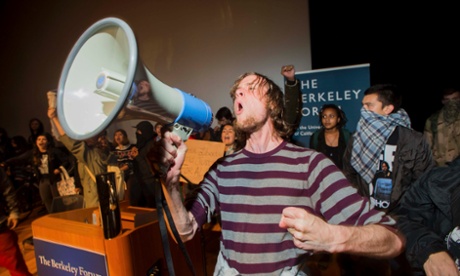
Students have expressed anxiety and confusion about the effigies on social media, but many still took part in peaceful protests on Sunday. Even after a woman confronted protesters and drove her car directly into the march, young people surrounded the vehicle and managed to defuse the situation, chanting throughout “black lives matter”.