Nearly everyone at some point in their lives is affected by tooth decay. Indeed, half of you reading this article are likely to currently have it. It’s common knowledge that a sugary diet can cause cavities, but specific bacteria living in our mouths are part of the process. They consume the sugary foods and release acids into the mouth as a by-product. If this happens frequently, the tissue that makes up a tooth – including enamel and dentine – decrease in mineral concentration. This is called demineralisation, and it ultimately causes cavities.
Apart from humans, some species kept as pets and in captivity (such as in zoos), can regularly display tooth cavities. This is mostly due to being fed a diet containing processed sugars that differs from their natural foods.
But we might expect that wild animals wouldn’t suffer from the same dental issues as they are not eating processed foods. In fact, that isn’t the case. It turns out that tooth decay may be relatively common in some species, including in a wide range of mammals such as bats, primates, bears and some other carnivores.
Cavities in primates
Primates in particular have been observed to have cavities, including in a diverse range of prehistoric species. But dental decay is still generally regarded as rare in wild primates living today, and there has been disagreement between specialists on whether deep cavities found within the front of their teeth are actually tooth decay caused by cavity-forming bacteria, or holes caused by factors other than tooth decay such as enamel weakness.
In a recent study we wanted to find out for sure whether primates get tooth cavities, and where in the mouth they were found. To do this, we used a 3D-imaging technique known as micro-CT scans to look at 8,000 teeth from 11 diverse primate species.
Nine out of the 11 species had at least some cavities. And several species had high levels of cavities on their front teeth, including chimpanzees, gorillas, Dent’s mona monkeys, blue monkeys and raffles’ banded langurs.
Crucially, we found that tooth decay causing bacteria had indeed been involved in the cavities we commonly observed on the front teeth, because demineralisation was evident deep below the surface of the tooth. Perhaps in hindsight this is not surprising since soft fruits are a staple of the diet in many primates, so they regularly chew foods with high levels of natural sugars.
And because we studied so many teeth, we were then able to assess variation in patterns of cavities – where they were on the teeth and how that differed in relation to diet and behaviour.
Why front teeth in primates?
In humans, including our fossil ancestors and relatives going back millions of years, it is the back teeth that are most commonly affected by tooth decay. The reason why, in living primates, the front teeth seem more susceptible to this disease is probably because of differences in their food, and also in the way they eat.
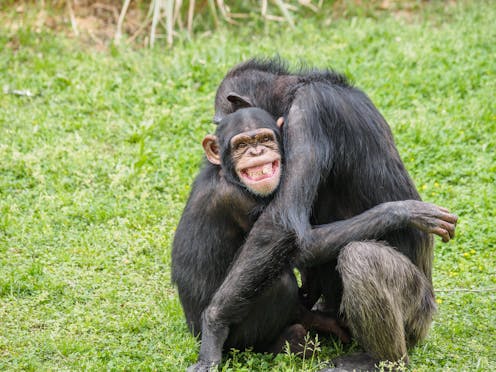
For example, chimpanzees undertake a behaviour called wadging, where they hold chewed fruits in the front of the mouth and then suck out the sugary liquids. These fruits include figs, some of which have high concentrations of sugars. They have even been observed wadging honeycomb. Not surprisingly the front teeth of chimpanzees show extremely high rates of cavities.
Although other monkey and ape species might have different diets and eating behaviours, they all use their front teeth to process fruits and other plant parts that are high in natural sugars. In contrast, some baboons and macaques, which have a much more varied diet, don’t appear to have these tooth cavities.
Read more: Monkey teeth fossils hint several extinct species crossed the Atlantic
Interestingly, female chimpanzees had considerably more decayed teeth than males – around 9% compared to only 2% in males. We do not yet know why, but it is likely to be caused by differences in their diet and behaviour, as well as other factors such as pregnancy, acidity of saliva, life history, and bacteria variations between the sexes.
So we humans are not alone in suffering from tooth decay. One other interesting point is that captive primates share our pattern of cavities, with back teeth regularly affected more than the front. This is mostly due to being fed a diet containing processed sugars that differ from their natural foods.
In short, primates’ cavity patterns seem to be a reliable indicator of food-processing behaviours and diet – and therefore, tooth decay has the potential to offer unique ecological insight into both extinct and living primate groups.

Ian Towle does not work for, consult, own shares in or receive funding from any company or organisation that would benefit from this article, and has disclosed no relevant affiliations beyond their academic appointment.
This article was originally published on The Conversation. Read the original article.