“Congratulations!”
No sweeter word could be spoken by federal judge Jayne Jagot. With that 400 Barkandji people erupted into cheering.
Her pronouncement recognising their native title claim, recognising the Barkandji people as the traditional owners of the land, had come masked in legal jargon: section 86A this, section 56 that. Only now was it clear what had come to pass: their 18-year struggle was over.
This case, finally resolved last week, was the largest native title case in the history of New South Wales. It involves pockets of land spread across 128,000 square kilometres of Barkandji country, land that extends from the South Australian border to Tilpa in the east, Wentworth in the south, north almost to Wanaaring. Within it lie the towns of Broken Hill, Wilcannia and Menindee.

Winning native title does not mean the Barkandji people now own the land. For example, it doesn’t bestow the right to sell or lease the land as a property deed would. Instead native title is an acknowledgment in “white man’s law” of pre-existing Indigenous rights and interests. It states the Barkandji people have a legal right to do things such as camp, hunt and conduct burials on their land, just as their ancestors did pre-European settlement. It can also give them a seat at the negotiating table when development projects, including mining, are being slated. As one native title expert explains it, it restores a traditional owner’s right to have a say about their country.
For the Barkandji people, this was no small thing. The hearing in Broken Hill doubled as a family reunion. Barkandji people from across the region and beyond descended upon the town. One woman from Fremantle, Western Australia, had driven for six days across the Nullarbor to be there. Chubby, bright-eyed babies were passed around and distant relatives traced out how they were connected (“I think the brother of your auntie’s husband was married to my cousin’s daughter”).
A makeshift federal court was set up in the main hall for the day, with the judge wearing formal robes. Like much of the heritage-listed town, the building looked like a relic from another era. The portrait of a much younger Queen Elizabeth II hung from the wall.
Maureen O’Donnell, a short-statured, feisty Barkandji elder, had been there from the beginning, when the application was filed back in 1997. “I was a young woman when we started,” she squawked. “Look at me now!”
The room broke into laughter.
She said it had been a long, hard fight. The rigorous demands of native title law had required they prove an unbroken connection to the land. What the Barkandji people knew to be true was hard to prove in the eyes of Australian law.
For nearly two decades they negotiated with the NSW crown solicitor’s office. A native title service provider called NTSCORP (the Native Title Service Provider for Aboriginal Traditional Owners in New South Wales and the Australian Capital Territory) acted on their behalf. More than 50 separate documents – affidavits, historical evidence, anthropological reports and family trees – were submitted to the office. Each passed through the hands of lawyers, historians, linguists and anthropologists on both sides, with countless revisions until there were versions that passed muster.
Dr Ken Lum, an anthropologist and research manager with NTSCORP, told Guardian Australia he had conducted hundreds of interviews with Barkandji people, tracing their genealogies back to 1850. Those early ancestors were listed in the native title application; evocative names like Granny Quayle, Tall Boy Keegan, Hero Black and Kitty Knight.
The law was specific too. Only those practices that could be traced, uninterrupted, back to pre-colonial times could be recognised. For the Barkandji people this included the right to camp, erect shelters, move about, hold meetings, hunt, fish, conduct burials and gather and use the natural resources of the land, according to traditional law and customs.
It was hard on some of the elders, digging up the past like that. And many, like O’Donnell, were required to submit up to five separate affidavits. They brought up a lot of painful memories and she felt indignant about the hoops they were forced to jump through.
“We’ve been here for a long time and we go pour our hearts out,” she said. “We’ve got to tell them all our secrets to get where we are today.” The determination should have been a “foregone conclusion”. Instead they’d faced 18 years of what they considered to be bureaucratic stonewalling.
Another Barkandji woman, Glyniss Church, stood up, dressed elegantly in black. She acknowledged the many elders who had attended native title meetings, spent hours and hours giving evidence, and not lived to witness this moment.
“Today is a very meaningful and powerful day for me,” Church said, choking back tears. Her own mother was among the departed, “to stand here and give recognition to, not only my mother, but to all my people that we’ve lost and were on this journey with us.
“The Barkandji elders before us fought against the removal of people from our country and made sure our culture, language and our laws were maintained and passed down from generation to generation.
“It’s because of them we are able to stand here today.”
The judge was also dissatisfied with how long the case had taken. It was only the sixth successful NSW native title case in the 22 years since the Native Title Act came into effect, and five of them had taken more than 10 years to reach its conclusion.
Jagot called it a “glacial pace” and said “when justice is delayed it is also denied”. She read aloud the act preamble, acknowledging the Aboriginal peoples and Torres Strait Islanders as the inhabitants of Australia before European settlement and the dispossession, without compensation, of their lands.
These laws were “special”, the act stated, and were intended to rectify the consequences of past injustices and give applicants full recognition and status within the Australian nation, to which “history, their prior rights and interests, and their rich and diverse culture, fully entitle them to aspire”.
The section that stated the act should “further advance the process of reconciliation among all Australians” had special resonance for the day, Jagot said. Native title should be achieved by agreement, as it had been for the Barkandji case, not the result of contested litigation.

In a town that rarely sees rain – just 25cm every year – with the Barkandji had come a three-day downpour. Outside the Broken Hill civic centre the streets were flooded with surging rivers of rainwater, turned brown from the red dust that paints the plains here. It was as if their ancestors had come to join the party.
Barkandji take their name from the Darling river, explained elder William “Badger” Bates. Barka was the original name of the river, and the ndji ending meant “belonging to”. The river was “the lifeline of our people” he said, and there were stories attached to every stretch of it, explaining how it was formed and how their people lived.
“My aunties, uncles, elders and our ancestors before them, lived and fished and camped on the Darling river for over 40,000 years,” Bates said. Now 400km of it run through the native title claim area.
That morning he had taken the judge out to a piece of Barkandji bushland called the Living Desert, a 20-minute drive from town. A fine grey mist had closed in on them and the rocks and grass appeared shining and wet. A small summit usually provided enough elevation to offer a spectacular 360-degree view of the plains, but on this day the poor weather meant Jagot had to use her imagination.
“A long time ago a fella was catching pigeons with his net,” Bates said, pointing at the pale, grey sky. “One escaped, flew around here and everywhere it dropped blood and feathers there were minerals.”
An accusation sometimes slung at native title applicants is that their claim is nothing but a thinly disguised rush to cash in on mining royalties. Never mind that native title doesn’t grant any such right (only in some circumstances native title holders can negotiate with mining companies compensation for any loss of their rights and ensure damage to important cultural sites is avoided). In boom-and-bust towns like Broken Hill, where streets have names like Oxide, Argent, Chloride and Sulphide, the presumption is that everything pivots around mining.
“We won’t work in the mines because of what happened here a long time ago,” Bates said.
On the way to some ancient Barkandji rock carvings, Bates stopped to tear off a clump of grass and encouraged everyone to do likewise. It burst with lemony freshness. “Stuffed in some emu or kangaroo, cooked with dumb leaf – this will just blow your mind,” he said.
He pointed out blooming Mulga trees and a water bush. “Take care to only eat the berries when they’re a deep purple. Eat them when they’re green and you’ll get a bad headache,” he said.
I asked Bates if he ever felt frustrated during the 18 long years they fought to have their native title recognised. He nodded. “I kept saying why do we have to prove who we are? We know who we are!”
He hoped the wider community would come to see native title was not a land grab. It was about defending their right to practise and teach culture, like hunting kangaroo. “And we’ll share our culture with them, if they ask us to,” Bates said. They had also established a corporation that would engage with government and private organisations regarding management of Barkandji country and economic development opportunities.
“Like we said, it’s about our future, our young kids. And we understand over there, they young kids got a future too. But if we stand together as Australians, and not be black and white Australians, together we can make the country work for the lot of us.”
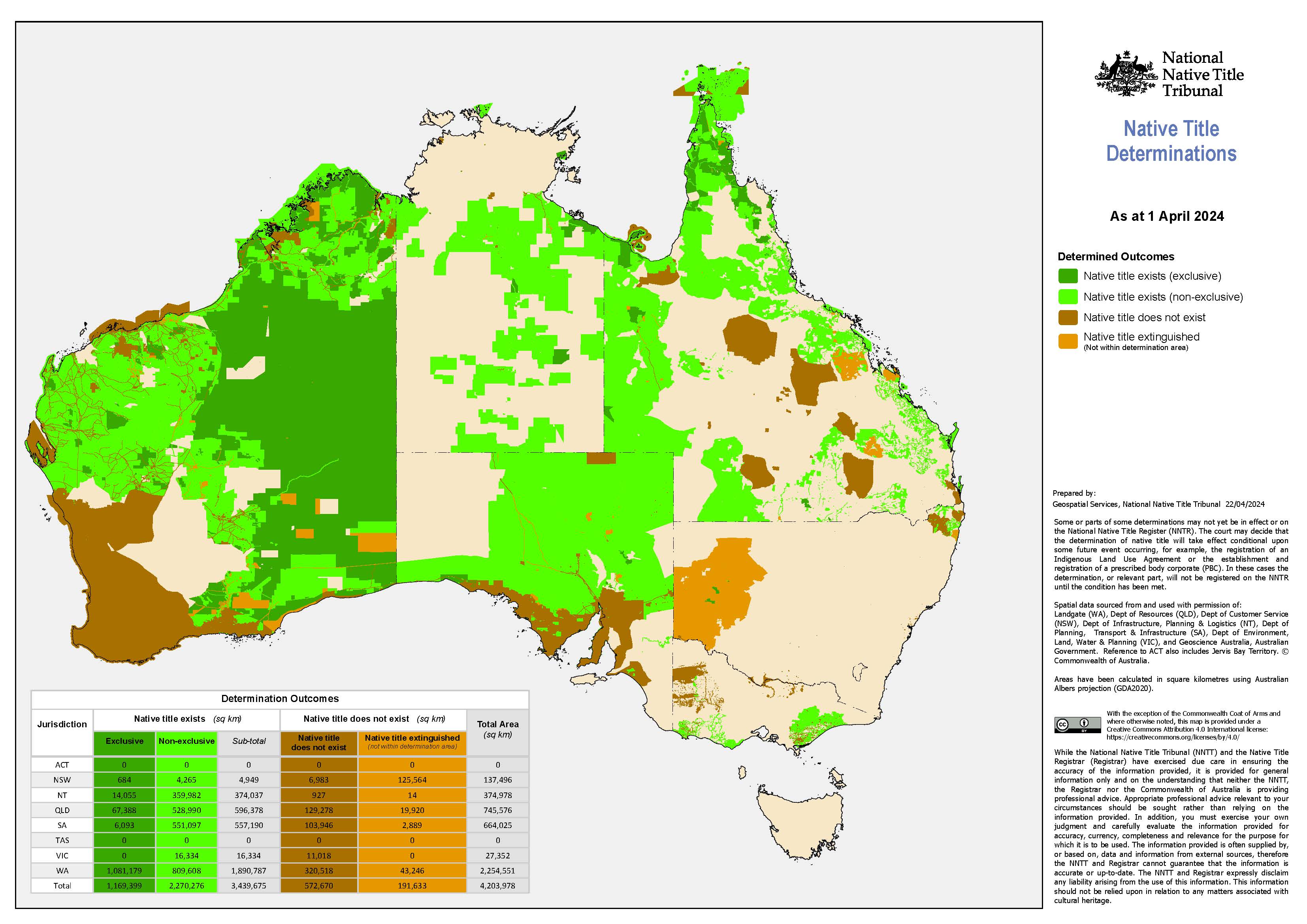
More Indigenous Australians live in NSW than any other state or territory, 208,500 people. And yet less than 1% of the state’s land falls under native title. Only Tasmania and the ACT (each with none) has less. Western Australia has the highest with 43% of land in the state recognised as having native title.
And of 48 native title case determinations in NSW, only six, including Barkandji, found native title existed or partially existed. (There are 27 active registered claims in the waiting line.)

Native title “by agreement” is easier said than done. In the case of Barkandji native title it not only involved the state government but two local councils, the Murray Darling Basin Authority, Telstra, Aboriginal land councils, two mining companies and members of the NSW Farmers’ Association.
A week before the court was scheduled to make its determination the whole thing was almost jeopardised by a last-minute objection from Wentworth shire council. In a 9 June hearing it explained to the judge it had not yet sorted through the thousands of parcels of land that may be subject to historical leases or grants of freehold, indicating native title would be extinguished.
Barkandji country covers 128,000 square kilometres but only a fraction of it, mainly crown reserves, can fall under native title. Land already owned freehold or subject to pastoral leases “extinguishes” or prevents any native title claim being recognised.
Their case was dealt a further blow in 2002 when the high court case Wilson v Anderson found historical leases in western NSW also extinguish native title, as it was considered a disruption of connection to country – even land that may have been subject to a lease 100 years ago and had long since lain in the hands of the state. It was why Barkandji’s native title could not be recognised in such places of spiritual importance as Mutawintji and Mungo Lake national parks.
Jagot was outraged. “These people filed this application on 8 October 1997,” she said. “How long do they have to wait is the question.
“Why should they be derailed at the last possible moment by somebody deciding that they want to go through every single parcel to work out whether they can find some possible extinguishment here, there or anywhere?”
She steamrollered the lawyer’s attempt to interrupt, demanding a “cultural change” among organisations confronted with native title. “Going through 20,000 parcels at enormous public expense to see whether it’s possible to find one scrap of extinguishing title” was not only impractical, it betrayed the spirit in which the act was intended.
The NTSCORP chairman, Michael Bell, said applicants in NSW faced several hurdles: in the densely populated eastern side of the state large swaths of land fall under freehold tenure; in the less populated western side of the state there is the Wilson v Anderson precedent.
There was also an entrenched prejudice, he said, from state and federal governments, who believed native title would never be achieved in NSW because Aboriginal culture had been “washed away” there.
“We assert that that hasn’t happened,” Bell said. “We have been there fighting on behalf of and with the communities to get those rights acknowledged.”
And with a hearing for the Yaegl people in the northern rivers district due this month and, just west of that region, the Western Bundjalung people in December, Bell said there could be a sea change in attitudes towards native title.
He hoped in the future claims will be turned around in “two or three years, as opposed to 18, 19 or 20”.

At Broken Hill, when words of pain, words of grace were spoken and small gifts distributed to all the men and women who had fought so hard, a Barkandji traditional owner handed Jagot a small box, cradling an emu egg.
Natalie Rotumah, the chief executive of NTSCORP and Bundjalung woman, said she stood in “humble awe” of their determination. They had fought “through the dust and the chill” and it was by no means a small win. “The troopers, the diseased, the child-stealing coppers, were all sent to break your culture,” she said.
“But you have endured and now you have fought back and sent a message to the bureaucrats of Macquarie Street that Barkandji people won’t be silenced. So stand up stand tall and step forward. Take your place in the western sun and make the future your own.
“From Wentworth to Wilcannia, and Mutawinji to Mungo, this is your country. Barkandji country. And no one can take it away.”