I travelled in South Africa recently. Outside Johannesburg, changing trains, I caught sight of what seemed like a meadow of solar panels on the roofs of modest houses in the Alexandra township, stretching out into the horizon.
The solar panels are part of a City-initiated programme that started in 2012 and aims to provide residents with affordable energy.
Working in the water world, it struck me as a perfect example of how much further we have come in public awareness and saving of energy, as compared to water.
Water is something we focus on when we have nothing, or too much, of it. Droughts and subsequent hunger catch our attention, as do excessive rains and floods. At other times it has, traditionally, been seen mostly a matter for engineers and scientists.
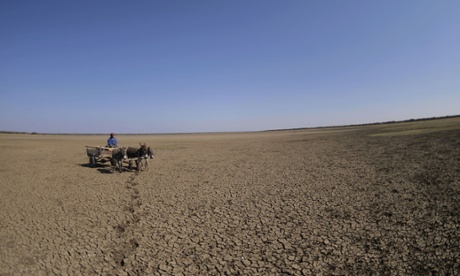
But things have changed. Today water is becoming a frequent presence in the public discourse. Water and dryness are in the news every week. From the Horn of Africa, over the Sahel, to São Paulo and California, the long dry spells have put people to the test.
In developing nations, people are being tested to the brink of survival, while in the West, people realise that they can no longer take a steady water supply for granted.
The global population and many economies are growing fast, and with that, the demand for freshwater resources. The amount of freshwater we have, however, is constant.
The local and regional water crises today combine into a severe global water situation that touches the core of every society in the world. Water is the foundation for all aspects of human and societal progress.
While we need it to survive, to quench our thirst, to prepare our food, and maintain our hygiene, it is also central to economic and social development, and a prerequisite for healthy ecosystems. The water crises concern every single one of us.
California is a striking illustration of how, despite stellar human and economic resources, we come up dry when rains fail. It is just the beginning. In many parts of the world, we will simply have to get used to living with less reliable water.
Climate change is likely to cause even more disturbance to our weather systems, causing erratic rainfall and prolonged dry spells, thus affecting our supply of water. Meanwhile, we need to grow more food for a growing world population. In sub-Saharan Africa especially, this will be a great challenge.
And here, we need to shift the way we think: we must learn to focus on the water we have, not the water we do not have. What does that mean?
When water in sub-Saharan Africa has been discussed in development circles, the focus has been on so-called blue water: surface water, lakes, rivers, streams and groundwater. But sub-Saharan Africa does not have enough of it, and so the discussion has often stopped there, at the absence of water, and what to do about it. But, water scientists say, the water is there, and it is what we call green water, the water that falls as rain and infiltrates into the soil.
It never reaches the lakes, rivers or groundwater table, but it is available for agriculture, if you manage to catch it before it evaporates. And that is one key to eradicating hunger in large parts of sub-Saharan Africa.
The 5th assessment report of the IPCC (Intergovernmental Panel on Climate Change) showing over 25 per cent decline in total rainfall for certain parts of sub-Saharan Africa. The projected increase in population in Africa (3-4 billion by 2100), indicates that the situation is set to worsen unless we rethink the way we manage rainwater, there and elsewhere.
The Asian green revolution was sustained by irrigation, with water flowing down from the Himalayas. In Africa, there is simply not enough blue water.
An African green revolution, a necessity if we are to eradicate hunger, lift billions out of poverty and enable people to build healthy productive lives, rests on our ability to maximise the use of rain, especially that which falls over the vast savannah grasslands and often evaporates before it is put to use. The water exists, it just doesn’t flow to us.
The technique of harvesting rainwater has ancient roots. This year’s Stockholm Water Prize laureate, Rajendra Singh from India, has modernised old methods to bring water and productive agriculture back to thousands of villages in India, starting in the driest state, Rajasthan.
In a few weeks, world leaders meet in New York to sign off on a set of Sustainable Development Goals. The top goal is, of course, to lift people out of poverty. Many of the world’s poor live in sub-Saharan Africa.
Their numbers grow fast, and in a drier world. Rainwater is an underused and misunderstood water resource - we need to cherish it, and be very smart about how we harvest and handle it.
Focusing on the water we don’t have will get us nowhere. I’d like to be as awed by cities’ and people’s water ideas, as I am by their energy saving ideas. It’s high time to get seriously water wise.
Torgny Holmgren is Executive Director of the Stockholm International Water Institute
Content on this page is paid for and provided by WSSCC, a sponsor of the Guardian Global Development Professionals Network.


.png?w=600)