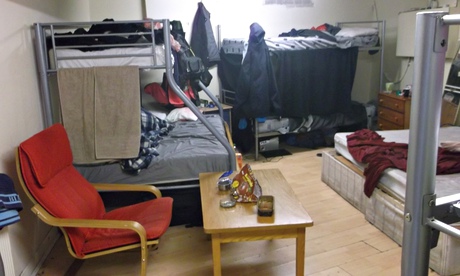
However you look at it, the scenes that greeted housing officers – and, by chance, the head of the civil service, Sir Jeremy Heywood – during a raid on a semi-detached house in London’s East End last week offer a graphic illustration of the housing shortage in the capital. The officers found a family house licensed to house seven people accommodating 26, including seven packed into a cellar with no natural light and only steep steps from the “garden” affording access. They pronounced it among the worst examples of overcrowding they had found, but did not seem overly surprised.
Nor, I imagine, will such conditions surprise anyone with even a fleeting acquaintance with the state of housing in the capital. Ever since the first accounts emerged of illegal “beds in sheds” in west London, the malign confluence of circumstances has been evident. People desperate for somewhere to live in the capital, where the jobs are; people paid too little – legally or illegally – to pay market rents; the lack of, and neglect, of social housing; and the proliferation of latter-day Peter Rachmans, making more than a bob or two off their plight.
The fact that the owner of the house in East Ham is likely to face prosecution offers little consolation. A guilty verdict would only add this landlady to the more than 400 owners who have so far been prosecuted in Newham, with 25 banned. The council recovers some of its costs in the form of fines and unpaid council tax, but the occupants of the premises become homeless – a new problem for the council which may then have a duty to rehouse them, from its increasingly non-existent housing stock.
These practicalities are why many councils are not nearly as assiduous in pursuing rogue landlords as the law would require. It has also to be said that, for obvious reasons, some hapless tenants are complicit in illegal deals. Questioning the terms and conditions of the only accommodation they can find is a risk they cannot afford to take. They don’t want the housing inspectors to call, either.
For some – and this is an uncomfortable reality many of those denouncing such conditions prefer not to face – even such glaringly substandard places to live may actually be an improvement on the squalid shantytowns people left behind. London has not just rich and poor, but the first and the third worlds, living side by side. Any amount of new housing is not going to banish overcrowding in coming years, if at all.
All that said, the mayor of Newham, Robin Wales, deserves enormous credit for doing something, where officials in other boroughs have tended to turn a blind eye. Newham has pioneered a scheme to register landlords and lettings, which is raising standards and at least attempting to set a benchmark of what is acceptable in the UK today. Its detractors will argue that licensing has the effect of driving such dubious business even deeper underground, and forcing some tenants even further into the black market. Such arguments are a recipe for inaction.
Newham has to reapply to the government to renew its licensing scheme in 2017. You have to wonder why such an obviously beneficial – if necessarily limited – measure requires additional scrutiny and renewal. Rather than imposing more red tape on Newham, the government should be requiring every council under housing stress, not only in London, to follow its example.