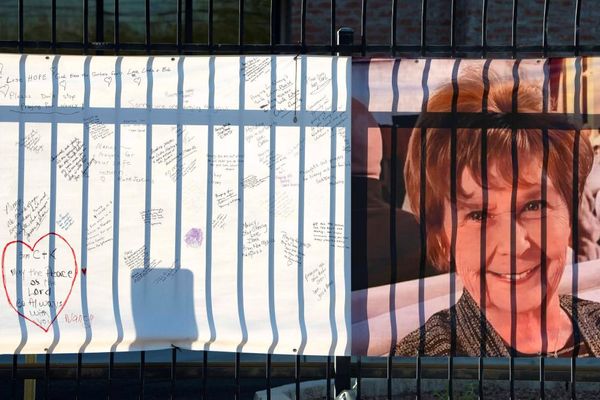
Gerald Kaufman. Chuck Berry. Tim Pigott-Smith. Ian Brady. Following his death last week, Brady – “The killer who showed no remorse” – became the subject of a BBC obituary, an honour the corporation did not extend to his more prolific colleagues Fred West and Harold Shipman, nor, indeed, to the parents of Brady’s victims. Winnie Johnson, the mother of Keith Bennett, died in 2012 without knowing where her son was buried, the murderer being keen to protract her suffering.
While by no means a eulogy, a BBC obituary can’t but establish Brady as a notch above the common run of murderer, which appears to be precisely how he viewed himself. Only the very greatest of the celebrities whose premature deaths punctuated 2016 enjoyed comparably extensive memorialising, both red-top and broadsheet, featuring extended analysis of his alleged influence on the national consciousness.
If nobody actually wrote: “Ian Brady shaped my life”, the lavish, if essentially completely unenlightening reconsideration of his murders confirmed that sadism and brutality remain as good a route as any to enduring celebrity status. Maybe it’s the shortage of truly sickening yet characterful killers that ensures the names of our premier felons can outshine and outlast – and not only at Madame Tussaud’s – those of high achieving yet less thrilling individuals, who never got round to killing anyone.
A century after Dr Crippen’s arrest, in 1910, for instance, the BBC took the opportunity to ask: “Was Dr Crippen innocent of his wife’s murder?” Extinction, then, seems similarly unlikely to conclude detailed media repetitions of Brady’s crimes. What made him what he was like? Was he evil or sane? What does it tell us about the potential for harm in all of us? That interminable study of the world’s worst killers has produced neither satisfactory answers nor notably helpful data, likely to identify the embryonic murderer, will never deter the true crime scholar.
Not that there needs to be some practical or professional purpose. For the much lamented Gitta Sereny, applying herself, in Cries Unheard, to the story of the child murderer Mary Bell: “The mystery starts with the question of what, consciously or unconsciously, can be put into a child by another human being to produce actions entirely incompatible with the intrinsic goodness of the human being as born.” But in the end, Nicci Gerrard concluded in her review, “what Sereny can never quite do is enlighten us”.
For the crime writer Patricia Cornwell, expensively preoccupied with a serial murderer who was active 129 years ago, a determination to identify Jack the Ripper stems from consideration for her chief suspect, the alleged serial murderer and undoubted painter Walter Sickert. “It’s never too late for redemption,” she says.
As for contemporary murderers, as Brady’s profile indicates, high status is more likely to attach to those who put some effort into self-promotion, whether by acting brainy or by withholding information, or both. Ditto Myra Hindley, who inspired quite a following of doting, well-to-do gentlemen, none of them highly rated for true crime expertise. Principal among those eager to broadcast her repentance and Open University degree was the late Lord Longford, with his catchphrase “love the sinner, hate the sin”. True, Longford was a sucker for celebrities, criminal and otherwise, but it must have taken something special to beguile his fellow Hindley supporter, David Astor, the former Observer editor, into corresponding from the early 80s, writing at one point (to Hindley): “I hope you will allow me to say that you have already made an astounding achievement which I think is seriously comparable to that of Nelson Mandela.”
Less charismatic killers hoping to enliven their life tariffs with some public recognition could also do worse than study the stratagems by which another celebrity murderer, Dennis Nilsen, created a public profile that must, if there is any justice, make a BBC obituary a sure thing. By impressing first Brian Masters, high-minded author of Killing for Company (who liked to giggle about owning Nilsen’s cooking pot), then a series of criminologists, amateur and professional, Nilsen has sought to pass off his 12 homicides as a grand insight into the murdering condition.
His habit of executing vulnerable young men, rather than women, may mean, however, that Nilsen must wait for admission to the highest rank of killer. For all his eminence, including Masters as an amanuensis, Nilsen can’t compete with Jack the Ripper, who has a museum dedicated to him, nor with the executed American serial killer Ted Bundy, the subject of scores of true crime books and four films. The last of these being now nearly 10 years old, the time is ripe to introduce a new generation to his savagery: step forward the producers of the upcoming Ted Bundy vehicle, Extremely Wicked, Shockingly Evil and Vile. Zac Ephron, as Teen Vogue reported, “has landed his creepiest role yet as one of the most gruesome serial killers in US history”. What’s not to like? “We couldn’t be more excited to see him in this amazing role,” said one of the producers.
For the sensitive creative, Bundy’s murder of at least 30 young women whom he selected – apparently that’s just how it was – for their prettiness, must be all the more appealing when made-up violence against pretty women has become so prevalent as to awaken suspicion that it is deployed, more than anything, as an audience stimulant by film-makers whose own senses may have been irreparably dulled by cynicism, self-delusion or misogyny. Unlike the makers of, say, The Fall or of Nocturnal Animals, the makers of a Bundy biopic can argue that the tasteful rape and torture of appealing – if lightly characterised – young women, at the hands of a dashing and personable man, is critical to their endeavour.
If there can be nothing so edifying in a Hollywood version of Bundy’s crimes as to excuse the inherent indifference to his real victims and their families, the same perhaps applies to quantities of domestic serial murder coverage, high and lowbrow. It’s some time, after all, since criminal profiling made excitable re-examination of serial killer behaviour look as respectable as, say, an interest in cloud formation.
What seemed so splendidly effective in Cracker and in The Silence of the Lambs, a book partly inspired by Bundy’s manipulation of law-enforcers, has yet, in real life, to be validated. One group of academics set a challenge, “for anyone to provide us with evidence where a criminal profile has led to the direct apprehension and sound conviction of a suspect in a serial murder inquiry”. Altogether, another study concluded, “there is no compelling scientific evidence to support the positive view of CP [criminal profiling], that dominates popular opinion”.
The reporting of the death of a serial killer can hardly be a subdued operation. That Brady’s squalid story should, however, purport to Tell Us Something may be less illustrative of collective wisdom than of this particular criminal’s talent for manipulation, ie, it’s what he would have wanted.