A small group of exhausted men and teenage boys sat together on a patch of grass outside a hotel on the outskirts of west London. They wore tattered trousers and faded T-shirts, ripped by the barbed wire fences in Calais. Some were barefoot.
They considered themselves to be among the lucky few who had made it to the UK. Some tried more than 50 times to jump the lorry trains at Calais before finally dodging police and rail officials and making it to British soil. French police estimate about 70% of migrants who arrive in Calais leave within four months. It is not known how many end up in the UK or other parts of Europe.
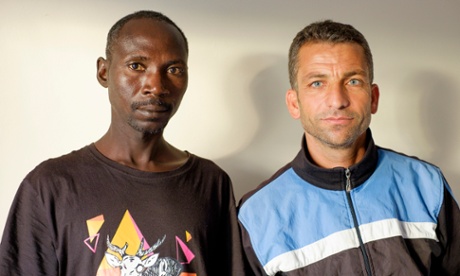
The men the Guardian spoke to had arrived in the UK since the start of August. All said they had fled persecution, either from Syria, Sudan or Eritrea.
Ali Mustafa, 37, a Syrian agricultural engineer, said he was one of 15 asylum seekers who jumped the same train to reach the UK a week ago. He believes that another train the same day carried 18 migrants.
Mustafa fled Syria for Lebanon with his wife, three sons and two daughters last year. The rest of the family remained in Lebanon while, over the course of three months, he travelled to Turkey, Greece, Macedonia, Serbia, Hungary, Austria, Germany, the Netherlands, Belgium, France and, finally, England.
“I spent 24 days in Calais,” said Mustafa. “Most of the time I slept in a park in the centre or on the streets, not in the Jungle [asylum seeker camp].”
He made dozens of unsuccessful attempts to get to the UK. “I first tried to get on to a boat in a lorry,” he said. “I got into a lorry transporting croissants to England. It was quite cold inside. I waited there for 26 hours but an hour before the boat was due to sail the police caught me. It is better if you can find a hiding place at the station that is not too near the trains.
“The French police search the areas close to the trains looking for people getting ready to jump. When the police catch us they drop us off halfway between the station and Calais centre. Then we just go back to the station again. Sometimes people make two or three attempts each night to get on a train.”
Each attempt would involve jumping on to a freight train carrying lorries to the UK, and attempting to hide under a parked lorry within the train container. “The aim is to try to hide under the train while it is dark so that it is harder for the police to see us,” explained Mustafa.
Mustafa finally succeeded, jumping on to a train and hiding underneath one of the lorries just after it started moving out of the station. He was with two Sudanese asylum seekers. “As soon as the train started to go fast and entered the tunnel without us being found we knew we had made it,” he said. “We did a kind of hug with each other as best we could under the lorry because we were so happy. We had struggled so hard but we had achieved.”
Adam Ishaq, 41, from Darfur in Sudan, arrived in the UK on 1 August. He successfully clambered under a lorry aboard a train on his third attempt. He had only spent one day in Calais.
“You need courage to jump the trains, you can’t give up when you don’t succeed and you need to be fit and thin,” he said. “If you are fat you can’t move fast and it’s harder to get under trains and lorries. The police are fast but we have to be faster.”
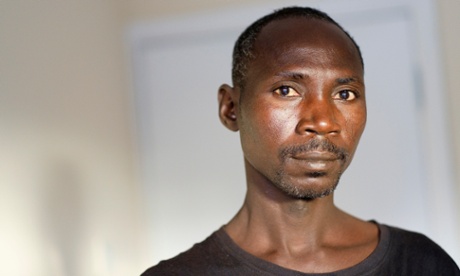
Kamar Ahmad, 30, also from Darfur, arrived in the UK on the same day, after 50 attempts. “One of the worst things is the many barbed wire fences we have to jump over to get to the station. My hands and wrists are covered in barbed wire scratches and I’ve got a bit of wire stuck in the palm of my hand that I can’t get out,” he said.
The police discovered them when they reached the UK, rounded them up and took them as a group to a police station in Kent to be interviewed by immigration officials. Those who hide on trains from Calais to England either declare themselves once they reach the UK or are discovered by police.
Anyone who declares they wish to claim asylum is taken to a local police station where they will be met by an immigration official. They are interviewed, an asylum claim is lodged and they are then either detained or taken to emergency accommodation, usually in London. At this stage they are only required to give brief details of why they are claiming asylum.
“We have just been here for a few days so don’t yet know what England is like,” said Ishaq. “All I want is to find peace here after what I went through in Darfur where our villages were burned and we suffered a lot.”
The men were moved to emergency accommodation in west London while they await the next stage of the asylum process. Food and a bed, often in a shared room, were provided – but not money. At a later date, perhaps in several weeks or months, the men will be asked to report to a Home Office location for a full screening interview where they will be questioned in detail about why they want to claim asylum.
Home Office officials look for inconsistencies in their stories, or information provided by the asylum seeker which is at odds with background information officials have about circumstances in their country of origin. Asylum seekers are required to provide a very detailed account of the persecution they have suffered in their home country during the screening interview. The Home Office might use language experts to determine whether or not an asylum seeker comes from the country or region they say they have come from.
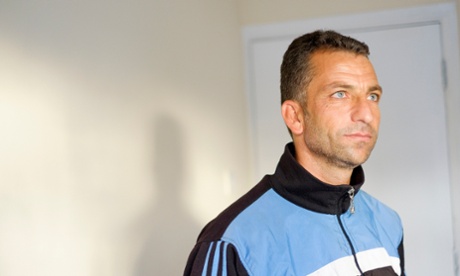
Then comes the wait while Home Office officials decide whether to accept or refuse their case. Accommodation and money is usually provided while they wait, as asylum seekers cannot work. On 10 August a new standardised rate of support for asylum seekers of £36.95 per week is being introduced. It can be months or even years before a decision is made, but others are granted leave to remain quite quickly; asylum seekers from Syria who can prove their nationality and opposition to the Assad regime are usually granted asylum quite quickly.
The majority of asylum claims are refused but around a third are granted on appeal. Mustafa said: “What I had to do on my journey and in Calais was dangerous but it is nothing compared to what was happening to me in Syria where we started our day with bombs and ended our day with bombs. We lived in fear every minute.
“The location on my Facebook page says London,” he said. “I pray for the day I can return home to a peaceful Syria and read Damascus as the location on my Facebook page.”
• This article was published in print on 8 August 2015. It was also meant to have been published online on or before that date, but its appearance on the Guardian website was accidentally delayed until 9 October 2015.