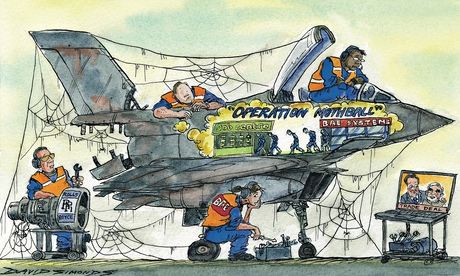
How ironic that just as Indian prime minister Narendra Modi was in Britain last week talking up the trading links between the two countries, defence group BAE Systems was announcing 371 UK job losses that are due in no small part to decisions made by India in 2012.
If India had agreed back then to buy 126 BAE-made Eurofighter Typhoon jets, British manufacturing might not be under the pressure that it feels today. That deal would have been worth around £7bn, with the order securing the jobs of thousands of workers at BAE plants across the UK. Instead, India chose to order the same number of Rafale aircraft from French manufacturer Dassault.
With limited overseas demand for the Typhoon, BAE has had to slow down production of the fighter jet and cut jobs. When production began in the 1990s, it was hoped that overseas orders would pour in to underpin the project. But, a controversial order from Saudi Arabia apart, tie-ups with India, the UAE and other countries have failed to materialise.
And BAE is not the only aerospace manufacturer in Britain feeling the pinch. Engine maker Rolls-Royce issued a profits warning last Thursday that wiped a fifth off the value of its shares. The problems facing Britain’s aerospace industry can be summed up in two aircraft: the Typhoon and the Airbus A380 superjumbo.
Rolls-Royce makes engines for both aircraft. The company placed a bet on large, wide-bodied aircraft such as the A380 and on the next generation of narrow-bodied, or short-haul, planes that will come after the Airbus A320neo and the Boeing 737 Max.
That bet went wrong, however, as long-haul airlines focused instead on smaller, single-aisle planes that are becoming increasingly cheap to run. Airlines have decided they don’t need large planes to cross the world and, as a result, orders for the A380 have been disappointing. This is having a twofold effect on Rolls-Royce: not only is demand for engines for larger planes down, but airlines’ existing smaller planes are proving so viable that the company may also have to wait longer than hoped for orders for the new generation of narrow-bodies.
The group is also being dragged down by a slowdown in Rolls-Royce’s other businesses – including defence, nuclear and marine. Warren East, the new Rolls-Royce chief executive, is reviewing the company’s strategy and has plans to cut costs by up to £200m each year. But this will not fix the strategic error made by his predecessors, Sir John Rose and John Rishton, which has seen Rolls-Royce miss out on the boom in the narrow-bodied civil aerospace market. Rolls-Royce is in for a rough few years.
For George Osborne, the march of the makers has become the malaise of the manufacturers. Rolls-Royce and BAE are two of the country’s biggest and best-known companies in this sector. It is difficult to get manufacturing in the UK firing on all cylinders and contributing to economic growth when FTSE 100 giants like these are struggling, and with them the hundreds of small businesses that supply them with parts.
To make matters worse, Jaguar Land Rover, the greatest success story of British manufacturing since the financial crisis, is also pausing for breath. The carmaker is reviewing its operation and could cut £4.5bn of costs.
To be fair to the manufacturers, they are battling against a collection of adverse global factors. A slowdown in Chinese economic growth and the fall in the price of oil has hit demand in their key markets.
BAE, Rolls-Royce and JLR will fight back. Although the performance of manufacturers can fluctuate with the global economy, they are anchored around long-term investors. These three companies have invested billions in technology and remain at the forefront of their markets, with extraordinary talented people in their ranks.
In 10 years’ time, Rolls-Royce could be enjoying extraordinary demand for engines for next-generation planes, and we could all be praising the decision to focus on developing new technology rather than supplying old. But with BAE also grounded, British manufacturing could struggle to take wing until then.
The Bank has not thrown its doors open wide enough
More of Britain’s institutions should throw open their doors to the public. It is good to see how the suits that make so many important decisions conduct themselves and to get them to answer a few questions.
When the Bank of England welcomed 200 members of the public last week to the Guildhall in London and a similar event in Edinburgh, it provided an insight into the way central bank officials think and some of their priorities. In an era when democratic institutions increasingly defer to unelected officials, any chance to get close to where the power lies must be important.
Yet this was not an exercise that could be compared to a company’s annual general meeting.
The open forum exercise orchestrated by Bank governor Mark Carney was a distinctly controlled affair, which meant the day avoided comparison to an annual meeting’s long lines of shareholders addressing their concerns to the chairman of the board, who must, through time-honoured tradition, offer long and often detailed answers.
There were a few questions from the floor, but not many. And too often speakers fell back on indecipherable jargon to get their point across – step forward, European Central Bank boss Mario Draghi.
It would be better if Carney had chosen a simpler exercise, much as the Bank’s sister regulator has done for many years. The Financial Conduct Authority holds an annual general meeting that must be gruelling for its board members, offering as it does the opportunity for experts and the public alike to grill them mercilessly.
An open forum is one thing. But providing a well-informed and feisty public with the chance to grill Bank insiders would be a better way to enhance democracy.
Monetary policy affects everyone and the Bank’s persistent failure to judge the course of the recovery must be worth a few questions from inquisitive outsiders.
‘The Lidl with a lav’ could flush away a big advantage
Not content with proffering cheap champagne and Iberico ham, Lidl is aiming to pamper its new middle-class fans with new luxuries such as customer toilets and self-service checkouts. Its new £2m Rushden store, the “Lidl with a lav”, is bigger and glossier than its usual outlets and marks a change in the way the German discounter wants to be perceived in Britain. If the economy improves it could be a smart move by Lidl, ensuring it doesn’t get left behind as people have more money to spend and become less interested in shopping around. The risk is that all the bells and whistles of a traditional supermarket will need to be paid for by price increases. Then shoppers will be left with a not-so-cheap, limited range of groceries and still have to visit other stores to get all they need. Lidl will have to be careful, or it could see its point of difference flushed away.