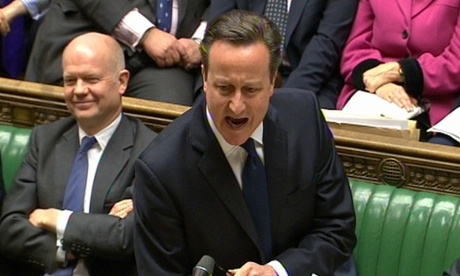
“Does the prime minister think that prime minister’s questions might be damaging parliament’s reputation?” asked Lib Dem David Ward. It sounded as if this might be a philosophical question on how much harm damaging something that is already damaged can do, but David Cameron chose to take it at face value. “PMQs are robust,” he conceded. For robust, read a Bullingdon night out. “But they do serve an important democratic purpose in allowing MPs to ask the prime minister anything they wish.” What he forgot to add was that a key part of the democratic bargain is that the prime minister should attempt an answer.
Ed Miliband had started the session by asking if Cameron felt the Tories had broken their promise at the 2010 election to reduce immigration to tens of thousands. This wasn’t necessarily a line of questioning that many of the leader of the opposition’s backbenchers would have been keen for him to pursue, as Labour being tougher on immigration than everyone else doesn’t sit comfortably with many of its members, but it did have the virtue of banging the prime minister to rights. At the last count, immigration had increased to 298,000, which even Nigel Farage would have been hard pushed to explain as a change of emphasis.
“We have kept our promises,” Cameron insisted. “We have grown the economy.” Indeed it was his great economic success that proved his downfall because it had merely encouraged more and more foreigners to come to this country. Miliband started bouncing up and down in his seat – a sure sign he felt he had the upper hand. “Your manifesto said: ‘No ifs, no buts. If we fail to deliver you can vote us out,’” he yelped. “You are making the Lib Dem promises on tuition fees look like a model of integrity.” Nick Clegg scowled. He seldom bothers to appear at PMQs these days and now he had remembered why.
“We have kept our promises,” the prime minister repeated. “We have kept free TV licences for the over 75s. We haven’t got rid of the winter fuel allowance …” Who knew these were the key battleground of the last election? Miliband tried another tack. Would the prime minister be willing to have a two-way TV debate with him on 30 April? The broadcasters were ready and so was he. “We’re already having a debate now,” Cameron replied. Only on Planet Dave could PMQs count as a debate.
Then came Cameron’s big moment. “How many members will be putting the leader of the opposition on their election leaflets?” he asked. On cue, the well-prepped Tory hordes and the Scots Nats stuck their hands in the air. As did just a handful of Labour MPs. A few brazened it out when they realised their error; the rest tried to make it look as if they had just been stretching. Cameron allowed himself one of his smugger smiles.
Less than an hour later, Clegg was in rehab with Sir Richard Branson at Chatham House. “We have to help those individuals who need weaning off people peddling dangerous substances,” the Lib Dem said in confessional mode. He is still fairly strung out on the coalition and needs intensive therapy. But he’s doing OK. He was with the Virgin boss to propose a radical drugs policy that was both almost sensible and with which almost all the country would disagree. A sure sign that the Lib Dems are back to their old unelectable selves.


.png?w=600)