Thirty-nine years ago this Sunday, college basketball’s last undefeated team celebrated a national championship. Indiana’s players danced in Philadelphia’s Spectrum, fans wept and for four decades the lasting image of perfection has been coach Bobby Knight in a plaid jacket standing beside Scott May and Quinn Bucker as they clutched the championship trophy.
At least for another week.
Forgotten in those memories of Indiana and an unblemished run that Kentucky may soon match is the other team that came into the 1976 Final Four without a loss. Maybe years of a school’s athletic disappointment and dysfunction have clouded recollections, making the name seem like a misprint on a short scroll of the undefeated, but for one improbable winter Rutgers – yes Rutgers – went to the Final Four having won all their games.
As Kentucky march toward history, now three wins from transcendence, the Rutgers run looks even more unlikely than when Gerald Ford was president. They had talented players, four of whom eventually played in the NBA, but none as good as Larry Bird who led unbeaten Indiana State to the title game in 1979 or the stars on UCLA’s four undefeated champions. It had no pedigree, no rich history, no great standing in the game. It was simply a school with the right players and the right coaches at the right time.
“If we were a sponge collecting water at the beginning of that year we squeezed every last drop out of that sponge,” says John McFadden, an assistant coach on the 1976 team.
In the years since, only two teams have ever done what Rutgers and Indiana did that season – Bird’s Indiana State and UNLV in 1991. It doesn’t even matter that Rutgers lost both their games in the Final Four to finish 31-2 and fourth in the AP poll. The fact a Rutgers team somehow went through a season not just winning every game but dominating almost every one of them with a crushing defense is amazing enough.
“I tell you it felt great,” says Hollis Copeland, a starting forward from that team. “I played in the NBA and I felt great about that but there was nothing like that year. Nothing like it at all. If rock stars feel like that every day then I want to be a rock star.”
Sometimes great teams just happen. But only 12 have ever gone to a Final Four undefeated. Eleven seemed like logical prospects, coming from big conferences or loaded with superstars. One stands out as the most implausible name of all.
Rutgers.
Why? How?
“We were a talented group but we were a family and that’s what kept us on the path,” Copeland says. “We really cared for each other.”
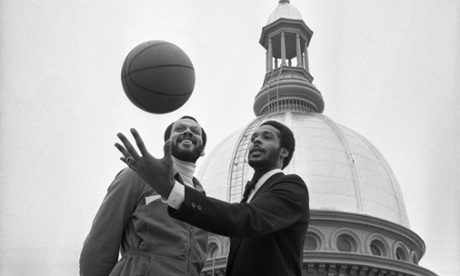
Rutgers had never been a basketball power in the east. Even winning seasons in the 1960s and 1970s were merely regional successes. An argument can be made that the program is best known for a player, (Jim Valvano in the 1960s), and an assistant coach, (Dick Vitale in the early 1970s), whose fame came elsewhere. But when Tom Young arrived from American University as head coach before the 1973-74 season, he brought discipline and built a unique roster of gifted and unselfish players. Everything went from there.
By the fall of 1975 it was clear Rutgers was going to be good. Forward Phil Sellers was an All American, Eddie Jordan and Mike Dabney highly-regarded guards, Copeland a dominant forward, and freshman James Bailey a promising shot-blocker. And yet no one could have imagined how good they would become and how well they would play together.
“It was a very tight-knit group of guys,” McFadden says. “There were a lot of egos when you consider there were [four] NBA players on the court then. There have to be sacrifices across the board to get the level of play and reach the level that we did. That’s a testament to the players and the coaches to get the players to see there was something bigger than themselves.”
The start might have come in Young’s first season when the new coach threw Sellers, a sophomore star accustomed to a measure of entitlement, out of two practices. Each time Sellers returned contrite. The other players noticed how their best player accepted coaching and they embraced it too, throwing themselves into Young’s preferred style of an aggressive, relentless full-court defense.
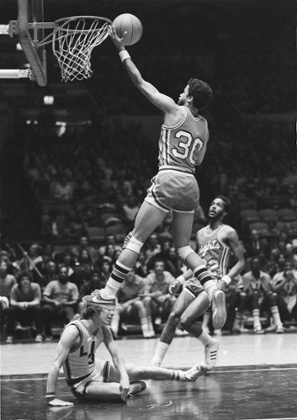
“We all fed off of each other and it was because of that defense,” Copeland recalls. “We’d always bait the other team’s ball-handler to do something unnatural. Eddie would go after him and the guy would eventually throw a lob pass or try something really slick like dribbling behind his back. That was the mistake for them. We’d steal the ball and be off running for a basket.”
As 1975 turned into 1976, Rutgers tore through Purdue, Seton Hall and Boston College. They destroyed Pennsylvania, Connecticut and Temple. When the Scarlet Knights played West Virginia, their defense kept the Mountaineers from getting across halfcourt for the first several minutes of the game.
A superstitious team trainer insisted on making the same pregame meal – steak, baked potato and peas – regardless of whether the game was at night or at noon. Television networks maneuvered to show the Scarlet Knights and soon their practices were filled with reporters looking to tell a story none of them had seen coming.
The record became hard to ignore. The players heard about their undefeated status everywhere they went even as Young and his assistants refused to talk about it with the team. Every question whether it was from a fellow student, professor or journalist was the same: Can you keep winning?
“It changes everything because you start looking ahead,” Copeland says. “We won all the games but we didn’t win by the same margins.”
In a way, this year’s Kentucky team reminds the 1976 Rutgers team of itself – only far better. The Wildcats, with nine McDonald’s All Americans, might be the greatest collection of players in college basketball history. Much like Young, their coach, John Calipari, has asked for stars to sacrifice for the collective good. Much like Rutgers in 1976, Kentucky has too – forming a second-team that might be better than anyone else’s starting five.
Rutgers didn’t have a second team of elite starters but it did have four players who could have been considered good enough to start, including Steve Hefele who lost his starting role early in the season to Bailey. Copeland remembers the practices that year being so intense with the reserves challenging the starters that they were usually tougher than the actual games. He suspects Kentucky’s practices are much the same.
“Kentucky has what we had magnified tenfold to the extent any great basketball team has to have great talent,” McFadden says. “But great teams don’t always win. You have to have great chemistry. You have to have guys who are willing to come together and accept roles and play together.”
You also have to be lucky. Kentucky nearly lost to Mississippi in its first Southeastern Conference game this year and trailed by nine at Georgia before scrambling to win. Rutgers too had their near-losses in 1976.
The first came in the last regular season game, at home against St Bonaventure. By then the frenzy surrounding the Scarlet Knights was overwhelming. The game was the last in the school’s tiny College Avenue Gymnasium, known affectionately as “The Barn”. Fans surged toward the players before the game, forming a small parade behind the team as they entered the gym.
Maybe distracted, Rutgers didn’t play well. St. Bonaventure led by seven with 5:00 left only to have Rutgers come back to win by five, aided by a controversial foul call on a St Bonaventure player that seemed to deflate the upset attempt.
“The guy makes a steal and the ref calls a foul,” Young says. “If the ref ignored it, we are 25-1. But he called it and we went on to win the game.”
The second near-miss came a few weeks later in the first round of the NCAA Tournament. The Scarlet Knights led rival Princeton 54-53 when Jordan was called for a foul with four seconds left, sending Princeton’s Peter Molloy to the free throw line for a one-and-one that appeared to doom Rutgers. Molloy had not played much that season and knowing this, Young called two timeouts in a row in the hopes of building tension and unsettling Molloy.
As the teams finally lined up for the shot, Copeland looked at Molloy.
“He’s uncomfortable,” he said to himself.
Sure enough, Molloy’s free throw hit the back of the rim, Rutgers rebounded and the streak lived on for two more NCAA Tournament wins over Connecticut and Virginia Military Institute sending the Scarlet Knights to the school’s only Final Four.
Those days before the Final Four were chaos. Because Rutgers is just an hour from Philadelphia and many of the players were from New Jersey or New York City, everyone around the team was besieged by family and friends hoping to get into the games. The practices were filled with pro scouts. At the time there were still two professional basketball leagues – the ABA and NBA – and agents kept approaching Copeland, promising to land him a pro contract if he signed with them.
On the day before the first games, Rutgers assistant Joe Boylan introduced himself to famed UCLA coach John Wooden, who had retired the year before. As Boylan walked away, Wooden called him back.
“Son, make sure you go out there and take a minute and look around at the crowd and take it all in” Wooden told him. “You never know if you are going to be there again.”
Little did anyone know how right he was.
The bracket did not have Rutgers playing Indiana, the other undefeated team, until the final game, which Boylan remembers as disappointing. The coaches were familiar with Indiana. Young and Knight were good friends. In fact, the season before, Young had missed his first practice in seven years to fly to Indiana so he could watch Knight run a practice, trying to see how Knight coached the passing offense he was trying to install at Rutgers.
Instead of Indiana, Rutgers played Michigan and this proved disastrous. After a winter of dominance, the Scarlet Knights couldn’t hit a shot. Everything bounced off the rim. The game wasn’t even close, Michigan won 86-70 and the undefeated season was over. In those days, the losing teams in the first games played a consolation game. Deflated from the Michigan loss, Rutgers played sluggish and lost by 14 to Woodenless UCLA.
“It’s really the worst feeling,” Young says. “Your whole career you spend trying to get to that moment and you have the worst shooting night of your life – in a game you should have won. No matter what we did [as coaches] we couldn’t correct the shots we were missing. They were good shots. They just didn’t go in.”
Nothing would be the same after that. Sellers and Dabney, the team’s top seniors were gone the next season. And even though Copeland, Jordan, Bailey and Abdel Anderson remained and became stars themselves, the magic was lost. The pressure defense was never as good.
“We lost quickness and other teams figured out how to play against it,” Young says.
In 1976-77, Rutgers went 18-10. Since then, it has only two NCAA Tournament wins: an upset of Georgetown in 1979 and a victory over Southwest Louisiana in 1983. For the next 32 years, the Scarlet Knights would only go to the Tournament twice, losing in the first round each time.
Eventually Young would leave for Old Dominion in 1985 and the glow of that brilliant undefeated year slowly faded.
Last weekend, Copeland was visiting a friend in California. As they sat in a beachside restaurant, watching the games, a chart appeared on the television: Undefeated teams heading into the Final Four. Copeland’s friend noticed the name Rutgers first.
“Look at that Cope!” he shouted. “Man, you guys are still relevant and that’s crazy!”
Over the phone, Copeland chuckles.
“We didn’t know how rare it was until now,” he says.