

It’s been a long time since a team has lifted the Asian Cup on home soil. Five tournaments and more than two decades have gone by since it last happened, at Hiroshima’s Big Arch Stadium in 1992.
That’s a daunting statistic for Australia, runners-up four years ago and hosts of the current tournament, which concludes in Sydney at the end of this month. They might have been hoping a bit of home ground advantage could get them over the line this time around, but seemingly, despite playing in the biggest and most diverse of Fifa’s confederations, that advantage is limited.
Historically though, the Asian Cup’s home ground advantage has been more significant. Host teams won five of the first seven editions. South Korea were the first side to do so and Japan the last, while Iran’s hat-trick of titles began and ended in Tehran.
This graph shows the win-per-match ratio for every team competing in an Asian Cup, coloured by host or visitor status:
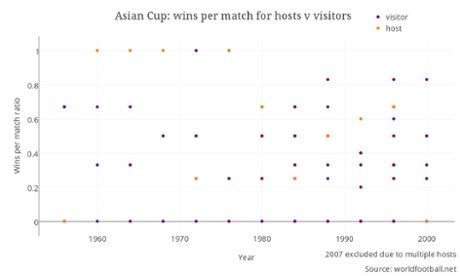
We can see in the early years, host nations generally did well, but since the late 1980s the advantage has dropped off somewhat.
So, while there’s still an advantage there, it looks like it has become harder for the hosts to win.
First of all, the tournament has evolved significantly. In 1956, Hong Kong welcomed just three other teams to the inaugural contest: Israel, South Vietnam and winners South Korea. Even in 1992 there were only eight teams involved, and the current tournament is just the fourth time there have been 16.
Then there is the arrival of Japan to take into consideration. The Samurai Blue snuck in to their first Asian Cup on goal difference in 1988. Four years later, as hosts, they took out the competition, and have been almost unstoppable since.
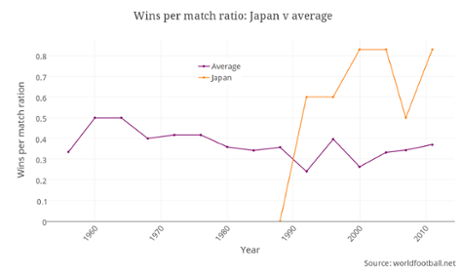
It was the first of four titles they would pick up in the six tournaments that followed. When they beat Australia in Qatar four years ago, they overtook Iran and Saudi Arabia to become the confederation’s most decorated team.
The other factor in this recent trend is the identity of the hosts. Between Japan 1992 and Australia 2015, the Asian Cup has been hosted by a range of mid- and low-ranked nations: the United Arab Emirates, Lebanon, China, Qatar and, in 2007, a cohort of South-East Asian nations.
While many have experienced a boost due to home ground advantage, most haven’t managed to clinch a tournament win.
This chart shows the wins-per-match ratio for countries that have played both home and away tournaments in the Cup:
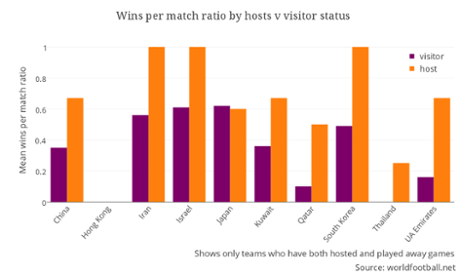
The biggest advantage was reaped by the Emiratis, who, as hosts of the 1996 Asian Cup, reached their one and only final. They made it all the way to penalties in fact, but were beaten in the shoot-out by their neighbours Saudi Arabia. They haven’t been a threat since.
Eight years later in China, the hosts once again made it to the final. It remains China’s equal-best performance. But despite always being a competitive nation, the home ground advantage wasn’t enough to help them take out their first title.
At the previous tournament, Qatar reached the quarter-finals, matching their best previous effort. They also hosted the tournament in 1988, and came close to progressing from a five-team group featuring Iran and South Korea.
Co-hosting has been the only way for Vietnam to get an invite, and the home-ground advantage got them all the way to the quarter-finals in their one and only appearance. Similarly, Lebanon’s only appearance was when they were hosts at the start of the millennium.
For Indonesia, co-hosting that 2007 tournament helped bring them closer than ever before to the knock-out stages, while for Malaysia, it got them into the Cup for the first time in almost three decades.
The other co-host in 2007, Thailand, could not trump the third placing they achieved in 1972 - the year they alone hosted the Cup. (Though that was a tournament with only six teams.)
Which brings us to Australia. Almost. First, the team we’ve hardly spoken about: Saudi Arabia. They’ve never hosted the tournament, yet have won it three times. Along with Japan, they are the only team capable of winning away from home repeatedly (though it has been a while, and it won’t be happening this time around).
Australia went in to this current tournament ranked 100th in the world, and 10th in Asia. Of the four nations who represented Asia at the recent World Cup, Australia could become the first not to win the tournament at home.
If there’s a home ground advantage to be had, they’ll need every bit of it.













