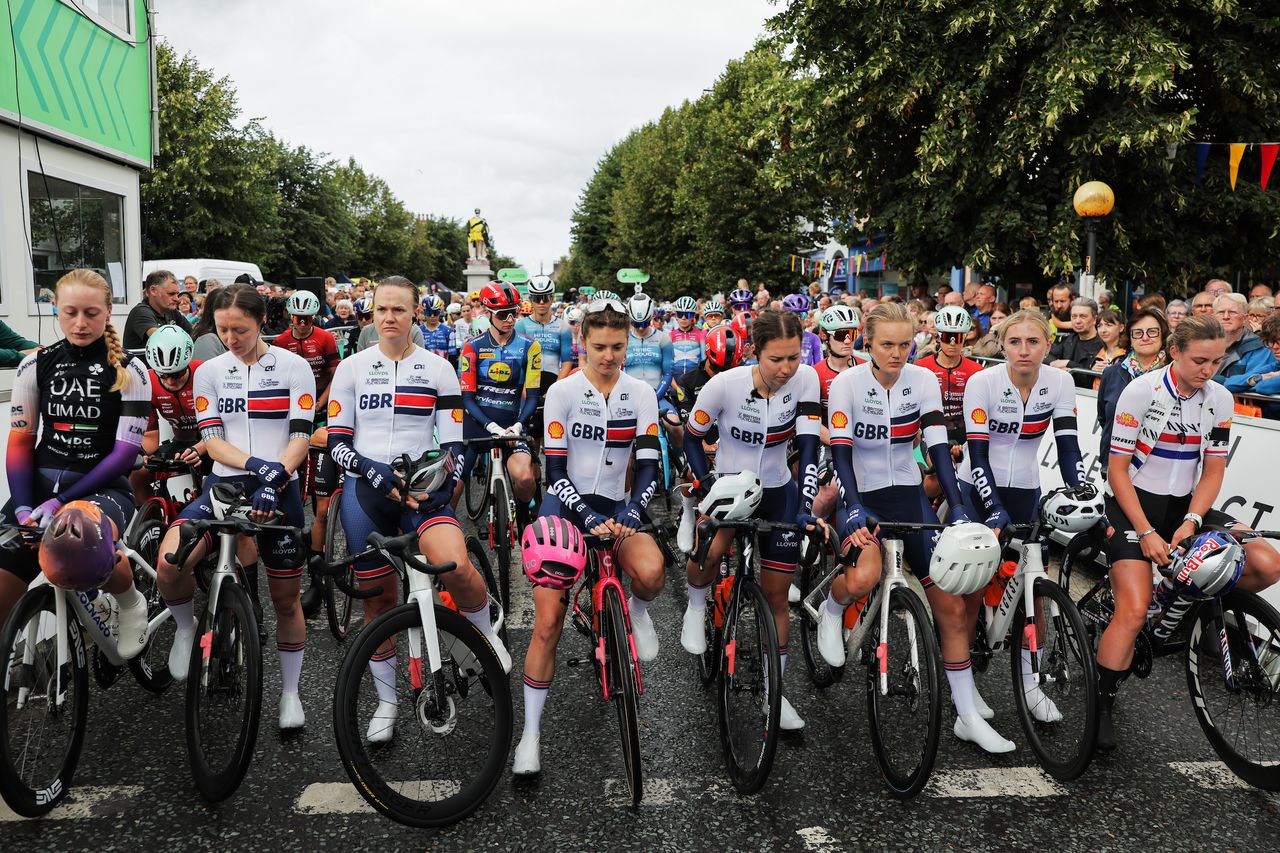
After the death of 19-year-old British rider Finlay Tarling at the Volta a Portugal last week, sports directors and race organisers at the Lloyds Tour of Britain Women have called for improved safety standards across the UCI calendar.
Sports directors Lars Boom and Magnus Bäckstedt, along with the Tour's race director Alice Wood, spoke to Cycling Weekly at the beginning of the 2026 edition, where a minute’s reflection and applause was held before the start of stage one in the Cumbrian town of Cockermouth.
Each called for greater safety while recognising the complexity of regulating elite road racing across the globe.
“More can always be done in terms of safety, that's always going to be the case, we can always push more and do more to improve the safety of the bike race,” said Human Powered Health sports director Bäckstedt. His daughters Zoe and Elynor – both in WorldTour teams and competing at the Tour of Britain Women – raced alongside Finlay Tarling and and his older brother Josh (Netcompany-Ineos) as youngsters in Wales.
“I think we're in a position where we're never going to be able to do things fast enough, and when tragedies happen we always go, ‘We should have thought of that, we could have done that.’ It's always a what if, and I think definitely more can be done and should be done, but it's how we do that.
“Ultimately, road racing, we're always going to deal with traffic, we're always going to deal with the road conditions, speeds are always going to be high, that's just the reality of the sport and unfortunately with all those combined, very unfortunate accidents do happen.
“But it shouldn't take our focus away from pushing to improve the safety and improve the courses and make sure that we have the safest courses possible available. We don't always need to go up the steepest climbs and down the steepest descents. The road: is it wide enough to put 160 bike riders on it? All these questions. We can always do more.
“Unfortunately, accidents do happen and it's a tragedy when they do.”
A former rider’s turned race director's perspective
Former WorldTour racer Alice Wood has taken on race director responsibility for the Tour of Britain Women this year, having retired from professional racing in 2024.
She says that she has been able to bring a rider’s perspective to the race organisation, with a particular focus on protecting dropped riders, having experienced the danger of traffic on the course during her career. British Cycling has increased its investment in marshalling and safety vehicles this year for both the women's and men's Tours of Britain.
“The safety of the riders is what's really important and we need to make sure that we're keeping the back of the race safe as well, obviously with what happened last week with Fin Tarling,” Wood told Cycling Weekly before the start of stage one.
“When I was racing it was something that I was always thinking about. I was dropped too many times, so I was one of those riders that was distanced… Unless we are the Tour de France, where you can shut down roads and have full road closure, you can't cover every road, every junction, every farm track, every driveway. It's really difficult to do.
“We have more resources than we've ever had on the race and that will have to improve year on year because there's more that's coming into play. There's more traffic furniture, there's more drivers, there's also unfortunately more ignorant drivers as well, so we just need to make sure that the riders are also aware.
“When I took up this role that was something I was thinking about the most... It's something that we'll never stop talking about.”
Consistency
Each nation where racing takes place has its own style of road, differing road furniture and changing attitudes towards bike racing.
A major challenge for the UCI to tackle as it looks to address road racing safety concerns is to enforce its regulations across these varying contexts says FDJ United-SUEZ sports director Lars Boom.
“I think in some countries we are, in some countries we aren't. And I think that's the whole point,” told Cycling Weekly when asked whether enough is being done to improve safety standards.
“I think you see many countries and many organisations try to do everything to make it really, really safe. They block the road with volunteers and stuff like that. Also, in some races that sometimes doesn't happen.”
“Also [there are] some moments that things happen, that there's a car coming on the road…You can say a lot about it, but it's really, really terrible that it happened, of course, [but] it always can happen. It's difficult.”