
One of the biggest stories in gaming this week was the news that a £656 million (roughly $900 million) lawsuit Valve is facing in the UK has been given the go ahead by the Competition Appeal Tribunal. The case was initially filed in 2024 by the digital rights campaigner Vicki Shotbolt, with Valve trying to get it thrown out since. Ultimately, though, it can now move forward per the new ruling.
Specifically, the lawsuit zeroes its crosshairs in on Valve's PC game distribution platform Steam, with Shotbolt accusing Valve of "rigging the market and taking advantage of UK gamers" by pressuring game developers and publishers to never sell their games for lower prices than the ones they're available for on Steam.
This, Shotbolt argues, helps Valve maintain Steam's dominant position as the most popular PC gaming storefront, "shutting out" and limiting potential competition from other retailers like the Epic Games Store and GOG. She's also taken issue with the fact that Steam versions of games are only compatible with Steam versions of DLCs and add-ons, which discourages players from purchasing extra content on other platforms.
As a result, Valve can charge developers what Shotbolt calls "excessive" 30% commission rates on all game sales, which has allegedly driven them to make their games more expensive to offset that cost — ultimately resulting in a worse deal for players. Thus, the case is a collective action claim that represents 14 million Steam users in the UK, and seeks to "help people get back what they are owed."
When I covered this story earlier this week, I put up a poll asking you, our readers, if you think the way that Valve runs its Steam business is anti-competitive or not. And though I've left it open for continued voting, the results thus far have made what you think loud and clear:
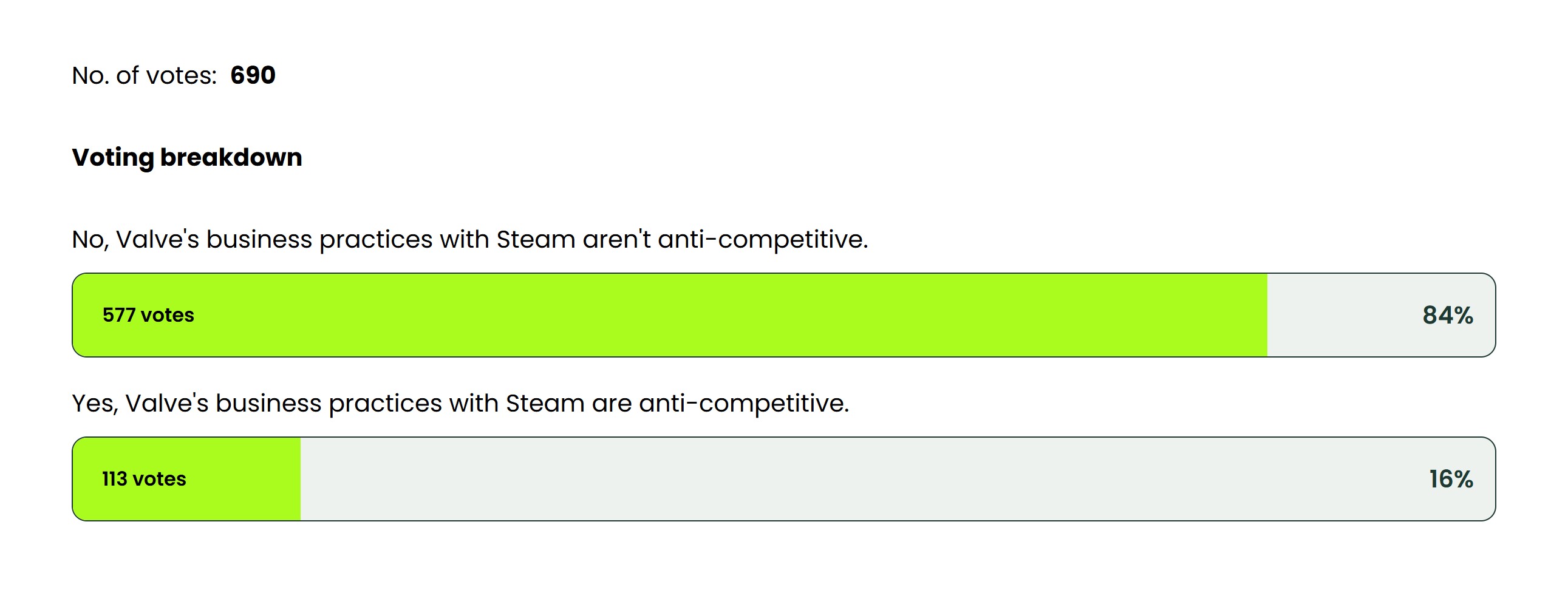
At the time of writing, 690 of you have voted in that poll — and 577, a whopping 84%, believe that Valve's Steam business practices aren't anti-competitive, and that Shotbolt's case against the publisher doesn't hold any weight. 113 hold the opposite view, and support the arguments she's made against the firm.
That's a significant difference, and it suggests that the lawsuit against Valve won't have much public support from PC gamers. Of course, public opinion isn't what determines final rulings in court cases, but I do think the fact most of you believe the case is weak indicates Shotbolt has a very uphill battle to fight.
For one, it will have to be proven that Valve enforces price-parity clauses, or undergoes some sort of process to significantly pressure developers into not offering better prices on platforms besides Steam. No such policy is listed publicly; Valve only requires that devs offer equivalent deals on Steam "within a reasonable amount of time" if they run discounts on Steam keys on different stores. Considering Steam is still the platform the game will be played on, that seems perfectly reasonable.
I imagine it will also be extremely difficult for Shotbolt to argue against Steam games only working with Steam DLC, as this is a limitation shared across other big PC platforms like GOG and the Epic Games Store (as well as the console market). The 30% commission rate Valve charges is also used by GOG, which means Steam's fee doesn't exactly stand out.
With all of that said, this case has been backed by the Milberg London LLP law firm that's "defending the rights of victims of corporate wrongdoing," and there was enough here for the Competition Appeal Tribunal to give it the green light to continue. Shotbolt and her partners could have a decent chance of winning, which may yield compensation for the aforementioned 14 million Steam users in the UK.
For now, all we can do is wait. We may not see further developments in the case for a long time, but its potential ramifications are huge, so it's definitely one to watch.

Where do you stand on this debate? Do you agree with the case against Valve that its Steam business is anti-competitive, or do you think the way it's running things is fine? Let me know in the comments, and add your vote to our poll below.

Follow Windows Central on Google News to keep our latest news, insights, and features at the top of your feeds!