It was when Wayne Rooney was going over his previous 99 caps, some exhilarating highs and a few excruciating lows, that he stopped to go a little further back and revealed there was a time when he nearly called a halt to his football career before it had really even begun.
He was 14, with the keys to the football universe, yet prone to the occasional moments of impetuousness that he has never really lost from his character. At Everton’s centre of excellence Rooney came to think that one of the coaches had it in for him. One day he was asked to help out in defence. Rooney refused and lost his temper. That night he went back to the house in Croxteth, Liverpool where he had Everton pennants in the bedroom window and posters of Duncan Ferguson on the walls and told his mum and dad, Jeanette and “Big Wayne”, he was not going back.
“I can remember my dad was upset with me, but I’d stopped enjoying it,” Rooney recalls. “At that age I just wanted to play football. And then you start getting told what different things you need to do on the pitch, and learning the tactics of the game. I was being told things I didn’t want to do. I just felt it was too much and, yeah, I remember going home and telling my dad that I didn’t want to go any more.”
Looking back, he says it was “probably my fault and the coach’s dislike of me was all in my head”, but Rooney was deadly serious when he said he was prepared to walk away. It is why, when you ask him about the biggest influences on his professional life, the first name he picks out is Colin Harvey, then Everton’s youth-team coach.
“He sat me down and made me fall back in love with it,” Rooney recalls. “He said he had seen so many players throughout his career but no one with my talent and that I would be making a mistake. He said he would always be there to help and support me and ‘if you keep working hard, you will be in the first team a lot quicker than you think.’ That’s when I said to myself: ‘This is what I want to be doing.’ That’s when I stopped going to boxing and focused solely on football.”
Wayne Sr started out as a butcher’s boy and eventually became a labourer. Jeanette was a dinner lady at De La Salle, the school her children went to. Rooney sometimes wonders what he might have done had it not been for football. “I suppose I just have to look at what my friends are doing. Some are landscaping. Some are builders.” Boxing? “I would have tried it, yes, but boxing is so difficult I wouldn’t have pinned anything on that.”
His life would certainly have been vastly different. Before England take on Slovenia at Wembley, Sir Bobby Charlton will award him with his 100th cap. Rooney will have “100” stitched into his boots and his children, Kai and Klay, will accompany him on the pitch for the presentation. Back at his home in the village of Prestbury, Cheshire, a place has already been set aside for the latest souvenir of his career. “I’ve got a room in my house where I keep my shirts and boots and other stuff,” he says. “The first thing you see when you go in are my Premier League medals. They’re on a mannequin in a Man United shirt. Then there’s a glass cabinet underneath with all my England caps in.”
Someone asks how big this room is and Rooney looks around him. We are in the Sir Bobby Robson Ballroom at St George’s Park and, to give you an idea of its size, the table alone has 24 chairs. “Probably this size,” he says, “but split between upstairs and downstairs. It’s something I’m very proud of.” And he smiles, albeit nervously, when someone asks if we journalists can pop over.
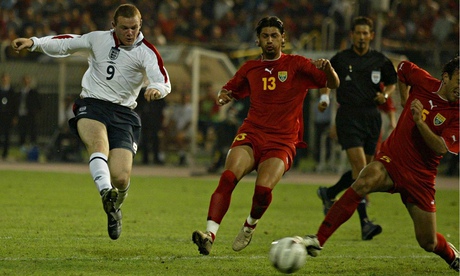
Yet there are glimpses of hurt, too. Ask him to select his favourite three goals and he selects his first one against Macedonia in September 2003 and another two, against Switzerland and Croatia, from Euro 2004. Nothing, in other words, from the last 10 years. His happiest memory? That was Euro 2004 as well. “A great experience for me, to go at such a young age, start all the games, score four goals. That’s still the high.”
However, every tournament since has brought him regret. “The first one was great. The others have been disappointing. I feel I could have done a lot better. I wanted to do better but it just hasn’t happened.” Steven Gerrard rated his England career six out of 10 when he reached 100 caps. Rooney is reluctant to be so precise but he, too, is slightly downbeat. “I can’t say it’s a three or an eight; you just have to look at how successful we have been and we haven’t been successful.”
The game that still makes him wince goes back to the 2006 World Cup. “The low was definitely the red card against Portugal in the quarter-finals. I still believe to this day that if I’d stayed on we would have won the game. I was in the dressing room watching the rest of the game [on television] and it was so difficult to watch knowing no matter what happened that my tournament was over. Obviously we didn’t go through, and that made it even worse for me. You start thinking: ‘Is it my fault that we haven’t gone through?’ That was a really tough moment.”
That was the game when Cristiano Ronaldo harangued the referee to show a red card for Rooney’s stamp on Ricardo Carvalho, then winked to the Portuguese dugout. What had Rooney said to his Manchester United team-mate? “I spoke to him straight after the game because I knew which way the press were going to go in terms of ‘we’d fallen out’, and we had to make sure that that didn’t happen for United’s sake. There was never an issue for me [with Ronaldo]. I understood why he did it. He was trying to win for Portugal, and I’d probably have done the same if it was the other way round.”
Wait a second – is Rooney saying he would try to get an opposition player sent off? “Probably him, yes! I remember in the first half, I was trying to get him booked, saying to the referee that he was diving, and trying to get him to give a yellow card. It does happen.”
Rooney’s contribution in the next World Cup is probably best remembered for his outburst after the team were jeered off against Algeria in Cape Town. That, he says, was probably the most embarrassing moment of his international career. “Sometimes it’s tough because, no matter what people say, we do care about playing for England. When things aren’t going right, it’s frustrating because we know we can do better. Sometimes it boils over, the frustration. That’s what happened. It’s certainly something I regret.”
Fabio Capello would later explain Rooney’s indifferent England performances on the basis that Sir Alex Ferguson’s player “only understood Scottish”. Rooney looks bemused: “Me?” Capello, he says, was the one with the language barrier. “He was Italian, all the staff were Italian … sometimes it is a bit more difficult that way than when it’s an English manager.”
It has been a “tumultuous” England career, to use Roy Hodgson’s word. Yet Rooney’s achievements are still considerable and – though he acknowledges it is different to his comments before the last World Cup, when he said 2014 “really is the last big one” for him– he still intends to be involved in Russia in 2018.
Billy Wright was 35 when he became the first England player to reach a century of caps in 1959. Charlton was 32, Bobby Moore 31, Peter Shilton 38, David Beckham 33, Gerrard 32, Frank Lampard 35 and Ashley Cole 32. Rooney turned 29 three weeks ago.
“It’s a great honour and I’m extremely proud,” he says. “It’s a special moment for me, but I don’t just want to be remembered as one of the players who gets 100 caps or more. I want to be successful, that’s the main aim. That would mean so much more than getting to 100 caps.”