It is the function of theatre to disturb. But, although it is powerfully written and imaginatively staged, I was made distinctly uneasy by this play by the 40-year-old Spanish dramatist Juan Mayorga. It indulges in fictive speculation about a subject best approached through documentary reality: Nazi genocide.
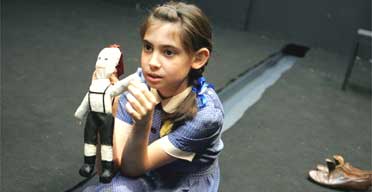
Mayorga's premise is that in 1942 the Nazis have created what is euphemistically termed a Jewish re-plantation zone north of Berlin. At first we hear an account it through a visiting Red Cross representative. He describes synagogues, schools, town-squares, children playing in sunshine. But everything has a theatrical quality. And subsequent scenes between the camp commandant and a Jewish interlocutor confirm that this social experiment is an obscenely scripted charade to which the only alternative is extermination.
But one has to ask oneself what Mayorga is saying. On one level his play is an attack on the familiar German duality in which high culture co-existed with barbarism: the commandant makes great play with his love of Shakespeare, Calderon and Corneille and, as we enter, we are each handed a choice volume from his library. By making us complicit in the spectacle Mayorga also implies that we all share in Holocaust guilt; and it is historically true that, even when the facts of Jewish extermination became known in 1943, the world was slow to react.
Mayorga's arguments, as translated by David Johnston, may be valid. It is the means employed that make me uneasy. By suggesting that aid agencies and others might easily have been fooled by the creation of show-camps, Mayorga overlooks the furtiveness that was a vital part of genocide. And, although he shows Jewish prisoners being coerced into participating in this grisly ritual, their ultimate failure to rebel could be construed as criticism. Director Ramin Gray and designer Miriam Buther make intelligent use of the enclosed space; and Dominic Rowan as the commandant, Richard Katz as the Jewish go-between and Jeff Rawle as the Red Cross man all give soberly judged performances. But, although the play disturbs in its suggestion that all humanity is implicated in the most hideous crime of the 20th century, a work like Primo Levi's If This Is A Man makes this kind of theatrical fantasy redundant.
· Until July 9. Box office: 020-7565 5000.