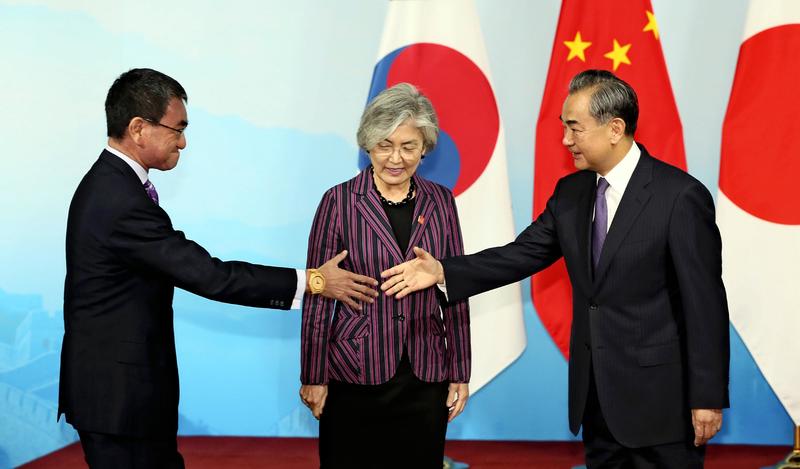
BEIJING -- Foreign Minister Taro Kono and his South Korean counterpart Kang Kyung-wha confirmed at their meeting in Beijing on Wednesday that they should resolve their differences through dialogue to prevent the current situation from deteriorating further.
But it will not be easy for both sides to compromise, and mutually acceptable ways to resolve pressing disputes have yet to emerge.
The bilateral relationship has been worsened by the South Korean Supreme Court rulings that ordered some Japanese companies to pay compensation for former requisitioned workers, and Japan's tightened export controls on shipments of some goods to South Korea. It was the first meeting in about three weeks between Kono and Kang.
Kono, who greeted Kang outside the room where they held the meeting, smiled as they shook hands, but Kang's expression remained unchanged from beginning to end. Even when Kono spoke to Kang in English, she did not reply. After the meeting, Kang left the venue with a stern face as if she was avoiding questions from reporters.
Kono, for his part, repeatedly emphasized, "We share a belief that the [requisitioned workers] issue must be resolved," and indicated his policy of seeking to continue communicating with the South Korean side through diplomatic authorities.
A senior official of the South Korean government also said, "Even if there is no concrete progress on the details, it is important to earnestly restore dialogue on issues including the export controls."
ROK approach in spotlight
The Japanese side had been closely watching for any signs of change in the South Korean side's approach at this meeting. This was because a slightly softer line toward Japan was observed on the South Korean side, such as in President Moon Jae-in's speech on Aug. 15 in which he refrained from criticizing Japan and called for dialogue with Tokyo.
According to a source accompanying Kono, the South Korean side did not single out Japan for criticism during the trilateral meeting between Kono, Kang and Chinese Foreign Minister Wang Yi held before the bilateral Japan-South Korea meeting. Earlier this month, during a meeting of foreign ministers from the Association of Southeast Asian Nations and other nations, the South Korean foreign minister had repeatedly blasted Japan.
"The tone clearly changed this time," the source said.
The Japanese government will implement Wednesday a Cabinet order to remove South Korea from the so-called white list of countries that can receive preferential treatment for streamlined export procedures. However Japan is also trying to restrain its actions, and it will grant approval for a second shipment to South Korea of materials used to produce semiconductors since export controls on these items were tightened in July.
Putting the brakes on
It appears South Korea's main focus at the latest round of talks was also to put the brakes on the increasingly intense wrangling.
According to a Japan-South Korea diplomatic source, the South Korean side is considering a new proposal designed to settle the requisitioned labor issue, and is carefully trying to figure out a suitable time to present the proposal.
Analysts believe that the Moon administration is concerned about the bigger-than-expected slowdown in the domestic economy caused by Japan's tighter export controls and other factors, which could work against him in next year's general election.
On Wednesday, Kim Sang-jo, chief policy secretary for the South Korean president, said the enthronement ceremony of the Emperor on Oct. 22 would be the "most important point," as it is expected to be attended by a senior South Korean government official.
"Both nations will strategically seek out ways [to resolve their problems] before then," he said.
Once that occasion has passed and as the year-end approaches, it is possible that legal procedures could start under which the assets of Japanese companies that lost in the South Korean court cases will be turned into cash for compensation to former requisitioned workers. Should the situation develop to the stage where Japanese companies' assets are forcibly sold off, the Japanese government would have no option but to take retaliatory measures. A flare-up of the antagonism between Japan and South Korea would be unavoidable.
Moon upending earlier positions
Previous South Korean governments have agreed with the Japanese side's position that the issue of compensation for former South Korean requisitioned workers was fully resolved by the 1965 Agreement on the Settlement of Problems Concerning Property and Claims and on Economic Cooperation between the two countries. But the Moon administration respects a South Korean Supreme Court ruling in October 2018 that concluded the issue was "not resolved," to the extent that Moon effectively revised previous governments' interpretations of this position. This is likely a nod to his left-wing supporters who take a tough line on Japan over historical issues.
Read more from The Japan News at https://japannews.yomiuri.co.jp/