Swathed in forensic tape and policed by stern men in decontamination suits, the ponds in my local park looked like a crime scene. Which is what they indeed were, but not of the sort we’re accustomed to in the east London borough of Hackney.
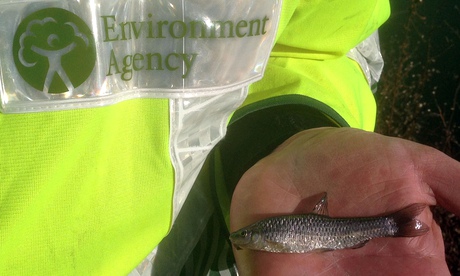
Pinned to the barricades were signs warning: “Invasive fish eradication in progress”. The criminal was the dastardly topmouth gudgeon; its victims the innocent legions of native water life that this small silver fish has been endangering in its relentless Darwinian race for domination of the UK’s waterways.
A government statement reported the operation triumphally. “The Environment Agency has moved one step closer to winning its war against a tiny yet destructive invasive fish,” it crowed. “Expert fisheries officers, kitted out in specialist protective gear, were onsite for this latest operation.”
A decade ago the topmouth gudgeon had 23 strongholds across the UK, but it’s now been battled back to three sites. So this Asian interloper, which could pass itself off as a sardine in a piscine identity parade, is on its way to joining the fathead minnow and the black bullhead catfish as unwanted immigrants that have been successfully eliminated since 2008.
The problem with this particular species of gudgeon is that it breeds at four times the rate of native fish, spreading parasites and beating them to food and habitat, adding insult to injury by eating their eggs. How did they get here? “Ornamental fish shops used to stock them. They were probably dumped,” said a worker in fluorescent waders, as his colleague flicked a fish net at a small silver corpse floating on the organically poisoned water.
Overhead, grey squirrels (a late 19th century import) scampered through the branches of trees blighted by horse chestnut leaf miner (arrived 2002); higher still, ring-necked parakeets screeched through the sky, trailing urban myths as exotic as their emerald plumage. My favourite is that their ancestors were escapees from the set of the Bogart/Hepburn film The African Queen at Isleworth Studios in 1951.
A striking feature of this sort of alien invasion – not only in Britain but all over the world – is how many are attributable to people with more money than sense. The grey squirrel was introduced to the UK as an adornment to country estates. In France, thousands of kilometres of Napoleonic canal walls are being gnawed away by the coypu, a beaver-like creature imported from South America for its fur. From the Americas to southern Africa, the humble Scotch broom has become public enemy No 1 after escaping from the farms and gardens of wealthy 19th-century settlers, presumably nostalgic for the bonny yellow heathlands of home. It’s a satisfying irony that pests imported at the whim of the rich now provide employment for the poor as the battle to contain them rages.
Reading by numbers
My segue from topmouth gudgeon to global capitalism can probably be blamed on the fact that I’m a judge of this year’s Orwell prize. Now in its 21st year, it was set up by the late Bernard Crick “to encourage writing in good English – while giving equal value to style and content, politics or public policy, whether political, economic, social or cultural – of a kind aimed at or accessible to the reading public, not to specialist or academic audiences”. Phew! This year the 200 titles submitted have already been whittled down to 50. Two crates of books have thumped down on my doorstep. Years of judging prizes have taught me the value of meticulous sorting. So, I can tell you there are seven political biographies, five novels, nine books about foreign affairs, 12 history tomes, 14 I’ve classified as “state of the nation”, and a couple I’ve assigned to “miscellaneous”. Now all I have to do is read them.
On the shelf
A YouGov report last week showed that, far from aspiring to be actors or musicians, 60% of British people would like to be authors, and 51% to be academics. Eat your heart out, Simon Cowell: the most enviable people in the country are those whose work is currently spread across my sitting-room floor. But the depressing discovery is how many, even in this elite selection, have yet to receive any attention at all. If the books average 80,000 words and there are 50 of them, that is 4m words in search of a reader.
• This article was amended on 26 February 2015. An earlier version described the coypu incorrectly as a “large beaver-like rat”; it is not a rat.