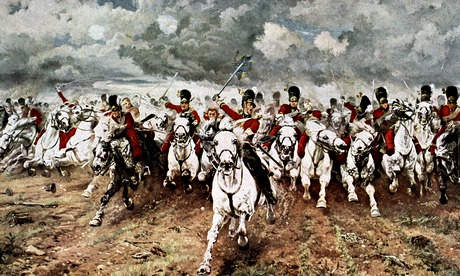
It has taken 200 years, but Britain is finally getting round to handing out the medals it commissioned to recognise the role played by the four allied sovereign powers in defeating Napoleon.
Described by the Royal Mint museum as “a triumph of medallic art and a masterpiece of engraving skill”, the Waterloo medal was commissioned in 1815 by the Duke of Wellington to mark the end of the Napoleonic wars, but was never produced. Almost 140mm in diameter and designed by the chief medallist, Benedetto Pistrucci, an Italian immigrant with a fiery temperament, its mammoth dimensions and the complexity and intricacy of its design meant it took 30 years to finalise the dies needed to make it. By the time Pistrucci had completed the work, all the sovereigns of Britain, Austria, Russia and Prussia who had been due to receive the medal had died. Another problem was the lack of available technology to produce them in solid gold, as Pistrucci had dictated.
Now, with the 200th anniversary of the battle coming up next June, the medals will be presented this Tuesday – 11 November – in a special unveiling ceremony at Apsley House, Wellington’s London home at Hyde Park Corner. Created by the Waterloo 200 Committee, a charitable body formed in 1973 to stop the building of a motorway across the battlefield in Belgium and which now has a remit to promote interest in the battle, they will be presented by the Marquess of Douro, son of the 8th Duke of Wellington, and Sir Evelyn Webb-Carter, who is chair of the committee.
They will be given to the ambassadors of the allied nations – Russia, Austria and Germany in the case of Prussia. Angela Pistrucci, a descendant of Benedetto, the 8th Duke of Wellington and a representative of the Belgian Waterloo Committee will also receive medals.
The decision to hold the presentation on Armistice Day is seen by the committee as a timely reminder of the need to honour those who died in battles outside the two world wars. Waterloo saw appalling carnage because the fighting was at such close range. Historians suggest the density of the bodies after the battle was 20 times that after the first day of the Somme.
“Waterloo can’t compete with the first world war,” said David Martin, a director of the committee. “In some ways it’s unfortunate that the 200th anniversary coincides with first world war anniversaries, but around 10% of the population at the time – some one million people – were somehow involved, many because they had joined the local militias, and this is in danger of being forgotten.”
The medal ceremony is one of a series of events designed to raise the profile of Waterloo and bring in funds to help the charity raise awareness of the battle. It is behind plans to restore a farmhouse on the battlefield and to erect a proper monument to the British soldiers who died there.
“I am often asked whether we should not now, in these days of European unity, forget Waterloo and the battles of the past,” the 8th duke explains on the Waterloo 200 Committee website. “My reply is, history cannot be forgotten, and we need to be reminded of the bravery of the thousands of men from many nations who fought and died in a few hours on 18 June 1815, and why their gallantry and sacrifice ensured peace in Europe for 50 years.”Historian and presenter Peter Snow, a patron of the Waterloo committee, who will attend Tuesday’s event, said it was important to remember what happened 200 years ago. “If there’s one moment in history – other than the defeat of Hitler – that every citizen of Europe should be encouraged to commemorate, it’s the day the battle of Waterloo decided the shape of our continent for a hundred years,” Snow explains on the website.
Tuesday’s presentation will fulfil a commitment that was delayed largely due to Pistrucci’s awkward personality. As a foreigner, he could not be appointed chief engraver at the Royal Mint, something that rankled throughout his life. Fearing his behaviour would see the Royal Mint sever its association with him as soon as he handed over the dies, he deliberately stretched out their completion. His fears were justified. When they were finally finished, his association with the Royal Mint came to an end. He died shortly afterwards at Englefield Green, near Windsor, in 1855.