We’re going to close out our live coverage of today’s Mars water announcement with an audio clip from Nasa’s Dr Jim Green. Speaking at the press conference in Washington DC, he described how our understanding of the red planet is changing.
Thanks for being with us today for this news, which may just make sending astronauts to Mars a lot easier.
Updated
Summary
So the news is that there is flowing water on Mars. The evidence comes from dark streaks that appear on the surface of the Red Planet. These have been known about for many years because the landscape has been seen to change on successive images taken by spacecraft orbiting Mars. Although flowing water has always been a possibility for their creation, other ideas such as the movement of dry ice (carbon dioxide) or the action of the wind, could not be ruled out.
Now, however, strong evidence for them being driven by water has been collected by an instrument called CRISM on board Nasa’s Mars Reconnaissance Orbiter. It has seen the signature of salts known as perchlorates in the dark streaks. These indicate that flowing salty water is responsible for the markings.
In light of this discovery, the search is on for finding where this Mars water is coming from, how it finds its way to the surface and how much of it is down there? There is much we do not know: previous radar studies from Europe’s Mars Express spacecraft had come up empty handed when looking for underground aquifers of water. So where is the water hiding?
Nevertheless, the news that there is (occasionally) flowing water on the surface of Mars boosts the chances of using it to support astronauts when we launch a crewed mission to the Red Planet.
This new discovery is likely to change the focus of future Mars exploration by influencing decision makers to focus on how to safely land near areas where liquid water may be close to the surface.
Today’s announcement may not be lakes and rivers, but even small amounts of flowing water on Mars is big news. Not that many years ago, the place was thought to be the most arid desert imaginable.
Grunfeld’s final message at the press conference is that science drives exploration and so “please stay tuned to science.”
McEwen: This water is much much more salty than than in Earth’s oceans. It is distributed probably in thin layers of wet ‘soil’.
Similar streaks to those being seen on Mars can be found in Antarctica but looking the same doesn’t mean it is the same, says Michael Meyer, lead scientist for the Mars Exploration Program at Nasa Headquarters.
True, very true...
This salty water is all very well but it makes an awful cuppa. #bringmehome
— Beagle2 (@LonelyBeagle2) September 28, 2015
Grunsfeld explains that the slopes on which the dark streaks are visible are steep; too steep for current rovers. But not to steep for astronauts he says with a wishful smile.
Grunsfeld explains that just because there is water on Mars does not make it easy to grow crops. The challenge there is pressure, the Martian atmosphere is far too thin. But if you could build a Martian greenhouse and then tap the water, you could be in business.
Dr Joe Michalski, Mars researcher at the Natural History Museum in London, where he is part of a world-leading research team investigating the origins of our planet and Solar System, comments on the Ojha et al. Nature Geo paper “Spectral evidence for hydrated salts…”
These results provide strong evidence that salty water occasionally flows on the Martian surface, even today. We know from the study of extremophiles on Earth that life can not only survive, but thrive in conditions that are hyperarid, very saline or otherwise “extreme” in comparison to what is habitable to a human.
In fact, on Earth, wherever we find water, we find life. That is why the discovery of water on Mars over the last 20 years is so exciting. We have found water in ice form, in permafrost, and in the structures of many types of minerals.
This finding is yet another example of water on Mars, but a hugely important one because it points to environments that could potentially be habitable to certain kinds of bacteria, even today. In addition, the discovery of active geological and hydrological processes elsewhere in the Solar System underpins the point that these other worlds are actual places one could visit, where nature is happening every day.
Updated
Nasa’s planned 2020 rover will carry an instrument to test ISRU (In-situ Resource Utilization). This instrument is directly related to testing how easily astronauts may be able to live on Mars.
John Grunsfeld, associate administrator for the Science Mission Directorate, Nasa, sounds optimistic that finding ‘resources’ such as water will make sending astronauts to Mars easier.
Updated
Jim Green, director of planetary science at Nasa Headquarters, is explaining that the spacecraft currently at Mars will allow them to zero-in on more and more interesting places to investigate on Mars.
Pictures
Pictures released by Nasa show the dark, narrow streaks that scientists say are formed by the flow of briny, liquid water.


There are three spacecraft planned to go to Mars in the next three years: One of these is the European Space Agency’s ExoMars rover, which will drill into the surface to look for evidence of life on the red planet.
Updated
Alfred McEwen, principal investigator for the High Resolution Imaging Science Experiment (HiRISE) at the University of Arizona in Tucson, says that he thinks the chances of [microbial] life on Mars is very high.
Mary Beth Wilhelm of Nasa’s Ames Research Center in Moffett Field, California says these salts have been found in many locations. “These vital perchlorates have been found at many of the landing sites on Mars. They may be more widespread than first thought.”
She says that it is too early to assess the implications for life on Mars, however.
It does, however, spur the need for further astrobiological investigations.
Updated
Scientist Lujendra Ojha is now explaining to the press conference that the presence of perchlorate salts allows water to stay liquid at lower temperatures.
Alfred McEwen, a senior author on the study, told our science editor Ian Sample that it is not clear where the water is coming from.
Where the water comes from remains a mystery. It has to come from either the atmosphere or the ground, or both, via shallow ground ice, but there are problems with both ideas. It could even be water liberated from certain hydrated minerals that contain a lot of water, such as polyhydrated sulfates, which do exist on Mars but not in association with most RSL [gully-like features]. I’m favoring the idea that it comes from the atmosphere, trapped by deliquescent salts such as perchlorates and chlorides.
Updated
It seems like Nasa may have broken the Internet with this one. The livestream is not connecting for many. Some news via Twitter though:
“The journey to Mars just got a whole lot more fascinating,” NASA’s Dwayne Brown says to kick off the press conference.
— Jeff Foust (@jeff_foust) September 28, 2015
Updated
So the news is that dark streaks on the surface of Mars have been analysed and are showing evidence of having been created by salty water. Clearly the next question is how much water lies under the surface of Mars?
You can count on Twitter:
I'm assuming that's it's too early to say whether those Martian water zombies from Doctor Who are responsible. #Mars
— SDSO (@darkskyobs) September 28, 2015
Updated
Nasa scientists find evidence of flowing water on Mars
The announcement to elaborate on these findings takes place very soon. We’ll be covering all additional details on this blog as they happen.
And here’s science editor Ian Sample’s report of Nasa’s announcement confirming the speculation:
Liquid water runs down canyons and crater walls over the summer months on Mars, according to researchers who say the discovery raises the odds of the planet being home to some form of life.
The trickles leave long, dark stains on the Martian terrain that can reach hundreds of metres downhill in the warmer months, before they dry up in the autumn as surface temperatures drop.
Images taken from the Mars orbit show cliffs, and the steep walls of valleys and craters, streaked with summertime flows that in the most active spots combine to form intricate fan-like patterns.
Scientists are unsure where the water comes from, but it may rise up from underground ice or salty aquifers, or condense out of the thin Martian atmosphere.
“There is liquid water today on the surface of Mars,” Michael Meyer, the lead scientist on Nasa’s Mars exploration programme, told the Guardian. “Because of this, we suspect that it is at least possible to have a habitable environment today.”
Full story here.
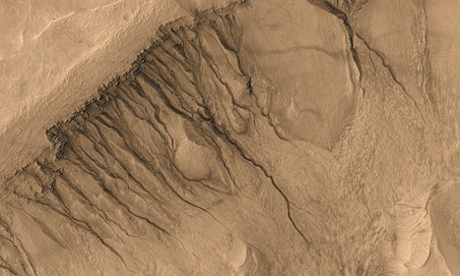
Back in 2003, Nasa revealed images from Mars Global Surveyor that showed what they said looked like ‘fresh rain gullies’ on Mars. At the time, Philip Christensen, a professor at Arizona State University, said that he thought the gullies were formed by water melting under snow that had accumulated on the side of Newton Basin, a crater on the planet’s surface. An alternative idea was that water sometimes burst out from the interior of Mars, creating the gullies. Read what Nasa said at the time.
Not everyone agrees that the large-scale erosion features on Mars have been made with water. Giovanni Leone, ETH Zurich, Switzerland thinks that most of the features commonly interpreted as water-cut are actually lava channels. If so, Mars was never as Earth-like as we are commonly led to believe. His paper on the subject can be viewed here.
Mars water has been much in the news this year, and never more so than in March, when Nasa and colleagues at the European Southern Observatory (ESO) announced they had compelling evidence that a massive ancient ocean once covered nearly half the northern hemisphere of the planet.
Where is this water today? 13% is estimated to be now locked in Mars’s polar caps, meaning 87% must have been lost into space. Read the full story here.
General public interest in whether there is water on Mars has been a perennial interest since the the 1800s. In 1877, when Mars approached Earth almost as closely as it could (still a rather distant 56 million kilometres away), the Italian astronomer Giovanni Schiaparelli observed the Red Planet. He made maps of the surface features that he saw, including what looked like a network of channels.
Others made maps that appeared to show these channels as straight lines - leading to the speculations that they were artificially built canals.
American astronomer Percival Lowell championed the idea that Mars was the home of an intelligent civilization and the canals were the proof. He wrote books on the subject: Mars (1895), Mars and its Canals (1906) and Mars As the Abode of Life (1908). HG Wells also wrote the novel The War of The Worlds (1897) to imagine what would happen if the Martians gave up the fight to irrigate their dying planet and decided to invade Earth instead.
Analysis of Mars’s atmosphere, made with telescopes and spectroscopes, however showed that water vapour was not present in the Martian atmosphere, as would be expected if there were large bodies of standing water. Also, improving telescopes showed that the canals themselves were optical illusions.
Updated
Liquid water at the surface of Mars cannot be pure H20. If it were, it would rapidly evaporate because of the low atmospheric pressure on Mars, or freeze because of the low temperature. The surface temperature of Mars is usually less than –50°C.
Although the temperature may occasionally rise above freezing at noon, water on Mars would generally freeze rapidly unless it were salty because brines have a lower freezing point and slower evaporation rates. Various chemicals have been identified on the surface of Mars that could provide the salt content and lower the freezing point by many tens of degrees Celsius.
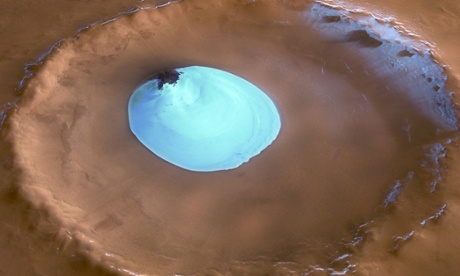
This image shows a patch of water ice on the surface of Mars. It was taken by the High Resolution Stereo Camera (HRSC) on board ESA’s Mars Express spacecraft back in 2005. The crater is approximately 35 metres across and sits near the Martian north pole. Rumours suggest that today’s announcement concerns liquid water being discovered at the surface of Mars.
There is a wide-spread belief that Mars once had rivers, lakes and even seas on its surface.
Nasa found evidence of water-cut erosion features on Mars back in 1972. It came from pictures beamed back from Mariner 9, the first spacecraft to go into orbit around the Red planet.
But getting that evidence back was a tense affair, as you can read in this story, because Mars was engulfed in a planet-wide dust storm.
In many ways, Mars is the most Earth-like of the other planets. It has a relatively clement surface (unlike Venus, where the temperature is hotter than a kitchen oven), and it has an atmosphere (unlike Mercury, which is barren and cratered like the Moon). The discovery of water at the surface of Mars would make it feel even more Earth-like. It would also raise hopes that perhaps microbial life could be found there.
Nasa once adopted the mantra ‘follow the water’, which is now gradually changing into ‘seek signs of life’. A place on the surface of Mars where liquid water can be easily accessed would be a great place to look for life.
Nasa’s overview of their Mars exploration programme can be read here.
Nasa will detail a major science finding from the agency’s ongoing exploration of Mars during a news briefing at 11:30 a.m. EDT (4:30pm BST) today.
It is widely rumoured to be the discovery of traces of water at the surface of the Red Planet.
News conference participants will be:
· Jim Green, director of planetary science at Nasa Headquarters
· Michael Meyer, lead scientist for the Mars Exploration Program at Nasa Headquarters
· Lujendra Ojha of the Georgia Institute of Technology in Atlanta
· Mary Beth Wilhelm of Nasa’s Ames Research Center in Moffett Field, California and the Georgia Institute of Technology
· Alfred McEwen, principal investigator for the High Resolution Imaging Science Experiment (HiRISE) at the University of Arizona in Tucson
Stay with us for on-going coverage and essential context around this announcement.