Participants:
LL Lucy Lamble
MDD Mamadou Diarafa Diallo
MM Maggie Montgomery
VB Vinima Baya
F Fatouma
BAM Boubacar Abida Maiga
BD Baka Diarra
EPA Elly Prosper Arama
DB Daniel Bouàré
AID Adama Issa Diarra
LL Welcome to this edition of the Global Development podcast. This month we’re in Mali.
MDD One of the biggest causes of child death through diarrhoea, through pneumonia and others is lack of access to water, water and sanitation and lack of hygiene.
LL A recent WHO report looked at water, sanitation and hygiene, also known as Wash in health centres. Mali was one of the worst performers.
MM This is a huge issue and, as as the report has detailed, we have upwards of almost 40% of facilities without any water access at all. And it became apparent that this was an issue that the health sector wasn’t necessarily addressing.
MDD The water is probably for two hours a day or three hours a day, so the rest of the time we ask, “So if you have to help a woman to deliver what will you do?” “We’ll still do it.” “So how?”
LL This is Lucy Lamble. And this month on the Guardian’s Global Development podcast we look at how health centres in Mali are affected by this problem. I visit the rural village of Diatoula and a clinic in the town of Kalabancoro; and I also go to a school in Bamako where they’re implementing a water and sanitation programme. But first let’s hear more from Mamadou Diarafa Diallo, country representative for WaterAid in Mali.
MDD In preparation of our water and healthcare facilities project I had visited a few healthcare centres. We went to this big CSRef [a referral health centre]; the CSRef is the second level healthcare facility where they do most of the surgeries. Basically they have water between 7am and 9am. After that no water. So they would just have some small bowls where they keep a little bit of water here and there. I just take care about water. We are not taking care about have you soap, or have you any other? Just simply having access to water. And when the head doctor took us to the latrines he said, “These latrines, I can’t go in. You can if you want to but I can’t go in.”
They are smelly because they are pit latrines – they are filled, with no resources to empty the pits. So I think it reflects what has been happening, what is really happening; because that’s not even at community level it’s a second-stage level of a healthcare facility.
LL So we’re just coming into the village now, Diatoula. It’s a rural community of about 1,000 inhabitants so quite a big community really.
Male speaker So this is the chief. They’ve come to say hello to you and they’re going to visit the village and also the health centre. So you are welcome here.
LL The health centre is staffed by just one pharmacist and one nurse who both live nearby. Vinima Baya is the centre’s nurse.
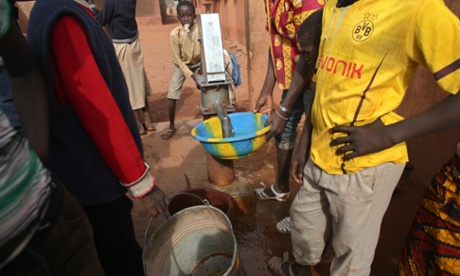
VB So generally all those who come to us are pregnant women; women who are ready to give birth and also malaria patients come to us a lot. When we need water we have to go to the traditional well which is far from here. Patients and pregnant ladies who come to us need to ask someone in their family to go to collect some safe water somewhere. They have to go to the well five times. We need five buckets of water for the work. Once we receive the water we clean the mother, we wash all her garments and then we try to clean the room. We also give her some water for drinking. I don’t know the number of latrines in the village but here in the health centre we have two. We have one where we go to wash ourselves and the other is just for our needs. There is no ladies; everyone uses both.
LL Maggie Montgomery is from the World Health Organisation.
MM That’s a really important time when infections can occur and there’s high risk to both the mother as well as the child in terms of delivering in an environment that doesn’t have clean tables, where those that are facilitating the birth aren’t using clean scalpels to cut the delivery cord. So there’s really high risk involved when these Wash services aren’t in place. And there’s of course all of the emotional and psychological issues of, as a woman, not having access to a toilet or not being able to wash yourself after this really important moment in your life.
F My name is Fatouma. I am 16 years old. I grow vegetables and sell them in the village here. I used to have a baby but unfortunately he died. When my baby died he was 15 days old exactly. I came with my family members. We had water because we had gone to collect it from the traditional well in the village so there was water at my disposal and I didn’t have any special complications.
MM So there was a new review that just came out last month, an individual bulletin that found upwards of 40% of newborn deaths are linked to sepsis and these are all, for the most part, preventable infections, many of which link to lack of water or safe hygiene practices.
F I noticed he was not feeling good. He didn’t eat anything, he didn’t drink anything, he couldn’t do anything. I tried to give him some traditional medication. And I could see black spots on his body. One day later he died. So it took only one day.
LL Boubacar Abida Maiga is the WHO Wash consultant in Mali.
BAM There’s a very important link between mortality rate and Wash today because one of the main causes of infant and mother mortality is infections. And to avoid that we need good sanitation and good health. So for us it’s very important that we put at the disposal of health centres all the necessary tools and products that they need in order to promote and also be able to practise Wash in a very efficient way. So the World Health Organisation has been working a lot with the Ministry of Health of Mali to reduce infant mortality and encourage the community to observe Wash. Jointly we’ve put in place a plan to help the community.
LL There are NGOs such as WaterAid, Unicef and Oxfam working here to get Wash facilities in place, but one major barrier is the cultural aspects associated with something as simple as hand washing, for example.
BAM Of course, there are still many social barriers that are making the work very difficult. For example, in some communities some people still think that by washing their hands with soap they lose part of their traditional power.
LL Baka Diarra is the president of the health centre here.
BD So we are in a rural area. It’s not easy to actually do some promotion activities because there is no light, there is no TV. I mean the community members can see something on TV and then when you come to talk to them about it they already have a global idea. But here when you come to talk about those things people are going to find it weird, they don’t understand what you are referring to. So this makes it very, very, very difficult.
LL Maggie Montgomery from the World Health Organisation.
MM There’s some really interesting work that’s going on around creating habits and one of those habits is hand washing. Some of this has to do by looking at what are the determinants of psychological behaviours and how can we influence those factors that suggest someone is more or less likely to wash hands. So there’s the whole idea of norms, you know, if other people are doing it then someone is more likely to do it; the whole idea of self-advocacy – do I know how to do it? And also the idea that it just becomes a culture and something that is not only encouraged but almost seen as if you don’t do it you’re not a healthy respected person. I think also there was perhaps a disconnect in places where the burden of disease, especially communicable diseases is quite high, there sometimes is a perception that the risks are very low, and that there are so many risks that why should I engage in this one behaviour as I’m also drinking contaminated water and my food may be contaminated.
LL Mamadou Diarafa Diallo from WaterAid again.
MDD We are working on getting some evidence-based communication tools that will work on what the evidence is on the ground, what the culture says and how you can use that and turn it around. Use the opportunity of Ebola and other tragic suggestions and say you should probably there is a need to change for that.
LL Mali’s been able to contain its isolated cases of Ebola, but what’s happened elsewhere in west Africa where countries have faced widespread outbreaks is that there’s been an obvious shift in the Wash culture among communities.
MM They’ve transformed many of those communities into hand-washing communities, and now you see hand-washing stations almost everywhere. People are washing their hands quite frequently. So hopefully it doesn’t take something as awful as Ebola to change behaviour; but I think having the infrastructure as well as creating a culture of hand washing are two ways that such changes can come about.
LL Today we’ve come to visit the health centre in Kalabancoro Extension Sud, the south extension. It’s just outside Bamako in a neighbouring district called Koulikoro Cercle de Kati, about 10 kilometres from the centre of Bamako. Elly Prosper Arama is president of the centre and is also a consultant at the Ministry of Foreign Affairs and Development.
EPA So the community is made of all the components of the Malian population. For example, I am Dogon so we have some Dogon families and some Bambara families, some Fulani families and so on. So all the different components of the population of Mali are represented here.
LL The centre is brick-built and very well maintained. It’s something the community is extremely proud of. They started fundraising in 2007 and were able to open in 2013 with a doctor, a nurse, a midwife, a pharmacist and an excellent association that does its best to keep funds flowing. Doctor Daniel Daniel Bouàré is the doctor here at the health centre. And his own thesis was on the impact of the lack of adequate water and sanitation on mortality rates for children under five. He explains the situation with hand-washing facilities in the centre.
DB Throughout the centre you’ll see in most of the rooms – the consultation room, the delivery room, the laboratory and all the other major rooms – you’ll see some hand-washing kits. And we also encourage people to wash their hands at the entrance before they get into the centre. We’ve put in place a team that takes care of cleaning the place in the morning to make sure it’s kept safe. And we keep encouraging people to wash their hands with soap even at home.
LL In Bamako, the capital, there are Ebola awareness campaigns everywhere – on billboards, on radio and television, even as you enter businesses. But here, further away from the outbreak, it’s a little more difficult to enforce hand washing.
DB I recognise, to be honest, that since the moment everyone said there were no more cases in Mali, I think everyone stopped doing it. But I promise I will take initiatives to relaunch the process of washing hands because we’re still hearing cases, say, in Guinea, and so maybe we should just keep on. And this will be a good incentive for the community to keep washing their hands at home. Also the government has given us some material in order to wash our patients’ hands. And this material is used here at the centre.
LL The WHO advocates seven main basic standards for Wash and health centres. Here’s Maggie Montgomery.
MM Certainly for water there must be supplies onsite so we’re not saying that people should be walking 500 metres to go and obtain water. The amount of water really depends on the type of services that the healthcare facility provides and our recommendation is anywhere from five to 400 litres per patient per day. So five would be something for just outpatient small facilities that are doing vaccinations and maybe general check-ups. For a cholera facility, for example, you would need 50 litres of water per person per day. I think for deliveries it’s about 100 litres per delivery and for Ebola it’s upwards of 300 litres per person per day. On water quality the standards follow the same standards we have in the guidelines for drinking water quality, but essentially it should be free of faecal contamination. And there should be some kind of residual or disinfectant such as chlorine in the water to ensure that there’s no recontamination happening.
Sanitation there should be toilets for staff and for patients and there should be gender separation so women and girls can have their own private facilities. In terms of medical care waste, which often seems to be something that’s neglected, there needs to be some kind of system in place for safely separating, for example, sharps from some other types of waste and then destroying that waste, either through incineration or autoclaving.
The hygiene standards on hand washing and obviously we advocate for either water and soap or hand rubs, which is something that our infection-prevention colleagues have worked diligently on at all points of care.
AID So this school has 4,500 students.
LL That’s a lot in one place.
AID My name is Adama Issa Diarra. I am the director of this school, whose name is School F. So this school is part of the Wash in School programme set up by WaterAid. Before this water facility was put in place the situation was very, very, very catastrophic because first of all students used to pee everywhere. They used to go for open defecation. There wasn’t any sanitation as such and it was very, very difficult. And of course this used to bring some diseases.
LL As we make our way to the rear of the school we can see rows of latrines and in this school they’ve got clearly designated areas for boys and girls.
AID It wasn’t easy at the beginning so the change came step by step because people were used to, let’s say, some other practices; both at school and also at home and they didn’t understand how to start. So we had to really insist, keep on telling them and continue training students at school. And also even sometimes go to families and finally people started understanding and now it works. Not all the families have access to safe water and here we are, let’s say… When you try to dig a well, wells are very deep and it’s not easy and it costs a lot of money and not everyone has the means for that. So having access to safe water is a big problem, a big challenge here.
So one key problem is students that come very dirty to school because first of all they don’t have even enough safe water for drinking, so we don’t even talk about washing themselves or washing their clothes. So this is why, as you can see around you, many kids are very dirty. And this is something that happens daily.
LL The schools Wash project we visited in Mali seems to be working. But in the village they’re facing basic infrastructure problems which limits access to safe water.
AID Ourselves we built, let’s say, a well but we’ve taken all the safety measures to help safe water. But we are not linked to the official adduction system. The government’s contribution is to set up the facilities. Once the facilities are in place there is the company called Somagep [Société Malienne de la Gestion de l’Eau Potable], which is a company for managing safe water in Mali. We still don’t have that official system of providing safe water. Most of the people are just connected to small water points which are not sufficient for the community. But we hope this project will be put in place soon.
MM At a bigger infrastructure scale, of course, this requires securing safe water supplies, whether it be through bore holes or through the piped water supply or even rain water catchment which could offer at least a seasonal opportunity to obtain water.
LL Mamadou Diarafa Diallo from WaterAid again.
MDD So most of the health centres where we went most of them they do have probably a water point, but the water is probably for two hours a day, or three hours a day. So the rest of the time we ask, “So if you have to help a woman to deliver what will you do?” “We’ll still do it.” “So how? Do you have gloves? Do you have anything to sterilise? Is it ordinary?” “Yeah it’s ordinary.”
MM So we’re advocating that there are some steps that healthcare facilities can immediately take. For example, making sure that within the delivery room even if there’s not piped water available that there’s clean covered buckets with soap and water available so equipment can be cleaned, tables can be cleaned. There’s at least water available for hand washing and safe water for drinking.
LL But Maggie Montgomery is the first to agree that to implement even simple Wash measures there needs to be awareness at the health centres about the minimum standards and clarity about who’s in charge of ensuring they’re upheld.
MM Most facilities have structures in place, they are just not maintained. And so a second thing is making sure that within the healthcare facility there is someone whose job is to make sure toilets are cleaned, that the doors are not locked so patients can access them, and that there is water for hand washing after using the latrines.
LL The success of WaterAid’s Wash in Schools project has provided a tangible model. The NGO is now taking this to healthcare centres to help get them engaged.
MDD Through this project to do a good advocacy which now has resulted in the fact that the government has decided to include Wash in the curriculum of the teacher training school, which they didn’t have before. So the primary school teachers and secondary school teachers will be now trained in Wash so that they will do Wash as a subject in the schools.
LL We’ve had quite a tricky time as a team finding anyone at the department or ministerial level who’s prepared to do interviews. So what’s it like trying to work with a government and hold those responsible to account here?
MDD Very, very challenging. For the past two years it has not been a very stable government so I don’t think they are really a government that has stayed more than 12 months. So you are always coming back to a new minister saying, “Can you remember your predecessor signed the commitment, he said he would put 5% of the budget on this?” “Really? I’m not aware of it.” “OK.”
This is difficult because of the context, because there was a reconstruction agenda, so I think donor money was more directed in building up a strong army, buying more weapons, preparing more for any terrorist attack.
LL Getting the government to come on board with the schemes is an important part of the advocacy work for organisations like WHO.
AID The WHO has always worked with the government of Mali to focus on some very important aspects such as Wash. In practice, Wash is shared by many ministries. There are also many government organisations who have special responsibilities concerning promoting Wash in the field. Many partners are working in the field to promote Wash and also help communities understand it and accept it.
LL Evidence is obviously key here and yet the WHO report found that data about health centres was almost non-existent.
MM Even the data that does exist is largely from the African region and we find that there’s lots of inconsistencies about how Wash access is monitored and very little done in looking at aspects of quality and functionality in the reliability of supply. Mostly, not all countries have health management information systems, and ensuring that Wash is included in those is really important because in our review we actually didn’t find a single monitoring information system that included Wash.
WHO and Unicef have committed to taking on this aspect of the monitoring work that they’re already doing in communities for the next round of the sustainable development goals. So I think having regular reporting and reflection of that data will also help to not only improve the quality of the data but also to improve our understanding and where we really need to focus effort.
LL WaterAid Mali is also doing what it can to collect data through its Wash in Schools programme.
MDD We just have to give more attention to that, and like I said as an NGO also get evidence, show a model that works. That could be very simple because some of the things are just technically the design has not been good enough to make it work. So if you have water between 7 and 9 and you know it, why don’t you get something where you can start the water, where you can get a better design, the technical designs work, the social intake – prioritisation is not there.
MM This needs to be an issue that’s taken up at the health sector. If it’s always seen as a Wash problem and a Wash issue it won’t be sustainable. We’ve found just in the short amount of time since the report was released in March we’ve had a lot of positive feedback and we’ve had countries, for example, like Ethiopia, India, Zambia, Sierra Leone committing to be early adopters. So early adopters in terms of strengthening the standards and supporting implementation of those standards but also making sure that there’s the financial and human resources.
LL So awareness of the issue is growing and with the Sustainable Development Goals imminent could this finally be the moment where both finance and political will make health centres, like those here in Mali, as safe as they should be?
That’s it for this month’s global development podcast. Thank you for our translator in Mali, Boubacar Sidiki Kata. Thank you to our producer, Kary Stewart. All our programmes are available on The Guardian’s website at theguardian.com/global-development; and on iTunes, SoundCloud and all podcasting apps. My name is Lucy Lamble. Thanks for listening and goodbye.