It’s raining and grey, and Maggie Valley, North Carolina, is waiting for summer to start. About a third of the motels that line this mountain town’s main street haven’t opened yet. Some of the restaurants are still closed, too: darkened pancake houses and prime rib joints with chairs stacked on tables. But in a week, all of this will change.
Then the motorcyclists will come.
They come to ride the Blue Ridge Parkway, “The Diamondback”, up to the town of Little Switzerland, and “The Dragon”, a road known for its 318 turns over 11 miles. (You “slay the Dragon” like a knight in a medieval romance.) They come from May to November, from the hottest days through the changing of the leaves, which is so extraordinary in the mountains that the vistas of oranges and reds look almost artificial.
And when they pass though Maggie Valley, they will probably visit the 38,000-square-foot Wheels Through Time Museum, which is part temple to transportation and part rite of passage.
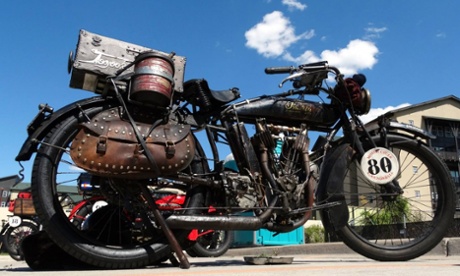
The museum houses the personal collection of Dale Walksler, a former Harley-Davidson dealer, car and motorcycle enthusiast, and acquirer of artifacts. It brings together machines that are about being elsewhere and about the peripatetic and nostalgic values of motorcycle culture.
Walksler has been collecting for 45 years, and the results fill a large warehouse. He owns about a dozen cars representing the decades from the 1910s through the 1960s. But his motorcycles – 350 or so – dominate the space. Some are the only example of their kind. Although the collection is all-American, the visitors are not. Thirty-five riders from Austria are expected soon; 30 Brazilians are also on their way.
The space is filled not only with cars and motorcycles, but also antique objects that piece together the history of these machines. Mannequins dressed in vintage drivers’ clothing watch over display cases teeming with newspaper articles, issues of Popular Science, vintage brochures, and advertisements.
I stop in front of the first motorcycle Walksler built when he was 15, trying to separate it in my mind from everything that surrounds it. The air smells of dust and metal.
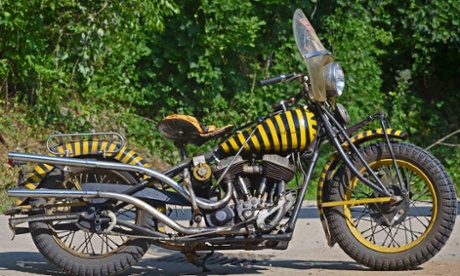
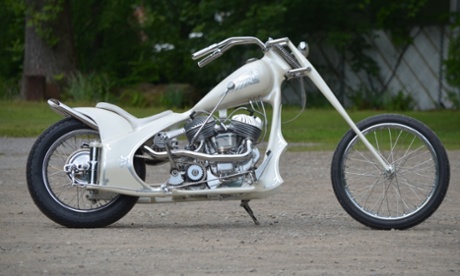
At first, these machines seem static, even dead, as things in museums often do. A spray-painted sign jokingly designates a Chopper Graveyard that houses “the skeletons of what used to be”, an hommage to the archetype of the Easy Rider from the 1969 film. But these things are not dead. Most of the museum’s cars and motorcycles, even the very old ones, have been restored and are regularly taken out for rides.
But the first motorcycle: that is the origin point for the collector. The philosopher Walter Benjamin wrote: “Every passion borders on the chaotic, but the collector’s passion borders on the chaos of memories.” The museum’s artifacts embody not just Walksler’s memories, but also national memories, and these memories fuel the present culture of enthusiasts.
Motorcyclists share a love of their mode of transportation and the space through which they travel, but they’re divided into smaller groups by the make and marque of their motorcycles. Each machine in the museum stands for one of these micro-communities, past or present.
I stop in front of an old black-and-white photograph in a silver frame: a national convention of Harley-Davidson dealers from 1920. Young men sit at long tables set for a meal, an American flag hanging on the wall of the banquet hall behind them. And in another image, two young women in skirts, blouses, and bonnet-like helmets pose with their Harley-Davidsons, their hands gripping the handlebars, their gaze fixed not on the photographer, but off beyond the frame.
Like many collections, this one is always changing. Walksler is constantly acquiring things and rearranging the museum to accommodate the new. I start chatting with Bob White, one of the museum’s volunteers and a retired Chinese history professor from Appalachian State. We talk about which of the bikes have been ridden across the country and when. After a while, I realize I’m late checking out of my motel and say that I should go.
“Wait,” he says. “You have to see something.”
I follow him outside, back into the rain that’s keeping the town’s few riders in their motels and in the museum for the day, and we climb up into a trailer. Inside are stacks of boxes filled with silver and black objects, some of them wrapped up in little brown paper bags. Bob picks up one of these things and says we’re looking at a collection of antique Indian motorcycle parts the museum has just purchased. He tells me that these parts are rare, and that a collection like this is virtually unheard of. Watching him handle these objects is like watching a priest with his relics.
“It’s manna from heaven,” he says, and maybe because of the museum, or maybe because I’m a collector, too, I know what he means.