
- The Volvo EX60 is probably the brand’s most important car right now.
- The automaker has put a lot of effort into making the EX60 as close to perfect as possible.
- This includes integrating the latest advancements in safety technology.
Everybody knows that Volvo makes safe cars. From the boxy wagons of the 1980s to the latest XC60 and XC90 best-sellers, the Swedish automaker has made it its mission to build some of the safest cars out there.
That philosophy remains true with the new EX60 electric crossover, which is probably Volvo’s most important car right now. After the problematic debuts of the EX90 and EX30 EVs, the Geely-owned company wants to make things right with its most advanced car to date.

All car companies are required to put their cars through some sort of crash testing, including low-volume brands like Koenigsegg and Bugatti, but few–if any–go to the same lengths as Volvo to make sure their cars can keep occupants safe in all sorts of real-world situations.
There’s the Euro NCAP procedure, and then there’s the Volvo way of doing things, as you can see in the video embedded below. The typical crash testing procedures usually involve a head-on collision, a lateral collision with another vehicle and a side impact with a pole. Volvo, however, takes things up a notch with its own testing.

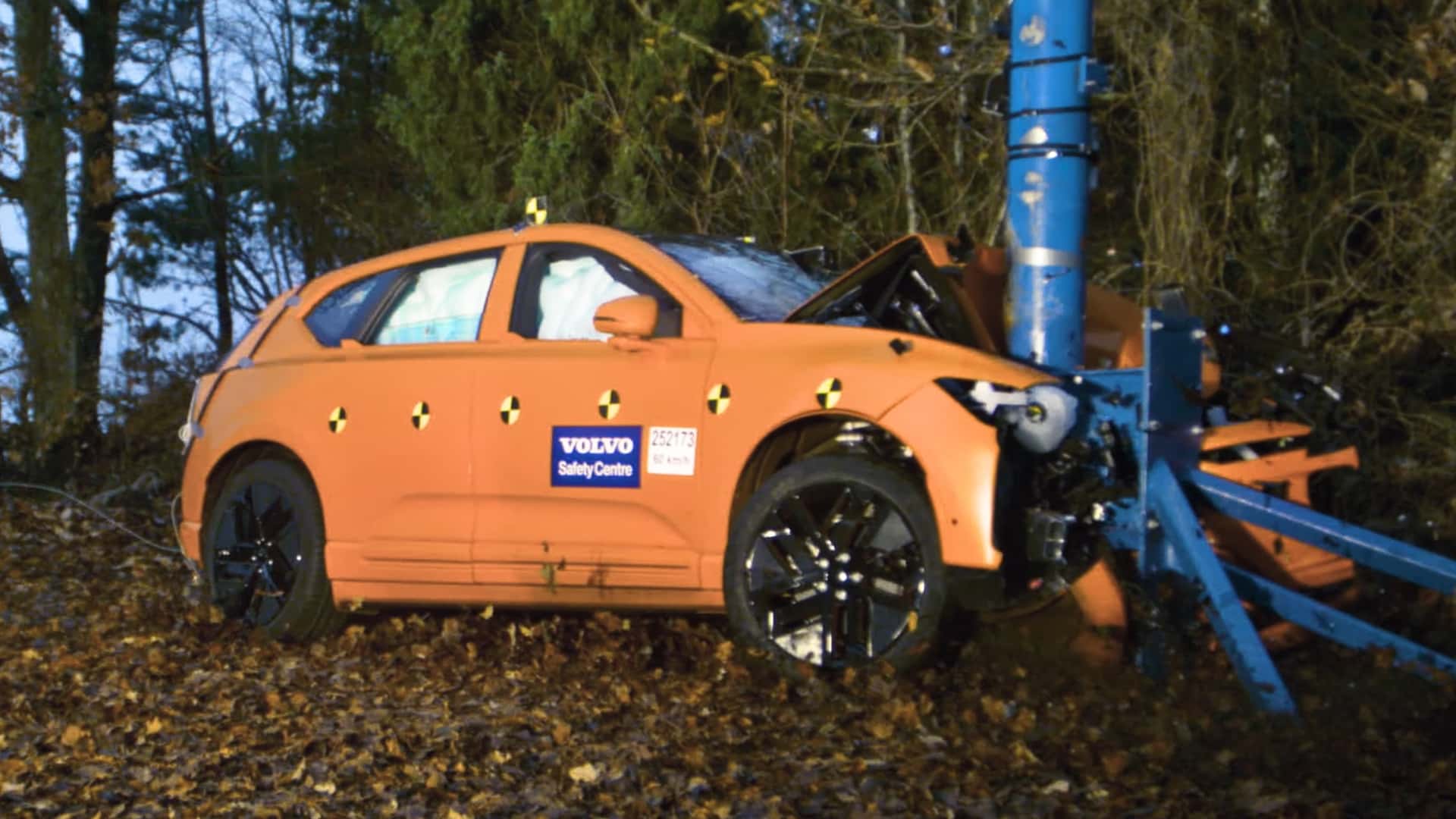
In this case, the Swedish automaker launched the EX60 off the road while traveling at 37 miles per hour (60 kilometers per hour). The car then went head-on into a pole to simulate a situation where a driver would veer off the road and crash into a tree.
Right before the impact, the multi-adaptive seatbelts–a Volvo first–firmly secured the driver and passengers to their seats, minimizing body movement and the risk of injuries. But what happened after the car slammed into the pole is very impressive.
The front section of the EX60 seems to have absorbed all the impact forces, because the A-pillars look completely unaffected by the crash. The windshield looks like it hasn’t cracked, either. This means the doors can be easily opened after the fact, allowing emergency workers to safely get everybody out.

“Upon impact, the car body of the EX60 is designed to absorb crash energy, keep the safety cage as intact as possible, and help protect the occupants,” said Lotta Jakobsson, Senior Technical Leader for Safety at Volvo.
There’s still a lot we don’t know about the new EX60, though, including when it comes to safety. The car has electronically operated exterior door handles, which have proven to be difficult–or even impossible–to operate after a crash. We don’t know how the doors can be manually opened from the inside or outside, and Volvo has not yet published the owner’s manual for this model.
What’s more, none of the established safety certification organizations, like Euro NCAP and the NHTSA, have published their crash test evaluations of the EX60, so we’ll have to wait and see how the Swedish EV performs.