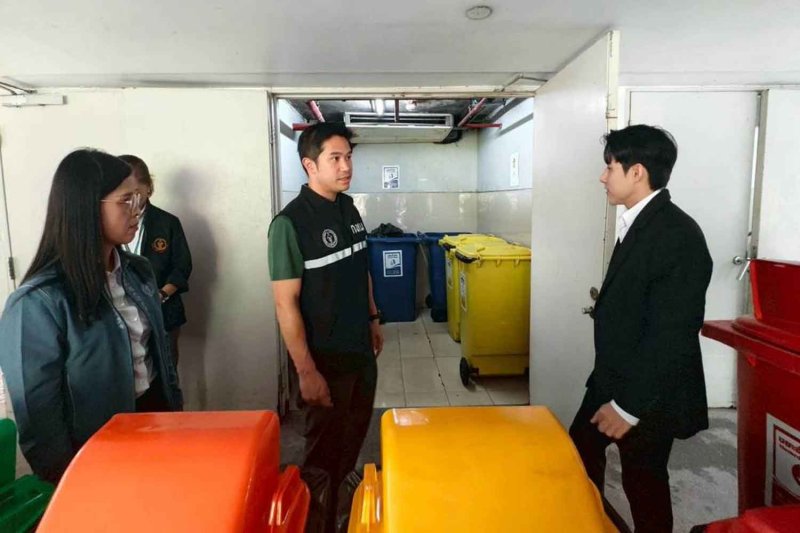
Bangkok is testing a pilot “No Mixed Waste” project in 10 condominiums in Klong Toey and Watthana districts to promote waste separation and reduce the amount of garbage sent to landfills.
The project started on Feb 12 and if it produces positive results, it will be expanded across all 50 districts in the capital in the coming years, according to the Bangkok Metropolitan Administration (BMA).
The pilot is being run by the BMA’s Department of Environment, with support from the Danish Environmental Protection Agency, the Thailand Environment Institute, and SCG Chemicals Plc as a network partner for circular economy and recycling solutions.
Condominiums represent a growing share of Bangkok’s housing stock. Waste from hundreds of households is often combined before collection, which reduces the effectiveness of waste separation efforts.
The pilot project tackles high-rise condominium challenges — such as garbage chutes, limited space for multiple bins, and centralised waste rooms. Participating buildings are being equipped with waste-sorting infrastructure, supported by resident education programmes designed to make separation more practical.
“We expect the pilot to show that waste sorting in high-rise buildings is achievable with well-functioning and convenient systems, education, communication and stakeholder engagement,” explained Rasmus Andreas Toender, circular economy and waste management specialist with the Danish agency.
Currently, Bangkok produces around 8,700 tonnes of garbage daily, of which more than half goes to landfills, according to Greener Bangkok. About 40% of all waste is considered recyclable, although actual recycling rates are around 20%.
Informal waste pickers, known as saleng, play a critical role, with some estimates suggesting they account for up to 75% of the recycling that actually happens.
Landfills, meanwhile, are a growing threat to the environment. Besides poisoning the soil, they produce methane, which is responsible for around 30% of the current rise in global temperature. Methane increases the risk of landfill fires, and both can contribute to air pollution, including the notorious PM2.5 fine-dust particles.
The “No Mixed Waste” campaign is not new — it began evolving in 2022, after Chadchart Sittipunt became governor. The BMA began testing small projects encouraging households to separate food waste from other garbage to reduce landfill disposal.
The campaign expanded from pilot projects in selected districts to a citywide programme covering all 50 districts in 2023, although encouraging consistent participation remains an ongoing challenge.
Then, in 2025, Bangkok introduced a new waste-management fee regulation: higher fees for buildings that send mixed waste and lower fees for those that separate it properly.
Overcoming scepticism
However, previous waste-separation campaigns have faced scepticism from residents who questioned whether separated waste remained separated after collection.
“Better waste management systems need the development of complex legislation, supporting taxes and fees, adequate public budgets, and public awareness to improve,” said Mr Rasmus.
“In Denmark, for example, it has taken us decades to get to where we are now on waste management, and our systems are still developing.”
He added that people need simple and accessible waste-sorting systems and confidence that they are actually contributing to improving the situation.
After the pilot, the Danish Environmental Protection Agency will continue to work with the Thai partners to examine the findings.
“We’ll continue to collaborate with the BMA and the other strategic sector cooperation partners … in their efforts to extend the project’s impact beyond the pilot phase to the benefit of everyone involved,” said Mr Rasmus.
Other partners in the project include the Pollution Control Department, Department of Local Administration, the Federation of Thai Industries and the Asean Centre for Sustainable Development Studies and Dialogue.