Waste is often seen as the inevitable by-product of economic growth. In reality, it may become one of the most valuable resources economies possess.
Thailand generates more than 27 million tonnes of municipal solid waste each year, according to data from the Pollution Control Department (PCD), and more than half is either improperly managed or left to accumulate in expanding landfills. What appears to be an environmental problem is increasingly becoming an economic one.
Yet this growing waste mountain may also represent one of Thailand's greatest untapped opportunities.
In the emerging global economy, competitive advantage will not belong to countries that merely talk about sustainability. It will belong to those that build the infrastructure to make it work. Waste management is no longer simply an environmental service. It is becoming a strategic industrial capability.
To seize this opportunity, Thailand must move beyond conventional recycling programmes and adopt a regenerative model -- one that extracts value from every waste stream and returns it to productive use.
A truly regenerative model does not depend on goodwill or environmental awareness alone. It requires coordination across three interconnected forces.
The first force is business. Every category of waste has value if properly separated and processed. Organic waste can be converted into biogas and organic fertiliser. Clean plastics, metals and paper can re-enter manufacturing supply chains. Even contaminated plastics, textiles and other materials traditionally destined for landfills can be transformed into Refuse-Derived Fuel (RDF). Instead of paying to dispose of waste, municipalities can generate revenue, with estimates suggesting net gains of over 3,500 baht per tonne when systems are efficiently integrated.
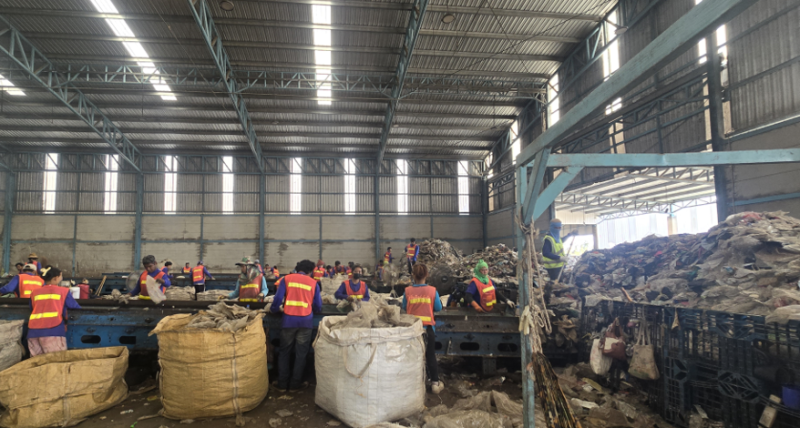
The second force is operational. Waste management today is an advanced industrial activity rather than a basic public utility. Modern mechanical-biological treatment facilities combine automated sorting technologies with skilled human oversight to maximise recovery rates. Integrated renewable energy systems can further reduce operational costs and carbon emissions, turning treatment plants into low-carbon industrial assets.
The third force is financial. A practical model is one based on Public-Private-People Partnerships. Governments invest in and retain ownership of essential infrastructure, while private operators bring technical expertise and operational efficiency. Such arrangements lower investment barriers, improve service quality and generate long-term savings by reducing dependence on landfills.
The model is not theoretical. Around the world, it is already delivering results. In Mexico City, the Gustavo A. Madero sorting facility diverts around 1,200 tonnes of waste each day from landfills and converts it into alternative fuels for cement production.
Thailand is beginning to demonstrate similar potential. Through the Saraburi Sandbox, the country's first low-carbon city initiative, advanced waste sorting and recycling systems are being developed to transform municipal waste into industrial raw materials and high-calorific RDF. At the same time, co-processing by the cement industry has significantly reduced dependence on imported fossil fuels, saving the country billions of baht in energy costs.
Waste is also becoming a matter of economic security. In an era of volatile commodity prices and fragile global supply chains, countries can no longer afford to ignore resources already sitting within their own borders. Municipal waste contains energy, materials and economic value that would otherwise need to be imported at significant cost. Every tonne recovered domestically is a tonne less imported of materials and energy to produce it, and that reduces our dependence on external markets.
Around the world, the circular economy is rapidly evolving from an environmental agenda into an industrial strategy. Countries are competing to secure secondary raw materials, build domestic recycling capacity and create low-carbon manufacturing ecosystems. The question is no longer whether waste should be managed better, but which economies will capture the value embedded within it.
A regenerative economy begins with people -- but it is accelerated by technology. Waste separation must start at the source, requiring schools and communities to see waste not as rubbish but as a resource. Today, AI and digital platforms can reinforce this shift by enabling real-time tracking of materials, improving sorting accuracy, and connecting waste generators directly with recyclers through digital marketplaces. These tools make circularity more accessible -- not only for industries, but for individuals and communities.
Equally important, this transition can create new employment opportunities and strengthen local enterprises around treatment facilities. At the same time, AI-enabled systems -- from smart sorting to blockchain-based traceability -- open up new roles in data management, system operations, and digital platform ecosystems, expanding the scope of green jobs beyond traditional waste handling.
Perhaps most importantly, it offers Thailand an opportunity to elevate vocational education. Advanced sorting facilities, automated systems, and waste-to-energy technologies increasingly rely on AI, robotics, and data analytics. By integrating vocational institutions directly into these emerging industries, Thailand can cultivate a new generation of industrial professionals -- equipped not only to operate systems, but to optimise and continuously improve them.
Every year of delay means more land which should have been used to generate better returns is consumed by a garbage landfill. Delay means more valuable materials lost, and missed opportunities to harness data and technology to unlock efficiency and value.
Without digital enablement, circular systems remain fragmented and inaccessible at scale.
For decades, countries measured infrastructure in highways, ports, and power plants. The low-carbon economy demands a broader definition. Resource recovery facilities, advanced sorting plants, and waste-to-energy systems must now be complemented by digital infrastructure -- AI platforms, material tracking systems, and circular marketplaces -- that enable transparency, efficiency, and participation across the entire value chain.
Waste is not the by-product of economic activity. It is one of the last great reservoirs of untapped domestic value. With AI as an enabler, countries can unlock this value more efficiently and inclusively, extending circular economy participation to businesses, communities, and individuals alike. Those that succeed will not only build cleaner cities, but stronger industries, greater resource security, and a more resilient, future-ready economy.
Thailand still has time to lead -- but only if it combines physical infrastructure with digital intelligence, and starts treating waste not as something to bury, but as something to build with.
Chana Poomee is Honorary President of the Thai Cement Manufacturers Association, President of the Asean Federation of Cement Manufacturers, and a Board Member of the Global Cement and Concrete Association. His contributions reinforce national policy objectives while enhancing Thailand's industrial competitiveness.