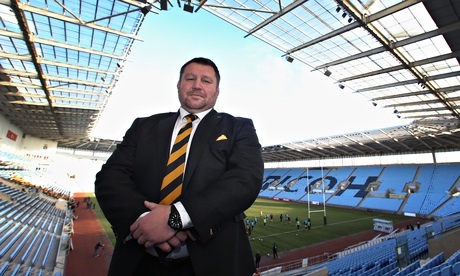
Even Dai Young still cannot quite believe it. His Wasps team are about to play a huge European game at their own stadium in front of 25,000-plus fans. Should they beat Leinster on Saturday they will reach the quarter-finals of Europe’s premier competition for the first time since they won it in 2007.
Domestically they are also upwardly mobile, backed by a committed owner. Had Young waved a magic wand during the club’s darker days he could not have wished for better.
But what about Young’s own contribution to the Wasps fairytale? Frankly, they should crown him director of rugby of the season now.
Sale’s Steve Diamond was asking recently whether such accolades should go to the coach with the biggest budget or someone who has overachieved against the longest odds. Given everything the 47-year-old Young has experienced – “It was starting to look like a bit of a suicide mission, to be honest with you” – he definitely qualifies in the latter category.
His coaching staff compare him to a synchronised swimmer: serene on the surface yet paddling like mad underneath. It is not an image you would instantly affix to a heftily built former Lions prop but Young acknowledges the similarity. “Sometimes coaching is an act. Sometimes when you’re a bit upset you have to act like you’re not,” he says. “I had to put on a mask and pretend things were better than they were. When you’re the captain of the ship if everybody sees you looking for the lifeboat they’ll be in there before you. It was tiring but you have to show confidence that things can turn around.”
Occasionally it has taken him to the limits of his endurance. It is well-documented that Wasps were almost wound up in 2012; Young reckons the club would never have bounced back had they been relegated. The transformation has been stunning. “I had to pinch myself a little bit on our first day at the Ricoh,” Young says. “Seeing 28,000 people there was quite something. I’m not an emotional man but I had a lump in my throat that day. The difference from where we’d been 15 months before was incredible. Totally incredible.”
It feels a lifetime since he agreed to join from Cardiff Blues, believing the foundations for a bright future were in place. It was all a mirage. “I was sold on a vision but I don’t believe I was misled. It just didn’t happen.” What was real was the creeping horror. “I ended up stepping from a secure environment into not knowing if I was going to get paid at the end of the month.”
Enter, in the nick of time, Derek Richardson, the Irish businessman who has financed the club’s move to Coventry. It has been Richardson’s enthusiasm, as much as his money, which has most impressed Young. “His drive to succeed is unbelievable. He is a real inspiration. When you feel a bit knackered on a Monday morning you’ll get five texts off Derek. I wouldn’t have been here if it wasn’t for him. In the early days I did as much as I could but after a while I was thinking: ‘This place is going nowhere.’ Everybody was starting to get twitchy. You wouldn’t be human if you weren’t.”
The players are grateful, too; Richardson even went to the trouble of arranging babysitters for their children at the club’s Christmas party. “He is a real quality man and that is important,” Young says. “He is not doing it for fame and he doesn’t want to pick the team. He is a dream come true for a director of rugby and a perfect gentleman in how he treats people. He’ll phone and invite my wife to dinner himself. He won’t get his PA to do it.”
Young has been around professional sport long enough to appreciate such things. His 51 union caps for Wales – he is the only man to tour with the Lions in three separate decades – and time in rugby league also qualify him as someone who has never ducked a challenge. “Even in the darkest days I still wouldn’t feel I made the wrong decision to come to Wasps. I’d been at Cardiff nine years when I left. Probably after six years I knew it was time to look elsewhere. I probably took the easy option to stay but you can’t be somewhere for ever. You have to challenge yourself in a new environment. I’m ambitious as a coach, the same as I was as a player.”
It has led some to speculate that his decision to sign a new four-year deal with Wasps is linked to Warren Gatland’s projected exit from the Wales job in 2019. Young dismisses that cosy theory – “It’s more a case of the World Cup being a natural watershed for coaches” – but does admit the clock is ticking on his international aspirations. “Make no bones about it, I would like to coach internationally before I finish but I don’t want to be doing this job when I’m 60. I think 55 at the sharp end is old enough.
“I’ve been a professional rugby player since I was 21 and I’ve not had a break. That said, if an international role doesn’t materialise, I’d love to feel I could carry on at Wasps. I’m not a club-hopper. I don’t see myself going to another club in Wales or England.”
Few, either way, are better qualified to compare young Welsh and English players, particularly with his son, Thomas, a flanker, on Wasps’ books. “I don’t think they are very different. It’s just that in Wales it’s far too easy to be famous,” Young says. “If you’re from the valleys, where I’m from, and you play for Wales Under-16s or Under-18s you’re already somebody within your little valley. If you play for Wales they get treated like gods. In London you’re nobody. It keeps you a bit more grounded. I’m a proud Welshman and love going home but I thoroughly enjoy living in England. I think it’s a great place to live.”
Not, however, if Wasps revert to their inconsistent old ways against Leinster after the fine win at Harlequins. “We try to ensure the players always feel there is some pressure. A comfort zone is a losing zone in any walk of life,” Young says. “But when you’ve been through what we’ve been through this is the icing on the cake.” Most would argue that Wasps – and Young – have already won the big one.