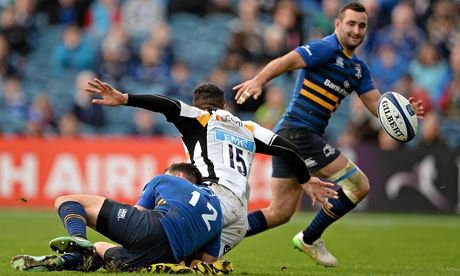
Wasps were the last English club to win the Heineken Cup, back in 2007 before they started a decline that left them flirting with relegation and on the verge of bankruptcy, and if their victory against Leinster in Dublin on Sunday received less attention than it would have generated ordinarily because of the terrorist attacks in Paris two days earlier, it was significant.
Not just because of the margin – 33-6 at the home of the side that, before Toulon, had been the dominant force in Europe – but because of the un-Premiership manner in which Wasps played, offloading and forcing turnovers at the breakdown. George Smith may be an openside flanker six months older than Richie McCaw, but he is proving as inspired a signing as the New Zealand full-back Charles Piutau, who signed a season’s deal ahead of his move to Ulster.
The conclusions of the review into England’s World Cup campaign were presented to the board of the Rugby Football Union this week, and while they will remain confidential, understandably in the case of players and coaches who agreed to be interviewed, by reverting to type after the bonus-point victory over Fiji on the opening night, the hosts’ traditional strengths – the set pieces, defence and organisation – were exposed as weaknesses, and their lack of impact at the breakdown, the single most important area in today’s game, left them exposed.
It was a World Cup unlike any other in the professional era because the best teams were not single-minded. They attacked as well as defended, with Japan setting the tone on the opening weekend with their victory against South Africa. And the manner in which New Zealand reached the final suggested that the game’s evolution had taken another step, exposing the power and no-risk approach that had long been Europe’s zeitgeist.
“I note the wheel is now turning,” said the new France coach, Guy Novès, in an interview with the Rugby Paper last weekend. “Going back 40 years, the kicking game was valued at one time and playing through the hands at another. What the emerging countries did is important. We did not know much about Japan’s potential, but they performed a spectacular, attractive style of rugby. It may not always have been effective, but it is the rugby of tomorrow. A modern rugby is showing itself. I saw players giving pleasure to supporters and that should be their duty.”
Wasps are helping turn the wheel in England, and if it is premature to predict they will reach the Champions Cup final, not least because they are in a formidably difficult pool with Bath and Toulon, their opponents in Coventry on Sunday, their effective mix of aggressive defence and ability to launch quick, incisive attacks, makes them a team to watch in the next few seasons. They have grasped the difference made by winning multiple turnovers at the breakdown, and for all the improvement made by Australia up front during the World Cup, it was David Pocock’s prowess in the tackle area that allowed them to exploit the attacking threat they had out wide.
Piutau and Frank Halai, his fellow former Blue at Wasps, are proof of the riches New Zealand are blessed with, measured in talent rather turnover. Piutau was omitted from the All Blacks’ World Cup squad after announcing he would be joining Ulster, while Halai’s solitary cap came in 2013 when he scored a try against Japan in Tokyo. With Christian Wade and Elliot Daly in their outside-backs, Wasps have the players to turn defence into attack in a quick pass, trusting skill rather than fearing risk. They lost the possession and territory statistics on Sunday but won the match: it was not how much ball they had that mattered but what they did with it and their approach without it.
One reason given for the more conservative approach in the Premiership, and the Top 14, compared to Super Rugby is the fear of relegation, but that is not an excuse for the majority of clubs for whom the drop never dangles. In May 2012, Wasps faced Newcastle at Adams Park knowing that defeat, albeit by a margin of 24 points or the Falcons securing a try bonus point, would relegate the club that in the previous decade had been one of the most successful in Europe. They lost, but only by four points and survived.
The move to Coventry from High Wycombe saved them financially and provided them with the resources to recruit. Wade, Daly and Joe Launchbury survive from that defeat to Newcastle, supported now players such as Smith, Piutau, Halai, James Haskell, Nathan Hughes and Joe Simpson, who missed the match against the Falcons because of injury.
Recruitment is one thing, playing style another, and Wasps, unlike England, have a clear and concise approach. The victory at Leicester followed single-figure defeats at Harlequins and Leicester in the Premiership, and Toulon will measure their progress, especially if Steffon Armitage is in their back row to compete with Smith, whose impact should persuade others in the Premiership of the value of a foraging openside flanker, as Bath have in Francois Louw.
Wasps are not playing like a side whose director of rugby was a prop in his playing days. David Young is rarely mentioned as a potential successor to Warren Gatland when the New Zealander steps down in 2019, as he has hinted he will having been in charge of Wales since the end of 2007, largely because of his final years at Cardiff Blues when he had to cope with a falling budget as the recession took its grip on regional rugby.
Young’s career with Wales started at a time when they had Robert Jones, Jonathan Davies, Mark Ring, Bleddyn Bowen, Ieuan Evans and Adrian Hadley behind a mixture of subtlety, invention, improvisation and pace. As Novès’s wheel turns, it is in the past where the future may lie.
• This is an extract taken from the Breakdown, to subscribe just visit this page, find ‘The Breakdown’ and follow the instructions.