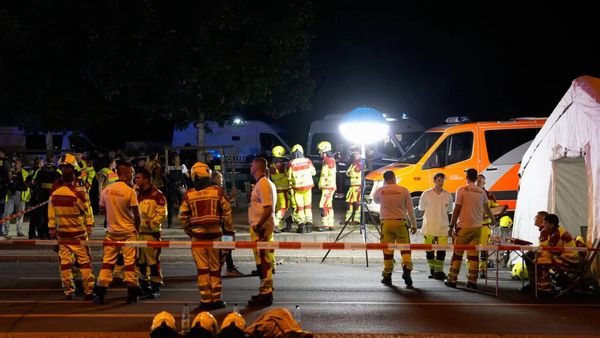
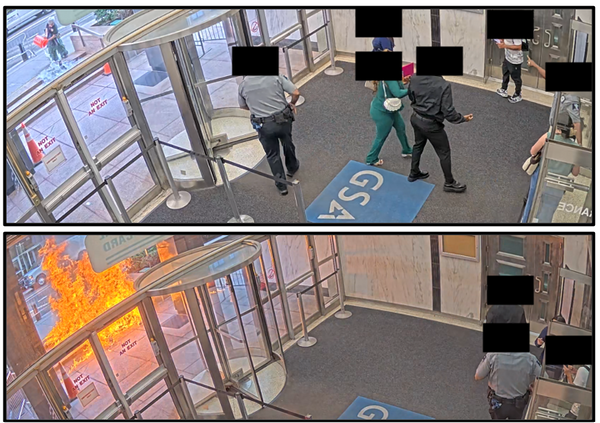
A stunned Washington faced searching questions about political violence and gun control on Sunday after shots were fired at a prestigious media gala attended by Donald Trump and senior White House officials.
A man targeted a Secret Service agent at a security checkpoint in the Washington Hilton hotel the previous night before being tackled and arrested. Trump and Melania Trump were rushed out of the annual White House Correspondents’ Association (WHCA) dinner as guests dived for cover under tables.
The chaotic events raised fresh questions about the security of top officials, many of whom were gathered in the hotel’s expansive ballroom. Todd Blanche, the acting attorney general, told NBC’s Meet the Press programme: “It does appear that he did in fact, have set out to target folks that work in the administration, likely including the president.”
The brazen assault at the Hilton – the same hotel outside which then president Ronald Reagan was shot in 1981 – also occurred against a backdrop of surging political violence and an epidemic of gun violence in the US.
Trump himself has often been criticised as an accelerant of vitriolic and incendiary discourse. Over the past 10 years he has called on a crowd to “knock the crap out” of protesters, urged supporters to “fight like hell” following his 2020 election defeat and mused that crime could be ended in “one really violent day” if police were allowed to be “extraordinarily rough” without fear of retribution.
Speaking from the White House briefing room on Saturday, while still in black-tie attire, the president characterised the gunman as a “very sick person” and a “lone wolf, whack job”, adding: “These are crazy people, and they have to be dealt with.”
When pressed by a reporter on whether political violence has simply become the cost of doing business in modern America, the president said with an air of resignation: “It’s a dangerous profession.”
But such a notion prompted fresh soul searching among Washington’s political class. Lanhee Chen, a fellow at the Hoover Institution thinktank in Stanford, California, told Meet the Press: “Political violence does seem to have become a part of doing business but it should not be normal. It should not be normalised and that is something we should not lose sight of. And ultimately, it is incumbent upon public leaders to set the right tone.
“I thought the president did that in his press conference last night. I think it’s important for others to follow suit. But ultimately, we should not say that, ‘Hey, we’re used to this. It’s America. It’s happened before.’ Somebody has to draw the line. And we’ve seen this too many times now.”
Over the past decade the US has been left reeling by a shooting at a congressional baseball practice, a deadly white supremacist march in Charlottesville, the January 6 insurrection at the US Capitol, two assassination attempts against Trump, and the killings of the former Minnesota house speaker Melissa Hortman and her husband, and the rightwing activist Charlie Kirk. Threats to members of Congress are at a record high, with some hiring private security guards.
On Sunday, Jamie Raskin, a Democratic congressman who found himself shielding Kerry Kennedy – a woman whose own father and uncle were victims of historic assassinations – decried the normalisation of violence, linking the latest incident to the broader epidemic of mass shootings in schools and communities.
Raskin told CNN’s State of the Union: “We have not dealt with the problem and we’re losing thousands of people a year to gun violence. There are 100 people shot every day. So, yesterday, while that nightmare was going on at the White House correspondents’ ball, dozens of people had been shot across the country.
“And we just accept that as the normal course of business. So I think, before we get back to all the political divisions and fighting about stuff, maybe this could be a moment of unity for trying to focus on the things that the vast majority of the American people want, like a universal violent criminal background check.”
America has more guns, and more phones, than people. The Trump administration has faced criticism for dismantling gun safety and mental health investments that had bipartisan support.
Thom Tillis, a Republican senator, told the Meet the Press: “The amplifier and the instigator of social media is able to really target vulnerable people. In many cases, we’re seeing people who are committing these horrible acts have behavioural health and other challenges – stability issues in their lives. And now we have platforms that can focus on them as state actors, terrorist organisations fomenting hate in this country.”
The suspect, identified by law enforcement as 31-year-old Cole Allen of Torrance, California, charged a security checkpoint located on the lobby level, one floor above the main ballroom, before being subdued. He was carrying a shotgun, a handgun and multiple knives. A uniformed Secret Service officer took a bullet to the chest, his life saved only by his ballistic vest.
The suspect will be charged in federal court on Monday with assault of a federal officer, discharging a firearm and attempting to kill a federal officer. A focus of the investigation is likely to be how he was able to smuggle the shotgun into the hotel.
Meanwhile the British embassy in Washington, which is preparing for King Charles’s visit to Washington starting on Monday, said in a statement that discussions were taking place on whether the incident may affect planning for the visit.
John Cohen, a former acting Department of Homeland Security undersecretary for intelligence, told ABC’s This Week: “This is the most volatile, complex and dangerous threat environment I’ve experienced in the 42-plus years that I’ve been involved in law enforcement and homeland security.
“We’re an angry, polarised nation. We have a growing number of people, particularly young males, who believe that violence is the only way to express their sense of grievance or their opposition to the current political conditions in this country. They are inspired and increasingly informed by content that they consume online that’s placed there by terrorist groups, foreign intelligence services and others, specifically for the purposes of inspiring and inciting violence.”