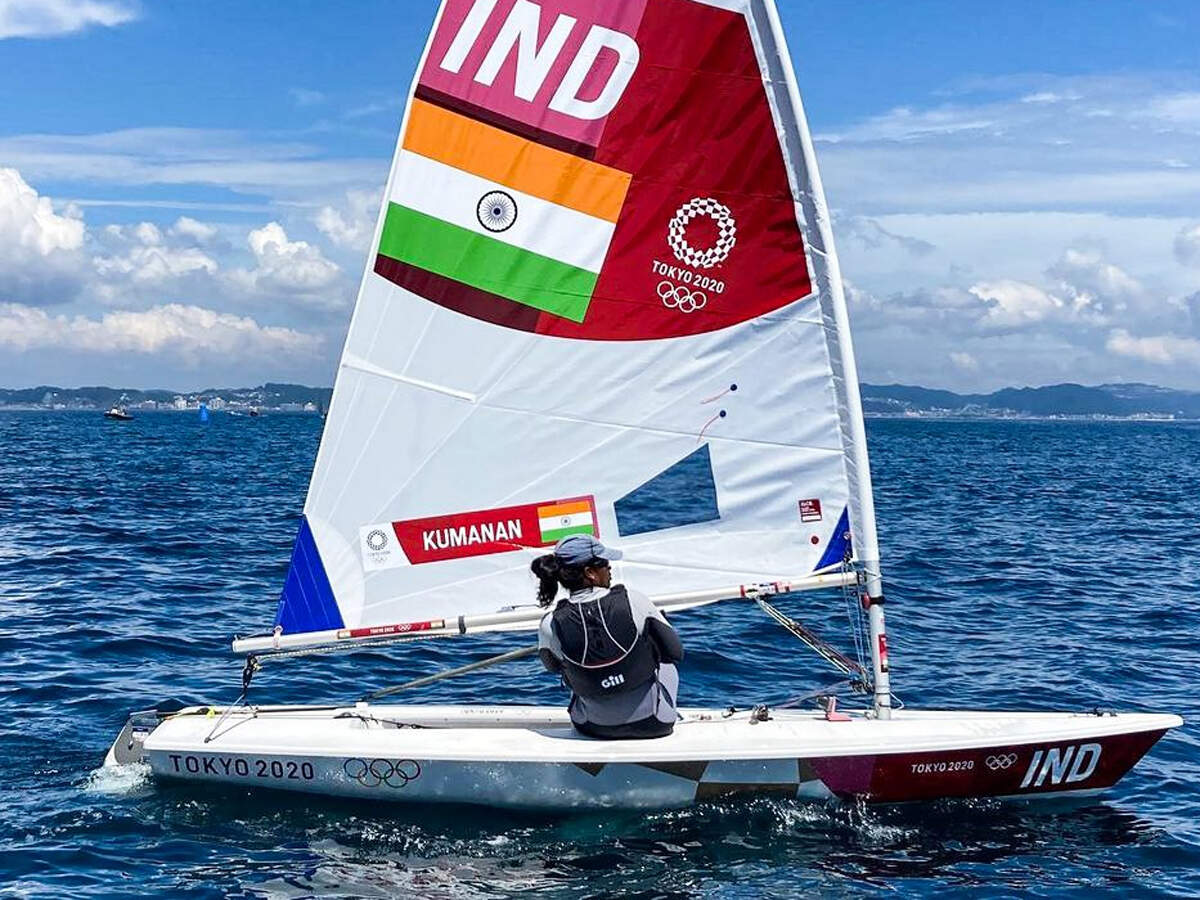
She is studying to be a mechanical engineer and has tried her hands at tennis and Bharatnatyam among other things. But Nethra Kumanan became the first Indian woman sailor to qualify for the Olympics when she finished second in the Laser Radial Class during the Asian Olympics Qualifiers in Oman.
The 22-year-old Kumanan, is among the four Indian sailors (KC Ganapathy & Varun Thakkar in the 49er category, Vishnu Saravanan in Laser Standard category and Kumanan in Laser Radial category) to make it to the Tokyo Games.
In an interview with TOI, she opens up about the physical, mental, financial demands of the sport and why she would get up at 3.30 am during the first half of the lockdown last year.
Excerpts:
Was there a moment or a period, when you sort of decided that you want to become a sailor? And then represent India at the international level?
It kind of just happened as I kept doing what I like to do. There was a certain point when I qualified for the Asian Games (Incheon, 2014) that I needed to leave school because school only allowed 10 days off in a year and I couldn't travel. I was in class XI at that point. So when that happened, there was kind of, let's push this and see how far I can go and then it kind of just then we tried for the Rio Olympics. For this, I went to Israel for training for about a year. And I got good enough. But I was mentally too stressed out to be able to perform and that was one of the reasons that I couldn't make it to the Rio Games.
Then we took a year off, and then I started back and then I got put in a programme by the world sailing body, which helps sailors from the smaller sailing nations to qualify for the Olympics. And then I found this new academy in Spain. I think the goal changes to look for a medal in the next cycle (next Olympics in 2024).
But, still, this idea of becoming a pro looks and sounds a bit too ambitious...
Me and my brother, went to the summer camp, okay. He was good at it as well, better than me at the beginning. Once we started sailing, we had spent all our weekends in the club. So I kind of slowly gave up everything else I used to do like dance, piano and a bunch of things, which took a lot of time and practice. So I liked sailing and at that time, it was good for college applications, you know, like going to nationals and getting national medals. And then we just kind of took it step by step.
What's your typical day, like when you are working on your skills?
When I was at the academy for a year at Gran Canaria in Spain we had quite a nice schedule. We would have morning training, like a warm-up where we worked on agility, balance coordination and then went out sailing on the water for an average of three hours. The training also depends on the season. If we are in the off-season, we work a lot on our technique, doing a lot of long runs, working on improving the focus and getting the speed right. And then when it comes closer to the racing season, we work a lot on the starts of the manoeuvres like turning the board and strategizing and playing with the sleeves and racing those things.
How long is the day…
So we do a morning session, maybe we have an hour before we go out on the water. We spend anything from two and a half to four hours or maybe more, maybe less. Depending on the goal, the period of learning that we're in, and then when we come back, we take a little break. We do a de-brief for an hour, where we talk about what we can improve, do a lot of video analysis and talk about the strategy and the wind. This is followed by a gym session or cycling.
Sailing looks like a very physically demanding sport. I mean, when you were at sea for long hours, and then you didn't you're struggling with the wind and the sail...
It depends on the class of boat that you sail. The training for the 49er is very different from Laser Class. The Laser guys use a lot of legs. So, a lot of our training is taking care of our backs, our joints, and obviously strengthening our muscles, which we use most, which is the core, the shoulders and quads. We spend a lot of time working on the health of our joints and our backs.
We do a lot of cycling, which uses the same muscles as sailing. We do something called hiking when we are on the boat. What we basically have to do is put our toes under the strap, and you're kind of using your legs and abs to get your body out as much as you can. This is to leverage the power on the sail. I'm one of the stronger ones and my priority is my cycling. We still do some weight training twice a week at least.
How much cycling to do? I mean, how many kilometers?
Depends, because, on the island, it's a lot of climbing. So it's not a lot of distance. It's a lot of metres up. But now that I am in India, it can range between 50 kilometers a day to 80kms per day.
You earlier spoke about being mentally stressed, but now you're, you're the mental conditioning coach in the form of Mr. Mon Brockman. How does this help?
Now I am supported by Gosports foundation under the Star of Tomorrow Programme partnered by DreamSports Foundation and FIFS. So this has given me the opportunity to work with Mr.Brockman. He speaks with me over the phone every week. We also exchange a lot of messages throughout the day. We basically talk about getting my focus in the right place and getting my energies directed on the right things. We also talk about how important it is to let go of things that were not important, not relevant to the moments and just honing that skill. He's not a motivator?
Because I think motivation has never been an issue for me. It's how to direct it. It’s about learning to keep the focus on the right place because I've always been driven. I think that's one of my only strong suits.
Brockman is helping me put my attention in the right places. A lot of people will do one part of the race and kind of give up. So it's quite important for us to keep that focus for an hour. He's also helped me build my self-confidence back. The gap between how I was performing in training and how I was performing on the racecourse, was massive. And it was a huge difference that I didn't know how I could overcome until we started working at Brockman.
Sailing doesn't look like a sport that's easy on the pocket. So how costly is that and how have you managed it?
Yeah, it's an expensive sport. My budget is like 50 lakhs in a year basically. This included travelling, coaching, travel expenses. I train in Europe and so living expenses are higher. And then the more events we do, the more it costs. Like last year, I was in DC the whole time. So, it was only coaching and living expenses there. But before we did like seven events across all over Europe and we went to Japan, so that was expensive. So it really depends. The Yachting Association of India has been of great help and so is Sports Authority of India and now GoSports.
And was it sort of a blessing that you were stuck in Spain during the lockdown?
It lasted a lot longer than I expected. It was difficult in the last few months because I really missed home. I wasn't really improving anymore. But it toughened me up more than I improved my sailing in the last couple of months. The study part was difficult because of the time difference between India and Spain. I had to get up at 3.30 am. After a while, it started affecting my training sessions in the morning. I had to stop that after a while and now I do it only closer to the tests. My college has been kind enough to help me with my attendance requirements.
Are you just being realistic when you say that you are aiming for a medal at the next Olympics in Paris and not the upcoming one in Tokyo?
I think for me, it's been about growth. It's been about getting better, and always growing and taking one step at a time. Qualifying for Tokyo is a huge step, it's going to be very helpful, hopefully, to get some financial help as well. I think the primary goal is to find help, so I can keep doing it. Okay, but it is a sport where experience counts a lot. For a young athlete, it's very hard to be consistent. All the girls that are good are like 30 years old and older 20s. The more experience you have, the more consistent you get and the more chances you have of a podium finish.