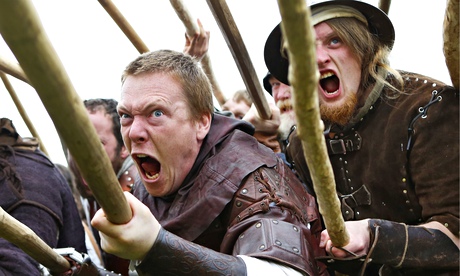
Today is St Crispin’s day and, as such, the anniversary of two battles – Agincourt and Balaclava – that took place on 25 October and in a further coincidence resulted in arguably the two most famous examples of martial writing in literature: Henry’s “we happy few” speech on St Crispin’s eve in Henry V, and Tennyson’s “The Charge of the Light Brigade”. Other depictions of battle run them close, however …
“Flower of Scotland” Roy Williamson
Williamson’s modern-day tribute to the Scots who died at Bannockburn, when “proud Edward” was sent “homeward / Tae think again”, has become the Scottish rugby and football teams’ anthems. It embarrassingly outclasses Robert Burns’s “Bannockburn”.
“Paul Revere’s Ride” Henry Longfellow
In 1775, at the start of the revolutionary war, Revere gallops to Concord (“the fate of a nation was riding that night”) to alert the militia that the British redcoats were on the move, ensuring the amateur freedom fighters’ victory.
“The Defence of Fort McHenry” Francis Scott Key
The original title of “The Star-Spangled Banner”, a heady celebration of American defenders besieged by the British in the war of 1812, which is sung at US sporting fixtures as well as national events.
The Charterhouse of Parma Stendhal
Dedicated to the “happy few” in an echo of Henry V, Stendhal’s novel includes an influential account of the bewildered hero stumbling around at Waterloo that offers a marked contrast to Shakespeare’s glorification of battle. Also different: the author’s side lost.
The Red Badge of Courage Stephen Crane
Depicting an unnamed US civil war clash, Crane’s novella anticipates and influences 20th-century war writing (and first-world-war poetry in particular) in its focus on the individual soldier’s psychology, and taking much further Stendhal’s anti-heroic portrayal of battle as chaotic.
“Strange Meeting” Wilfred Owen
Fully realised enemies (and hence guilt, apart from shame at fighting badly) rarely figure in earlier war writing, but here Owen escapes from a battle to a “Hell” where he is addressed by an unknown soldier resembling one of Dante’s damned: “I am the enemy you killed, my friend.”