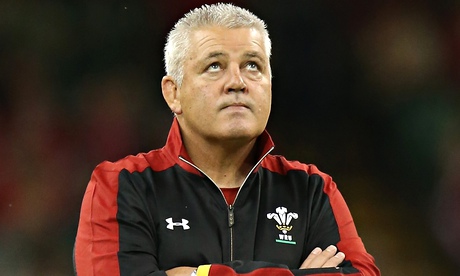
Warren Gatland has spent the summer warning that the World Cup fate of Wales would not merely be a matter of how they deal with England and Australia. Five days after they meet the hosts at Twickenham on 26 September, they face Fiji in Cardiff and their passage to the knockout stage may hinge on the quality of their reserves.
If not too much should be read into a warm-up match played when far more attention had been lavished in training on conditioning than rugby itself, Wales’s head coach was looking for evidence that he had the back-up he will need in all positions but after his side were overpowered up front and at the breakdown and committed costly mistakes in possession, his list of fringe players to leave out of the World Cup squad was longer than those to include.
Wales may have home advantage against Fiji, but they have lost in Cardiff to Samoans twice in the World Cup (Western Samoa in 1991 and Samoa in 1999), were defeated by Fiji in the 2007 tournament in Nantes and beat them by only four points in Cardiff last November with a starting side that was considerably stronger than against Ireland.
“The challenge for us always is to work on the depth within the squad,” said Gatland, who reckons he has six places in his World Cup 31 to decide. “The match against Ireland will have a huge amount of relevance when it comes to cutting the squad at the end of the week because there was an opportunity for a number of players to perform. Some of them need to take a pretty good look at their game.”
Perhaps the most disappointing feature of their weak showing in the first half, when Wales were fortunate to trail only 25-7, was that they failed to react to the way the match developed, persisting with a game plan of keeping the ball alive in their own half when their struggling forwards were in need of territorial relief. The end may have come to Mike Phillips’ long and notable career as an international scrum-half, once an extra back-rower now a phase-play shoveller of passes.
Wales had four debutants while Ireland, who also rested most of their leading players, had a greater core of experience, picking a largely second team rather than lacing it with thirds. “They did not have to work too hard for a number of their tries and that is our fault,” said the second-row Dominic Day, one of Wales’s new boys. “We have got a lot to work on and we will put it right.”
Ireland’s three first-half tries all followed turnovers and their two after the break were scored when Ross Moriarty was in the sin-bin for felling Simon Zebo with a swinging arm. Wales rallied at 35-7 down, profiting as the game broke up, but what will motivate them is what went before. They have a habit of starting campaigns slowly and tend to lose their first warm-up match ahead of a World Cup, but there are positions, most notably half-back, tight-head prop and the back row where they need their leading players to stay fit and fresh.
Ireland are in a more advanced position, reflecting the comparative strength of the Pro 12 teams in the two countries, and if Wales modified their gameplan, Joe Schmidt’s team stuck to the formula that has delivered two successive Six Nations titles, pressing hard, playing for position and attacking off turnovers. Like Wales, their World Cup group includes two tier one nations, but France and Italy are some way removed from England and Australia.
Keith Earls was named man of the match, scoring a try his first international appearance for more than two years. “It was probably the worst 24 hours of my life before the match because of nerves but it was great to be back,” the Ireland centre said. “We pulled away from Wales through some good scores, but we have a lot to work on. It was just good to be playing in a Test again.”
The one blemish for Ireland was a hip injury suffered by the flanker Tommy O’Donnell five minutes from the end. He was treated on the field for five minutes before being taken to hospital for a scan. Wales were in the verbal treatment room. “Everyone’s nervous,” said the flanker Justin Tipuric.
Wales are more experienced than four years ago, when they reached the semi-finals, and have a first team to take on anybody, but their schedule is unkind and the date with the Pacific Nations champions will continue to vex Gatland.
Wales Amos; Cuthbert, Morgan, S Williams (capt; Morgan, 56), Walker; Hook (Anscombe, 50), Phillips (L Williams, 50); Smith (Evans, 51), Hibbard (Dacey, 51), Jarvis (Andrews, 58), Ball (King, 58), Day, Moriarty, Tipuric, Baker (Faletau, h-t).
Tries Hibbard, Tipuric, Cuthbert. Cons Anscombe 2, Hook.
Sin-bin Moriarty 45.
Ireland Jones; Trimble (Zebo, 39), Earls (Madigan, 67), Cave, McFadden; Jackson, Reddan (Marmion, 67); McGrath (Kilcoyne, 52), Strauss (Best, 61), Ross (Bent, 58), Henderson, Ryan (Tuohy, 50), Murphy, O’Donnell, Heaslip (Henry, 53).
Tries Heaslip, Cave, Earls, Zebo, Jones. Cons Jackson 2. Pens Jackson 2.
Sin-bin Henry 60.
Referee G Jackson (NZ). Att 74,000