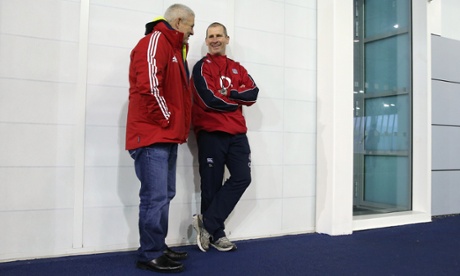
Warren Gatland and Stuart Lancaster exchanged views this week, but only like two tennis players practising before the start of their match. It befitted the four weeks of warm-ups, the phoney war before the real battles start and the barbs become sharper.
Gatland, after announcing his World Cup squad on Monday, had what is called a media huddle, sitting down with a group of print reporters for an interview that was embargoed until 10pm that night. He used to do them regularly and, as someone who invariably had something to say, they were worth leaving free some pages in the notebook.
He has rationed them strictly in the last four years, a victim of headlines after remarks he made about the rivalry between Ireland and Wales and then the temperament of Dylan Hartley. Words can be spun and there is no taking them back. He now mainly restricts himself to sitting at a top table for team announcements to all forms of the media and television and radio interviews.
He was accused this week, to his annoyance, of playing mind games with England by saying Wales had an advantage over their World Cup group rivals in knowing their strongest side (he said that Lancaster was still looking at his options at half-back, in the second row, the back row and in midfield). It was a point he made earlier in the year, when he also said, as he was to repeat this week, that England were also unsure about their style of play, “not 100% sure where they are going”.
He also echoed what he had said after Wales’s victory in Dublin last weekend when asked about Saturday’s encounter between England and Ireland, noting that the team that lost would not be going into the World Cup in the ideal frame of mind armed with a run of two successive defeats.
His one fresh remark was that he wished he had had the luxury of being able to omit the centre Luther Burrell, as England had a few days before when preferring Henry Slade and Sam Burgess. Had Gatland been in a mischievous mood, he would have got on to the subject of Burgess and it will be interesting to see what approach he takes with the media before the 26 September encounter with England with his opponents having home advantage as tournament hosts. The referee, Jerome Garces, is likely to be a topic of conversation.
Lancaster’s approach to the media is different to Gatland’s, reflecting the need in England’s case to generate coverage in a country where rugby union is not the national sport. It is different in Wales and Gatland, like his fellow New Zealanders Steve Hansen and Graham Henry before him, has often been exasperated at how the micro is closely examined at the expense of the macro, making it difficult for him to set the agenda.
He has found that when it comes to selection, attention is lavished on who was left out rather than who was included, a far cry from the days when a new cap would be pictured on the front page on the following day’s newspapers with his family. It explains why he took the decision to drop three Lions from the squad in the middle of August rather than leave it to Monday: the final seven players left out of the 31 were largely rookies, four of whom had won their first caps last month.
Their omissions caused barely a ripple, a contrast to his dropping of Mike Phillips, Richard Hibbard and James Hook a few weeks before. Gatland had ensured that there was no leaking of his World Cup squad by not informing beforehand the players who had been included and telling those who had missed out just before the announcement.
In contrast, most of England’s omissions were known before Lancaster publicly named his squad as he had told some of the players the day before. It got English rugby on to the back pages two days in a row, and while you get the feeling sometimes with Gatland that he regards the media in Wales as an occupational hazard, the view on the other side of the Severn Bridge is that it is a necessary evil.
Lancaster follows every media conference with a print-reporter huddle, accessible to the last. He has never been one for mind games and his approach can be summed up with his response on Tuesday when he was questioned about Gatland’s remarks. “Personally, I would rather concentrate on our own stuff. Different international coaches have different ways of preparing their team and preparing to play. My way is to focus on us; I don’t get involved personally or anything beyond that. We have had situations like this in the past and we’ve very much stuck to our principles. It’s done well for us.”
As in two successive victories over Wales. It’s not quite José Mourinho against Arsène Wenger, but it bears comparison. Gatland is like the former, always willing to ruffle his opposite number before a match, without making it personal, while Lancaster is more like the latter who takes the view that if he and his players get everything right, it does not matter what the other side says or does.
Gatland is right in that Lancaster needs a performance and a result against Ireland on Saturday, just as his opposite number Joe Schmidt does for the Six Nations champions after the loss to Wales. Lancaster has more questions to find answers to than is ideal two weeks before the start of a World Cup and a common denominator to the problems he faces are two players he left out of his plans in the summer for disciplinary reasons, Manu Tuilagi and Hartley.
Lancaster still has to find a midfield combination as effective as Tuilagi and Brad Barritt proved, while the absence of Hartley has caused problems at the lineout, where England have reorganised their second and back rows this weekend to sort out the problems at the set piece in Paris last month, while Hartley added to the scrum.
It may be that Hartley, who is serving a ban that ends after the opening World Cup game between England and Fiji, plays some part in the tournament, just as Gatland’s decision to name only two specialist hookers may open the door to Hibbard. Naming him as the third-choice hooker would have hardly motivated the Lion, but should he be recalled from his club, Gloucester, he would have a different mindset. Hibbard to start the final group game against Australia? Games within games.
CHANGES ARE WORTH A TRY
Llanelli face Pontypridd on Saturday in the Principality Premiership five hours before Wales take on Italy at the Millennium Stadium. The fixture would ordinarily be of local interest, but not this time.
The Premiership is acting as a guinea pig for various law experiments, as well as the Under-18 Wednesday league in Wales. The trial, which has already been carried out in Australia, was approved by World Rugby’s executive committee on Wednesday.
A try will increase in value to six points and a penalty try will earn a side eight points with no conversion needing to be taken. Penalties and drop goals will be reduced from three to two points and the aim of the experiment is to gauge whether the new points system encourages a greater focus on attack with increased ball in play time and fewer penalty attempts.
The other changes are:
• Uncontested scrums must involve eight players from each team.
• If time is up and a mark free-kick or penalty is awarded, play will continue and a lineout will be allowed if a team kicks a penalty to touch.
• The sevens game variation for kick-off sanctions will be introduced so a free-kick will be ordered at the halfway line instead of a restart kick.
It is 23 years since the value of a try was increased, from four to five, and the experiment is timely with the World Cup starting in a couple of weeks. Matches in the latter stages of the tournament have tended to be cautious affairs: in the last three, the average number of tries in a semi-final is two (boosted by the 2007 meeting between South Africa and Argentina) with the three finals producing four, including extra-time in 2003.
“This will attract attention from inside and outside Wales on the Premiership and Under-18 league,” said the WRU’s head of rugby, Josh Lewsey, who was England’s full-back in the 2003 World Cup final against Australia in Sydney. “We were already exploring innovative ways to increase the ball in play time, skills and match intensity. The trials are a superb fit for our intentions and we hope they will provide a further stimulus to the development need of our pathway players.”
The trial will be suspended when Premiership clubs meet lower league teams in the Welsh Cup and there lies the rub for the trials. It is one thing for professional players to cope with increased ball-in-play time, but another for amateurs who train twice a week.
Law changes designed to improve the professional game as a spectacle may have a detrimental effect at the grassroots where they would be introduced without a trial. Three converted tries are currently worth seven penalties; that will rise to 12 in the trial, but will it have an impact on lower-level matches, never mind during the winter months of wind and rain on inferior surfaces?
The trial in Australia found that, after a few rounds of matches, defending teams conceded more penalties in their own territory with the punishment in terms of points reduced, but referees were encouraged to reach for their yellow cards and that had a deterrent effect.
World Rugby will on Friday announce more law changes that will be trialled next year, the upshot of a request for submissions from unions at the start of the year. More will be announced next year, including a way of helping a defending team deal with a driving maul.
All the changes have player welfare at their heart and are being drawn up in discussion with a medical injury prevention group. Any permanent changes to the laws would be made two years before the 2019 World Cup.
SMALL WONDERS, BIG SCREEN
Next week sees the premiere of a film about rugby union in the Pacific island nations of Tonga, Samoa and Fiji, eight days before the start of the World Cup in which all three are again competing.
The theme of the film, Pacific Warriors, which is produced by Andy Perrin, is that the three are the greatest underdogs in world sport, constantly producing competitive teams despite having small populations and a rugby infrastructure that does not begin to compare with those of the tier one nations.
“The game of rugby has become the modern expression of their traditional warrior spirit,” said Perrin. Their lightning fast, brutally physical, high risk style of rugby is legendary, making them every true fan’s favourite team whenever they play. The reality behind the entertainment they provide is set against the unbelievable odds they go up against every time they play.
“Although a Pacific Island team may not have won the World Cup just yet, in one important aspect the islanders are victorious. Ask anyone in rugby where the greatest supply of raw talent comes from and the answer is unanimous – the tiny populations of the Pacific islands.”
Pacific Warriors features contributions from many greats of rugby including Jonny Wilkinson, Sir Clive Woodward, Bakkies Botha, Matt Giteau and Serge Betsen and will be available on DVD & Digital Download from Friday 11 September.
ALL UP FOR THE CUP
New Zealand, the holders, fly to London next Thursday for the World Cup with their head coach Steve Hansen, who will be involved in his fourth tournament after being in charge of Wales in 2003, saying the knockout stage is the only time you know you are facing teams giving 100%.
He feels that the tournament has become such a central plank in the international game’s calendar that most teams spend the time in between World Cups working on development.
“You know [at a World Cup] that everyone you are playing is up for it,” said Hansen. “Sometimes I wonder between World Cups how other nations are driving their bus, whether they are mucking around or whether they are really serious about what they are doing at that time.
“For us, the pressure at a World Cup is no greater than it normally is; it’s just a bigger box of chocolates at the end of it.”
The group stage is a different matter to the knockouts. When the World Cup was last held in Europe, in 2007, New Zealand were the favourites but emerged from their group having faced little opposition. When they faced Scotland at Murrayfield, they were confronted by a reserve team, with the “home” side keeping their leading players back for the second-place decider against Italy.
It meant the All Blacks were under-cooked going into their quarter-final against France in Cardiff and the outcome was an early trip home. Les Bleus at the Millennium Stadium in next month’s quarter-final is a strong possibility, leaving Hansen to hope that group rivals Argentina do not do a Scotland at Wembley on 20 September.
STILL WANT MORE?
• Get all the latest Rugby World Cup 2015 coverage on our dedicated site.
• South Africa addicted to drama over the race of their rugby squad, writes Kaya Malotana.
• Eddie Butler on why England are paying the price in warm-up wounds for strength at the World Cup.
• And to subscribe to the Breakdown, just visit this page, find ‘The Breakdown’ and follow the instructions.