Where's the fizz? ... Coca Cola bottles by Andy Warhol at the National Gallery Complex, Edinburgh. Photograph: Drew Farrell
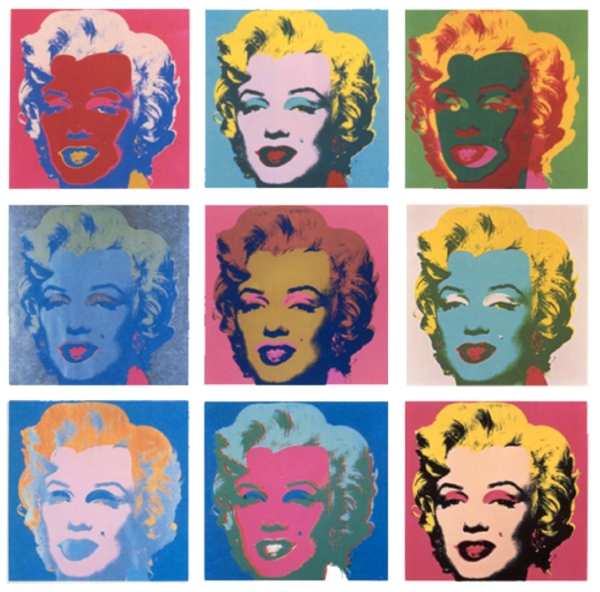
Andy Warhol is everywhere right now, as befits a pop artist. But do such retrospectives show anything fresh or bring any new insight that will prove valuable to contemporary art and culture? His making of Mao, Elvis and Monroe into definitive icons may have been startling back in the 60s, signifying that modernity was at its apex. The modern era is over, and so is its postmodern redux. So why do we continue to celebrate the vacuous plastic age? In Warhol's work there is little, if anything, lying under the surface, nothing shocking, awe-inspiring or jolting about it. It's not even pleasant, just always in our sights, like a McDonald's arch or an Athena poster.
Warhol declared, as he rolled off exhaustive, forest-decimating amounts of silkscreen prints, that he wanted to be a machine - the destructive opposite to the noble ideals of the British Arts and Crafts movement, which fought against the mass homogenisation of the industrial revolution to create hand-built objects of artisan uniqueness. Of course, bespoke pieces are out of reach to many people, but without Warhol and his loud embrace of product assembly lines, would Ikea, for instance, be such a colossus?
Warhol delighted in taking a hands-off approach to art. The concept was infinitely more important than the sweat and suffering of a toiling artist. Partly thanks to Warhol, it has become de rigueur in the art world to take credit for the creations of anonymous assistants.
Warhol celebrated mass consumerism, as it was available to all. On one level it was laudable anti-elitism - a democratisation of art that encouraged the DIY ethic that underpinned punk. On another, Warhol encouraged an ultra-uniformity and drew comfort from everything being the same everywhere. "You can be watching TV and see Coca Cola, and you know that the president drinks Coca Cola, Liz Taylor drinks Coca Cola, and just think, you can drink Coca Cola, too," he once mused. "A coke is a coke and no amount of money can get you a better coke than the one the bum on the corner is drinking. All the cokes are the same and all the cokes are good. Liz Taylor knows it, the president knows it, the bum knows it, and you know it." Never mind that the brand overshadows the chemicalised, coloured water that resides inside the can.
Warhol also built the still-prevailing, false cult of celebrity, surrounding his washed-out, over-indulged self with a coterie of hipsters, all in thrall to Hollywood and the star system. Unlike his fellow pop artists Peter Blake, as well as today's Stella Vine and Raymond Pettibon (who once declared himself an anti-pop artist), Warhol didn't even attempt a critique of celebrity obsession. There is no soul-searching. It's art that's bereft of any soul.
There's no denying the white-haired drug fiend with the cooler-than-thou bitchy put-downs was at the centre of pop culture in the 60s, and his blurring of art and society redefined the word "exhibit". But just because Warhol's imprint on the western hemisphere is so ubiquitous and the influence he wielded so pervasive, doesn't stop me wondering - is that it?