Information bubbles, state propaganda, and the use of social media to declare a stance on war. University of Otago Politics PhD students Elle Dibrova and Dmitry Zavialov share their experiences and observations on media control in Russia.
War is peace: the crooked mirror of Russian state propaganda – Elle Dibrova
On February 24, the world as I knew it stopped its existence. The state whose citizen I am invaded a neighbouring country in the most monstrous and unjustifiable manner. I have been completely shattered and terrified since then. I cannot even imagine what people in Kyiv, Kharkiv, Mariupol, and other places in Ukraine are having to go through.
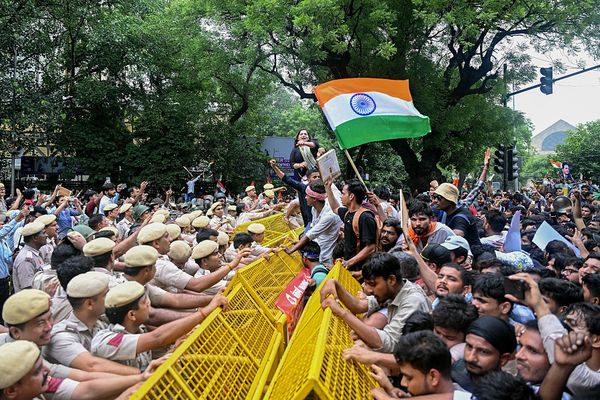
I have been asked repeatedly whether Russians support the war. Finding out real public opinion in Russia has always been hard during Putin's rule due to the powerful state propaganda machine and widespread repressions. Now it is close to impossible. Independent mass and social media have been blocked, and a law banning anti-war protests and sentiments has been introduced. From now on, Russians are allowed to have only one version of reality – the one provided by the state. Oppositionists get abused and beaten by the police, fined, or imprisoned.
There is some hope for Telegram, a messaging app that is perceived as a haven for free speech in Russia and Ukraine. However, its ability to fight Russian state propaganda is becoming limited since Kremlin propagandistic efforts have moved to the app and the information war is currently happening there as well.
An anti-Putin friend of mine who lives in Saint Petersburg and is currently terrified mentioned to me in a Skype conversation that her colleagues' opinions are diverging with hers more and more every day because they read different Telegram channels. Russian state propagandists and “Kremlin trolls” have learnt to use the app.
One of the things I hate most about the whole situation – apart from the fact that hundreds or possibly thousands of Ukrainian and Russian people get killed every day because of the insane and paranoid dictator – is that many Russians have got used to being apolitical, afraid, and lacking compassion.
Putin's regime has nurtured this apoliticism, fear of the state, and strong shortage of empathy for two decades. In my opinion, however, this “not in my backyard” approach will not work today – because the war is literally in the Russian backyard.
It is absolutely soul-destroying for me to see how some Russians buy into the state's hateful rhetoric and believe that violence and aggression can be a solution to a perceived problem. The lack of access to accurate and independent information will inevitably strengthen the idea, and this is genuinely scary.
Two-minute hate on social media routine for divided Russian speakers – Dmitry Zavialov
Coming from Central Asia, I still have an opportunity to observe the ongoing divide among Russian-speaking users of social media. Unlike in Russia, the main social media platforms can be accessed in my region, and their users continue arguing over the war in Ukraine.
Since the war started, I have noticed the outflow of my friends from Facebook to Russian social media (primarily to VKontakte). Some “migrated” because they felt access would soon be blocked, others sought refuge in Russian social media because they experienced various bans of their activity, as their posts were reported by other users.
Those who stayed can be divided into pro-Kremlin and pro-Ukrainian narratives. The divide grows as more and more users declare their stance on the war. This can be as simple as updating a profile picture with a flag of the country they support. Doing so “cleans” the audience from those disagreeing, at the same time preventing dialogue.
The groups of like-minded users live in their information bubbles. The users do not get to hear each other, and the exchange of ideas stops. They continuously discuss the very same arguments, over and over again, believing their reasoning is perfect.
When the users from the bubbles meet, they often cannot have a constructive discussion - they are used to discussing their own position and cannot critically react to counterarguments.
Keeping track of the thought patterns racing through the heads of the people united in their hatred is important for understanding the dynamics of this conflict, and Russia’s future.
While many accounts of support of the war in Ukraine by Russian audiences are subjective and surveys do not necessarily give the most objective picture, it still seems likely that the majority of Russians support the war.
What will happen next to the information bubbles in Russian social media?
Pessimistically, the bubble of pro-Westerners may slowly disintegrate under the pressure of a thick iron bubble reinforced by state propaganda and censorship.
Optimistically, it will retain its size supported by Russian media consumers’ knowledge of technologies for bypassing state control of the media (such as VPNs, TOR networks).
In the first scenario, the Russian media sphere will experience total isolation and state control. While preferable for the purposes of ending the war, the second scenario still contains the destructive potential to disintegrate Russian society.
However it turns out, it is in the best interests of other countries to facilitate bubble bursts and dialogue in Russian society, in which the strongest arguments will shape the political course.