The coronavirus crisis has greatly impacted people's everyday life, and the "new normal" is starting to emerge in various areas, including housing, food and transportation.
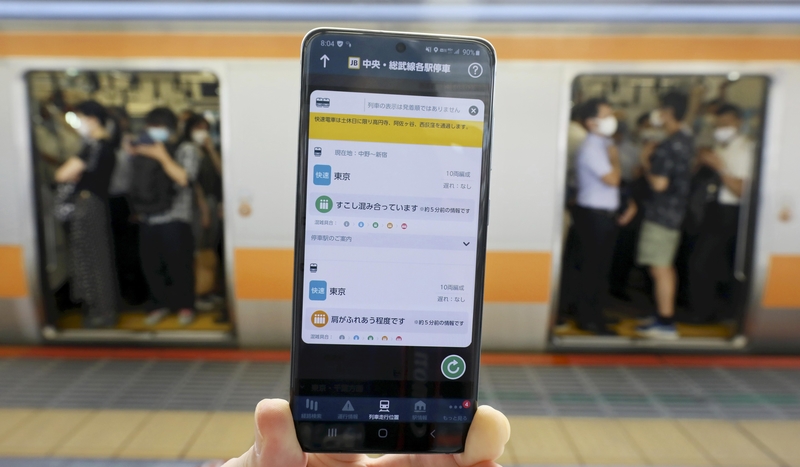
It's 8 a.m. on a weekday morning in early August and a passenger waiting on the Chuo Line's rapid service platform at JR Shinjuku Station in Tokyo opens an app on their smartphone and selects the "trains bound for Tokyo" option. The screen displays a message saying the trains are slightly congested.
The East Japan Railway Co. (JR East) smartphone app shows almost real-time levels of congestion for trains running on major lines in the Tokyo metropolitan area. The service analyzes how crowded trains are based on the weight of each car, and uses a five-stage scale to indicate the congestion level. There is about a five-minute lag.
The app initially was developed to help counter overcrowding during the Tokyo Olympics and Paralympics. JR East rolled out the service in earnest in mid-July in anticipation of heightened demand from passengers concerned about the spread of the new coronavirus. Yahoo Japan Corp. also provides a smartphone app that uses artificial intelligence to predict congestion levels.
It is only natural these days that many people are trying to avoid crowded areas. Previously, 8 a.m. or so was the peak time for commuters to work or school, but recently this has changed to between 6:30 a.m. and 7:30 a.m. "I don't think the trend toward giving priority to preventing infection will move back to the way it was," said Yuichiro Tokunaga, a JR East executive officer.
There is a growing movement to avoid trains entirely.
From mid-July until early August, major mobile carrier KDDI Corp. ran a trial in which about 100 employees each day commuted by taxi from near their homes with fellow colleagues. The company said it will decide whether to introduce this system permanently after carefully examining its cost-effectiveness and convenience.
"There is a growing demand [among employees] to avoid packed trains and travel to work with peace of mind," said a group leader of KDDI's business development section.
Rail companies had long tailored their staffing and train schedules around the morning peak rush so they can quickly carry large volumes of people. This is epitomized by the Chuo Line's rapid service, which has trains departing at intervals as short as two minutes during rush hour and can carry about 82,000 passengers an hour.
However, this model has started to crumble due to the coronavirus pandemic. JR East has started considering a train fare system that would set prices based not just on distance, as it does now, but also on the time of day, with fares higher during rush hours. Spreading out passengers could have the added benefit of saving maintenance costs by leveling facilities and personnel.
If train ridership declines, cutting costs will become imperative. Other rail companies could be forced to take similar action.
"In the post-coronavirus world, the social structure will change from being centered on commuting to daily living, from gathering closely to being more spread out," said Ryoji Akaishi, a JR East executive director. "We will need new ways to handle these changes."
Read more from The Japan News at https://japannews.yomiuri.co.jp/