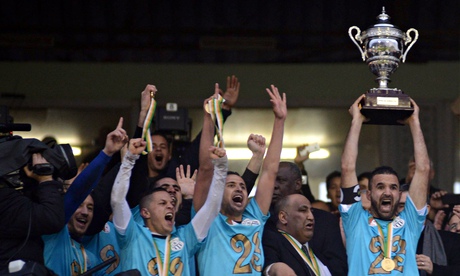
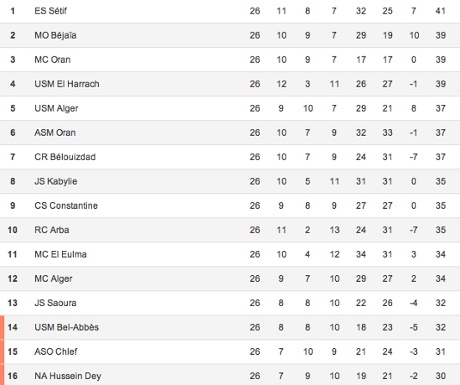
Disappointed that the Premier League lacks a genuinely exciting title race? Dismayed that the situation at the head of the Bundesliga and Serie A is similar? Then feast your eyes on Algeria’s top division. With four matches of the league season to go, a mere 11 points separate the leaders from the bottom club and no fewer than seven teams can win the championship.
Where nine games ago MC Alger were bottom of the table, now they are in the thick of the title race under their Portuguese coach, Artur Jorge. Top spot has been held by five different clubs and the battle to avoid finishing in the 16-team league’s three relegation places is equally intense. USM Bel Abbès, who are 14th, are three points off the comfort of eighth spot.
In Algeria, though, debate has raged over whether this is the best or worst campaign in the history of the country’s domestic football. By this point last season USM Alger had secured their sixth title and opened a 37-point gap on the clubs in the relegation zone, so in some regards it could hardly look more exciting. Yet a lack of goals as teams adopt overwhelmingly conservative approaches means entertainment has too often been lacking. No team have scored more than 34 goals in the 26 matches played so far.
A handful of factors have contributed to the topsy-turvy nature of the league. One constant in Algerian football is supreme domination of home teams. Only JS Kabylie, who played three-quarters of this season behind closed doors, have more defeats than victories at home. Algeria’s most successful club is now in danger of relegation.
Healthy attendances generate such intimidating atmospheres that visiting sides have developed a sort of inferiority complex and rarely go for it. They are often warned that they will face physical attack should they create an upset.
CR Belouizdad’s head coach, Alain Michel, told fifa.com of having to play away in Algeria: “It is practically impossible, for example, to win at RC Arbaa, who only lost one match from 12 at home. Visitors have to deal with a very hostile environment. Some are scared and don’t play at 100%.”
In April two Algeria goalkeepers – Azzedine Doukha and Cédric Si Mohamed – were hit by missiles in away fixtures that fortunately only resulted in superficial cuts on their heads.
Violence is a depressing feature of Algerian football. In August the Cameroonian striker Albert Ebossé died after he was struck on the head by an object following his club JS Kabylie’s defeat by USM Alger. The Federation of Algerian Football suspended the league for a number of weeks and convened to discuss crowd violence.
Suffice to say it is yet to find a permanent solution. A culture of violence reigns in virtually all north African leagues, where disenfranchised youth have claimed the terraces as a space to voice political dissent.
The Ebossé incident demonstrated that crowd violence is a threat to home teams, too, and they often adopt a negative approach for fear of losing.
MC Oran’s winger Kamel Larbi expressed his views on the defensive nature of the matches. “Each team has a tendency to defend. Their primary motive is to not concede goals. In such conditions, victory is seen as a bonus. Avoiding defeat can become an obsession because of the pressure exerted by the media and supporters.”
It also holds true that a uniform distribution of quality has helped make the league more competitive. A relatively small club such as MC El Eulma enjoy the luxury of fielding an attacking midfield of Ibrahim Chenihi, Walid Derradja and Samson Mbingui. Chenihi, whom the national team coach, Christian Gourcuff, has taken a particular liking to, is quite possibly Algeria’s hottest commodity and he will undoubtedly make a move across the Mediterranean in the off-season. Derrardja is this year’s leading scorer, and Mbingui is a Gabon international who competed in the Africa Cup of Nations.
Other clubs, such as second-placed MO Béjaïa and the newly promoted ASM Oran, have well-drilled squads that have displayed the tactical astuteness Algerian domestic football has long been lacking. Their coaches, Abdelkader Amrani and Djamel Benchadli respectively, along with ES Sétif’s Champions League-winning caretaker coach, Kheïreddine Madoui, provide plenty of optimism for the future of local coaching.
Overseas expertise has also helped establish an equilibrium in this season’s championship. Nicolas Anelka has been employed in a technical director role at NA Hussein Dey, which lifted the entire nation. He was, though, reportedly involved in a training-ground spat with Meziane Ighil, who has since quit as coach.
Jean-Michel Cavalli was brought in by MC Oran and the French coach, who led the Algeria national team for a couple of years, has masterfully set-up a fluid 3-5-2 that attacks as admirably as it defends. Jorge has made a big impact at MC Alger.
As the league enters its final straight, sell-out matches will be played under the eye of menacing crowds. One team will lift the title and another will join them in the CAF Champions League; three will be relegated. Supporters across the country have drawn a collective intake of breath, excited by the finish but also hoping these next 360 minutes will unfold in the total absence of violence.