

Shopping habits can say a lot about consumers and retailers. Some people prefer stores where they can grab whatever they need- in one trip. Others are happy to buy in bulk if it means getting a better deal.
That demographic perfectly captures the difference between Walmart shoppers and Costco shoppers. Both companies dominate the retail industry, yet they take very different approaches to winning over shoppers.
Naturally, it gives investors something to ponder. If these two retail giants run such different playbooks, which stock actually deserves a place in a dividend portfolio?
To find out, let’s take a closer look at Walmart and Costco and compare their business models, financial strength, dividends, and what Wall Street currently thinks about both stocks.
Walmart (WMT)
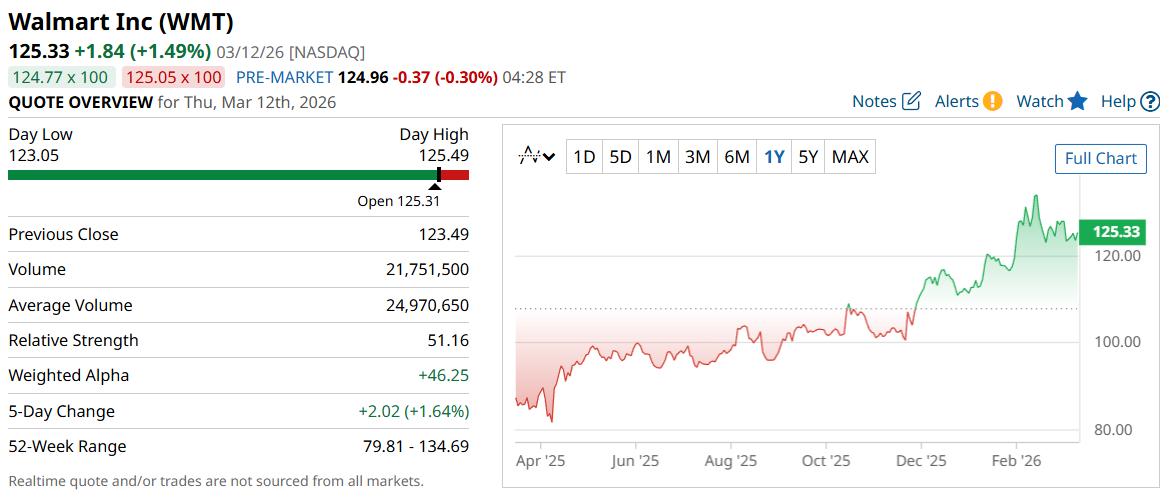
In aisle one, we have Walmart, the world’s largest retailer known for its everyday low prices. With thousands of stores worldwide, Walmart has become the one-stop shop for everything from groceries and household essentials to apparel and electronics. Walmart is also one of the largest companies globally, with a market cap of nearly $1 trillion.
Today, it’s trading around $125 per share, which is up rougly 12% year-to-date.
Costco (COST)
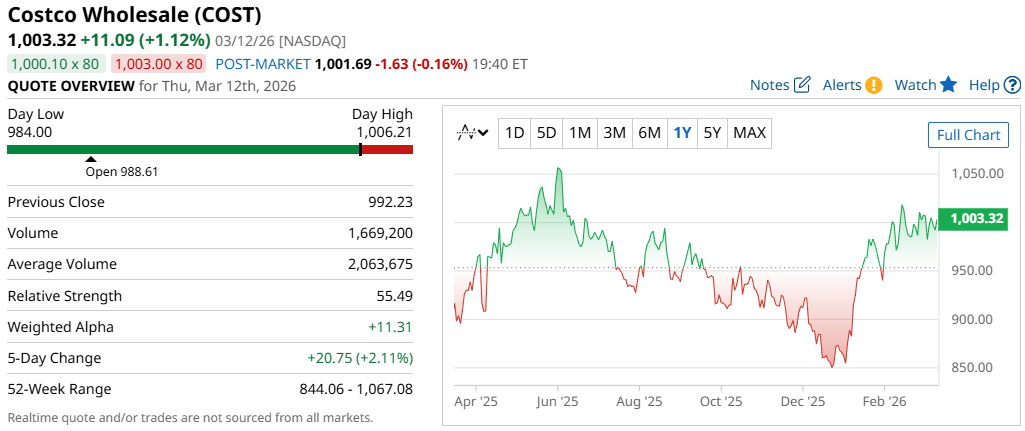
In aisle two, we have Costco. It too is a one-stop shop offering pretty much anything under the sun, including groceries, household necessities, and electronics- and more. What sets Costco apart is its membership model, which translates to a very loyal customer following.
With a $440 billion market cap, Costco is less than half the size of Walmart, but that alone doesn't make it any less investable.
Right now, the COST stock is trading around $1,003 per share, which is up 16% year-to-date.
How Walmart and Costco make money
Now, let’s take a look at how both companies' business models.
Walmart operates on a high-volume, low-price model by capitalizing on its massive product portfolio.
The company keeps prices low across thousands of items as a result of a super-efficient supply chain. Think of it like a store that sells a little bit of everything, but makes money by selling a lot of it. Buying in bulk also means better negotiating power with its suppliers. It also keeps costs down for its customers.
Meanwhile, Costco operates under a membership-based warehouse model with fewer product choices than Walmart.
The company keeps its product selection intentionally limited and focuses on selling items in bulk. Looking for a pound of sugar? At Costco, you'll be buying far more than pound. But you'll get a great price.
Another difference is that Costco earns money through membership fees, which bring a steady stream of income and also help keep product markups relatively low.
In short, Walmart depends on scale and convenience, while Costco leans on bulk pricing and membership loyalty to power its business.
Key financial metrics comparison: Which company is cheaper?
If we compare each company’s latest quarterly financials:
| Metric | Walmart | Costco |
| Sales | $179.5 billion | $69.6 billion |
| Net Income | $6.1 billion | $2 billion |
| Price/Sales | 1.40 | 1.61 |
| Price/Earnings (Forward) | 43.28 | 49.16 |
Right off the bat, we can see that Walmart has significantly higher revenue than Costco. Its net income is also higher at $6.1 billion vs. Costco's $2 billion.
Now, onto valuations. The price-to-sales (P/S) ratio compares a stock’s current market price to its revenue per share to gauge how expensive it is. The lower the P/S, the better.
However, “low” is a subjective value here. To get a better idea of the company’s current valuation, we need to look at the sector’s median.
The Consumer Staples sector has a median price-to-sales ratio of 1.04. That means both companies trade slightly above the sector median.
On the other hand, the forward price-to-earnings P/E ratio compares the stock’s current price to its estimated earnings per share over the next 12 months. Again, lower is better, but we should always be comparing against the peer group.
Right now, the Consumer Staples sector’s median P/E is 21. Both Walmart (+97%) and Costco (+129%) are higher than the sector median.
Now, stocks may look “expensive” as a result of their higher multiples, but that may also mean investors are willing to pay a premium because they believe in the company and they expect better performance in the future. In this particular case, it's the sheer size and moat that both companies have built that justify the higher valuations. I mean, one can't “easily” create a company that's able to compete with Walmart or Costco, can they?
Of course, if you’re looking for a pure value play between the two, Walmart is a better choice at a slightly lower forward P/E.
Dividend track records
Now, let’s move on to what you came for: the dividends. So far, here’s what the picture looks like:
| Metric | Walmart | Costco | Notes |
| Annual Dividend | $0.94 | $5.20 | Costco pays a much larger dividend per share, though the stock itself trades at a far higher price. |
| Dividend Yield (Forward) | 0.75% | 0.52% | Walmart offers a slightly higher yield, meaning investors receive more income relative to the stock price. |
| Dividend Payout Ratio | 35.43% | 27.22% | Costco keeps a lower payout ratio, leaving more room to grow dividends in the future. |
| Years of Dividend Growth | 53 years | 20+ years | Walmart is a Dividend King, reflecting over five decades of yearly dividend increases. |
Overall, Walmart leads in dividend history and yield, while Costco has a slight edge with its lower dividend payout ratio, giving it more room for increases. Both have strengths that appeal to income investors.
Analyst ratings
With that, let's look at what Wall Street says.
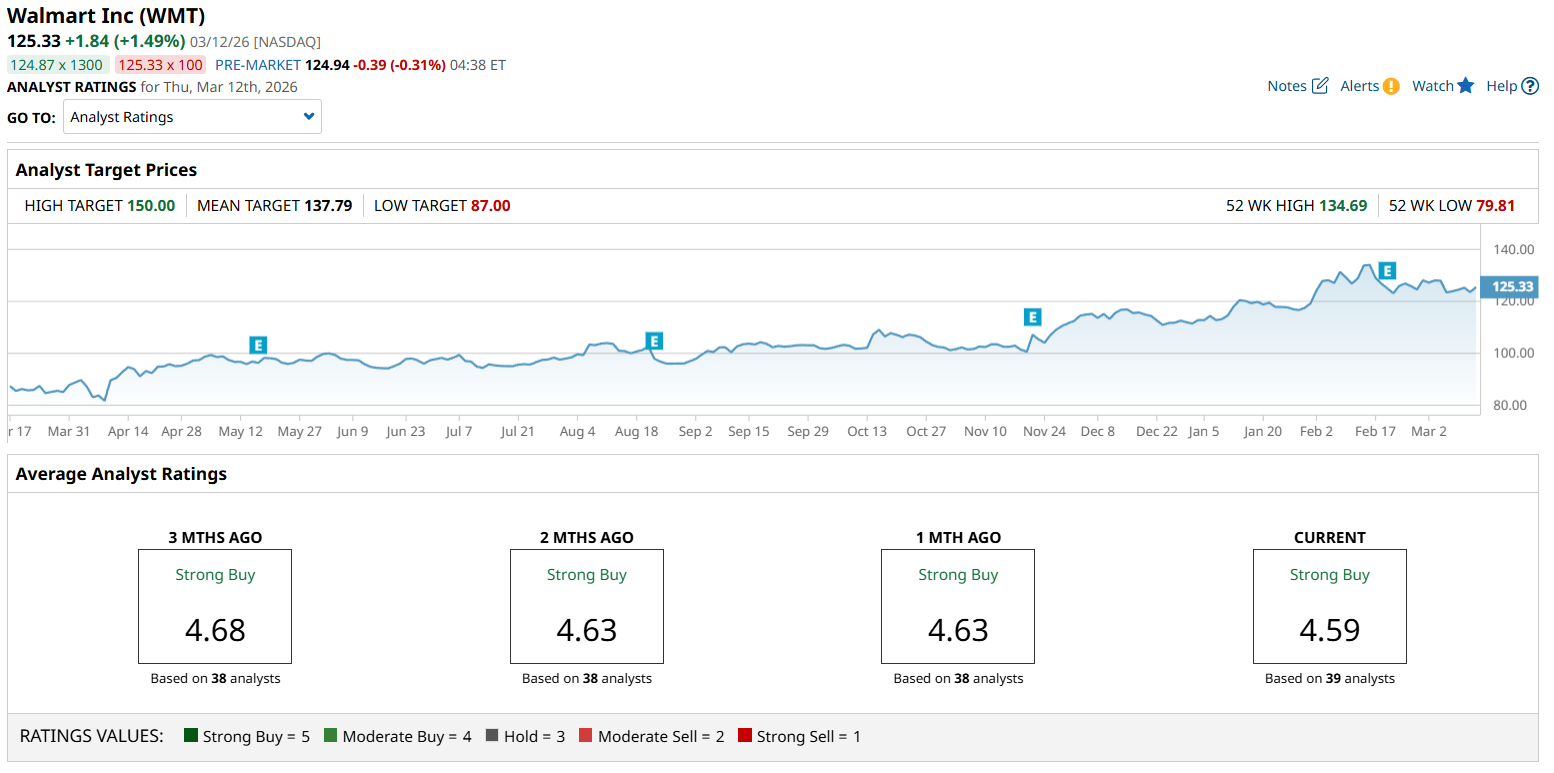
A consensus among 39 analysts rates Walmart stock a “Strong Buy”. The stock also has as much as 20% upside potential if it reaches its high target of $150.
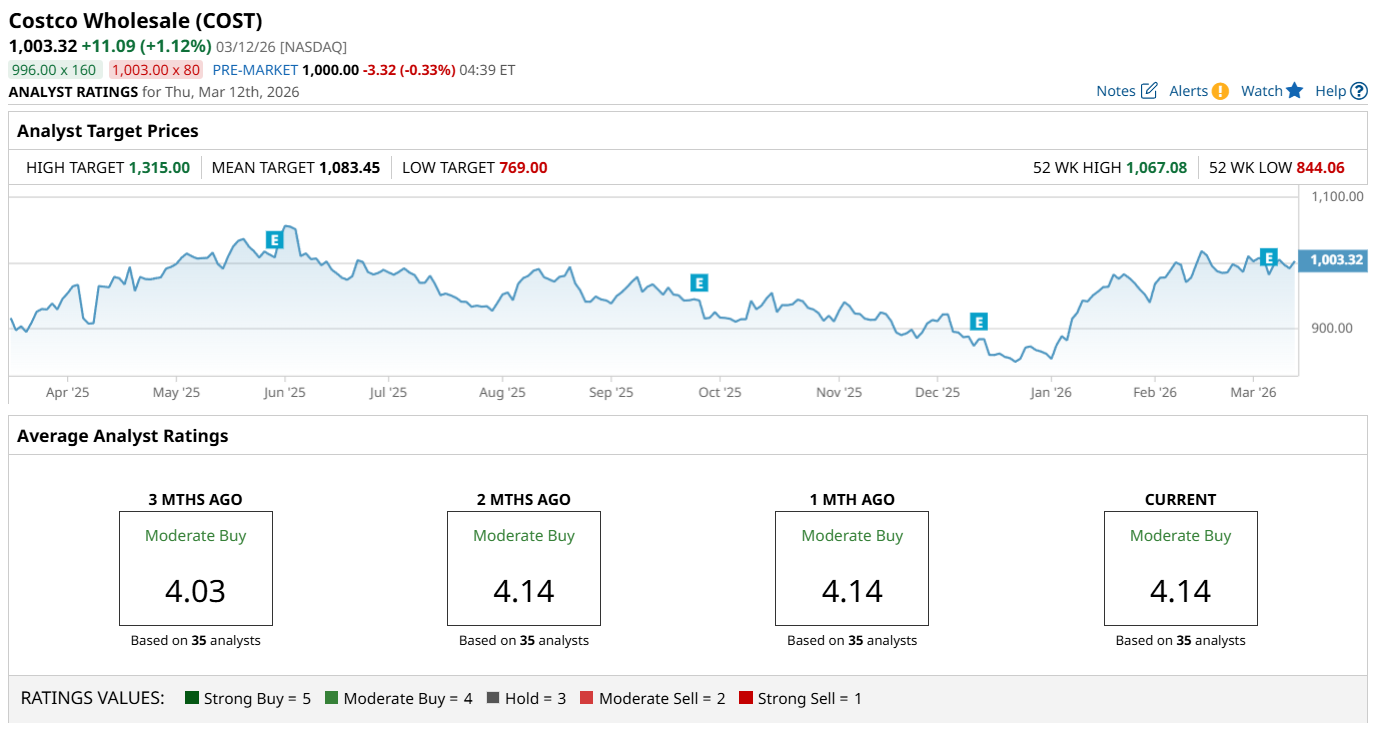
Meanwhile, Wall Street's rating of Costco is a little more modest, with a consensus of 35 analysts rating the stock a “Moderate Buy”. However, its potential upside is higher at at 31% if it reaches its high target price of $1,315.
Which is a better buy: Walmart or Costco?
At the end of the day, Walmart and Costco are simply two very strong independent companies with different strengths. The better stock ultimately depends on your goals and risk tolerance.
If you want the larger, more established company with a longer track record, paying dividends, and a slightly higher yield, Walmart may be the better fit.
But if you're looking for growth potential both in the stock and the payouts, Costco could be a better option over the long term.
In short, Walmart may appeal more to income-focused investors, while Costco could attract those willing to trade a bit of yield for efficiency and growth.