Microsoft and Meta reported within an hour of each other on Wednesday evening. Microsoft shares rose about 9%. Meta shares fell about 9%. Both companies are pouring record sums into artificial intelligence (AI), and investors were listening for the same thing from each.
Microsoft had an answer ready. Fourth-quarter revenue of $90.01B (£67.7B) beat the $87.62B expected.
Microsoft CEO Satya Nadella set out the full year himself within the hour.
Just wrapped our earnings call.
— Satya Nadella (@satyanadella) July 29, 2026
It was a very strong close to what was a record fiscal year for Microsoft.
· Annual revenue: $331B, +18%
· MS Cloud: $214B, + 27%
· And Azure: $100B, +41%
And even bigger opportunity ahead!
I wanted to share some more perspective on two areas…
Revenue reached $331B (£249B), up 18%, with the cloud division on $214B (£161B). Azure alone passed $100B (£75.2B) for the first time, growing 41%.
The two sets of numbers sat side by side and pointed in opposite directions.
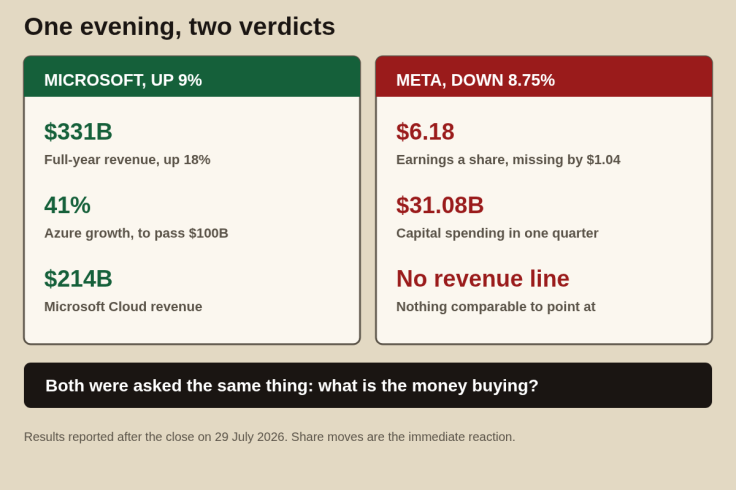
Meta earned $6.18 a share, $1.04 below forecasts, and guided to between $61B and $64B for the current quarter, compared to a consensus of $63.15B. Its shares closed down 8.75%. Neither figure is disastrous on its own, but together they left the company with little to show.
The symmetry of the two share moves is a coincidence. The pressure behind them was the same: both companies made their largest capital commitments in history during the quarter, and only one provided evidence of progress.
The Question Both Were Asked
Nobody on either call was really asking about last quarter. They were asking when the building will stop costing more than it returns.
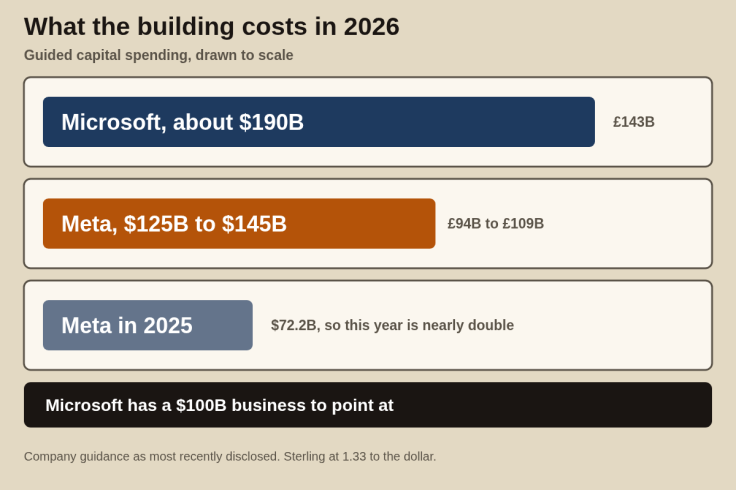
Microsoft has guided to roughly $190B (£143B) of capital spending this year. Meta has guided to between $125B and $145B (£94B to £109B), raised in April from a range already called aggressive. Its most recent quarter alone carried $31.08B (£23.4B) of that. Across the four largest cloud and platform companies, planned spending for 2026 runs to somewhere between $635B and $725B, against about $410B last year.
Money on that scale needs a story attached to it. Microsoft's story is Azure, a business with a revenue line, a growth rate, and a backlog of orders it says it cannot fill yet because of power constraints.
The company published the supporting numbers the same day.
It was a record year driven by strong demand across the Microsoft Cloud. Here’s three highlights from our FY26: https://t.co/wTl7smptYa pic.twitter.com/eACvOiJZBs
— Microsoft (@Microsoft) July 30, 2026
That backlog has been put at around $80B, which is an unusual thing for a company to advertise and a useful one, because unmet demand is easier to price than a promise.
None of those measures existed three years ago. Their point is not the numbers themselves but that they can be counted at all.
Why Meta Struggled to Answer
Meta has no equivalent line. Its spending goes into models and infrastructure that feed advertising, recommendations, and a longer bet Mark Zuckerberg has described as personal superintelligence. There is no quarterly figure to point at that separates the return from everything else the company does.
That gap is not new, and the market has punished it before. When Meta lifted its capital spending guidance in April, blaming component prices and additional data centre costs, the shares fell more than 6% after hours. Wednesday was the same reaction to a different trigger.
The pattern now runs across the sector. Alphabet was rewarded in April when it could point to cloud revenue growing 63%. Companies that cannot draw the line between what they spend and what comes back are being marked down, whatever the rest of the results look like.
What Happens Next
The build-out itself is not slowing. Every one of the four largest spenders has reaffirmed or raised guidance at its most recent results, and demand for computing capacity is still running ahead of supply.
What has changed is the patience. Analysts who spent two years treating capital spending as a signal of ambition now treat it as a bill, and they want to see the invoice settled.
Microsoft has started producing one. Meta has been asked twice this year and has not yet obliged. The risk for a company still earning most of its money from advertising is not that the spending fails. It is that nobody can tell whether it worked until long after the money has gone.
Disclaimer: Our digital media content is for informational purposes only and does not constitute investment advice. Please conduct your own analysis or seek professional advice before investing. Remember, investments are subject to market risks, and past performance does not guarantee future returns.