Closing Summary
It would be reckless to claim that this bout of volatility was suddenly over, especially when we have Societe Generale insisting we’re in a bear market.
So lets just stick to the fact that the financial sector is looking a little less alarming tonight, and come back tomorrow and see if it holds up.
The key points:
-
Wall Street has posted its biggest-two day gain since 2009. The Dow and the S&P 500 both jumped again, helped by speculation that US interest rates will not be raised in September, and decent economic data
-
Europe also recovered. Britain’s FTSE 100 now almost flat for the week
-
America’s economy expanded faster than previously thought in the second quarter of the 2015. Annualised growth of 3.9% beat expectations, helping to send the oil price surging
-
Our earlier summary explains how a recovery in China sparked the rebound.
Goodnight! GW

Updated
The oil price has rocketed by 10% this evening, its biggest rally in six years.
A barrel of Brent crude oil jumped by $4.49 per barrel to $47.63, a huge move. US crude oil jumped $4.18 per barrel to $42.78.
The upgrade to US GDP in April-June, to an annualised rate of 3.7%, has bolstered optimism over global growth prospects.
Three nights ago, fear was sweeping the markets that China’s Black Monday was trigging a global panic.
Tonight, though, the stock markets of Japan, Europe and the US have pulled back most of their losses, as this nifty chart shows:
Global stockmarkets since China’s crash in “real time” (hat tip to Tuesday’s @nytimes @WSJ) http://t.co/2LnThZSsOQ pic.twitter.com/VouW0bGUHV
— The Economist (@TheEconomist) August 27, 2015
Tonight’s surge on Wall Street mirrors the way that Shanghai stock market rallied in late trading, just 13 hours ago.
Insiders say that Beijing intervened to push shares up, to avoid a crash ahead of a big parade next week, to mark the end of the second world war.
David Woo of Bank of America Merrill Lynch says this has boost confidence in the markets.
Investors believe the Chinese authorities will keep taking action to avoid another market rout overshadowing the event, he tells Bloomberg.
Woo also explained how automatic trading systems are playing a massive role in the recent turmoil.
Algorithmic trading is "absolutely crucial" to understanding the recent market turmoil: BofA's David Woo @adsteel @TheStalwart
— Lisa Abramowicz (@LisaAbramowicz1) August 27, 2015

US stock market rallies again
Another remarkable day’s trading is over, with the US stock market sharply higher.
That late rally saw the Dow Jones industrial average end the day up 369 points, or 2.27%, at 16,655.
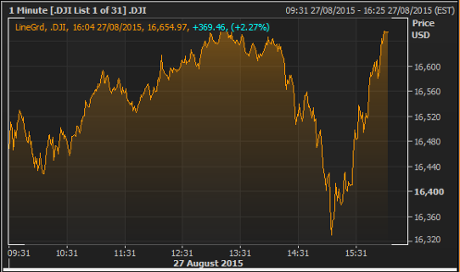
The S&P had gained around 47 points, or 2.4%, to 1,987. And the tech-heavy Nasdaq was 2.43% higher at the close.
That means the Dow and S&P have both posted their biggest two-day jumps since 2009, says Bloomberg.
Optimism that China’s market rout may be easing, and a solid upgrade for US GDP, helped to drive share up.
US Closing Prices: #DOW 16654.77 +369.26 #SPX 1987.66 +47.15 #NDX 4324.82 +105.22 #VIX 26.14 -4.18
— IGSquawk (@IGSquawk) August 27, 2015
Updated
DJIA now some 160 points above the Monday crash level and it's not even the end of the week!!
— RANsquawk (@RANsquawk) August 27, 2015
It’s been a volatile day though - at one stage, the Dow had dropped back quite sharply, before going on a late surge in the last hour.
Hello again. The rally is holding, as Wall Street heads into the close of trading.....
Dow up 1.9% S&P up 2.2%
— Sign of a Reciprocal (@FEED29) August 27, 2015
Wall Street continues to rally, recovering more of this week’s losses after today’s growth figures helped shore up confidence.
Stocks (not socks as I wrote earlier, drat it) are hitting their highest levels of the day, pushing the Dow Jones index up 377 points, or 2.3%.
So I’m going to take a break now, but will pop back later to catch the close of the New York stock exchange....

Updated
Greece’s first female prime minister, top supreme court judge Vassiliki Thanou, has just been sworn in.
Official handover at PM's office #Greece #elections pic.twitter.com/FdI6BiXPKU
— Nektaria Stamouli (@nstamouli) August 27, 2015
Habemus Minister Primus. #Greece pic.twitter.com/0K4Ay69gla
— Yannis Koutsomitis (@YanniKouts) August 27, 2015
Thanou will lead a caretaker government until elections are held, probably in September. Her administration will be sworn in on Friday.
Updated
Europe can ride out the Chinese turmoil, says European commissioner Pierre Moscovici tonight.
Reuters has the details:
“I am not worried, especially as monetary authorities in China and elsewhere have reacted or said they would,” Moscovici told France’s iTELE.
“My feeling today ... is that European economies are able to weather what is happening on the Chinese market. The fundamentals of the recovery in Europe and in France are solid enough.” [end].
The fundamentals aren’t *that* strong, though. France’s economy stagnated during the last quarter, for starters....
Although stocks have rallied today, they’re doomed to fall sharply in the coming weeks, claims one City analyst with a reputation for pessimism.
Albert Edwards of Société Générale warned clients today that we are already experiencing a ‘bear market’.
He believes investors are deluded to think that the west won’t be hit by problems in emerging markets, or that central bankers can “eliminate the business cycle” through more stimulus measures.
Edwards is known as a “permabear” in City circles for his gloomy view; arguably it would be more newsworthy if he were optimistic. But anyway, here’s his take:
One of the many lessons from equity investing during Japan’s Lost Decade is that in a secular bear market hope is a killer. In a secular bear market hope should only be flirted with briefly during cyclical upturns, but it must be ruthlessly rejected as the cycle turns.
In a secular bear market being wedded to hope destroys portfolios as the bear slashes to ribbons the hard-fought gains of the previous bull market. Gains that have taken years to accumulate are gone in months.
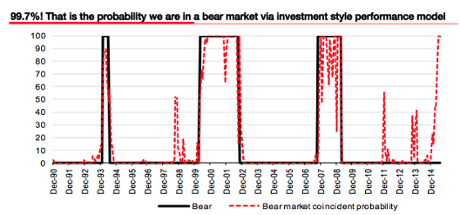
One key measure we monitor informs us conclusively: we are now in a bear market.
And here’s that measure:
Updated
This is the biggest rally on the FTSE 100 in almost four years, beating Tuesday’s record.
FTSE 100: Largest one-day percentage gain since Thursday, October 06, 2011.
— Josie Cox (@JosieCoxWSJ) August 27, 2015
By my reckoning, today’s market rally has boosted the value of the FTSE 100 by around £55bn (that’s not official, though)
Laith Khalaf of Hargreaves Lansdown, the financial services firm, says it shows the important of not selling when markets crash.
“It’s been one of the best ever days for the UK stock market, neatly illustrating why it’s a bad idea to sell out in a market rout. Black Monday was a truly dreadful day for stock investors, but it’s been followed by big bounce, with the Footsie now back where it ended last week. Markets tend to over-react to both good and bad news, so sharp falls are often followed by strong rallies.
Markets have today been buoyed by a rally in Chinese shares, a rise in commodity prices and a substantial upward revision of economic growth in the US. It would be foolhardy to suggest we’re out of the woods yet though, and share prices are likely to remain volatile for some time.
When markets are behaving erratically, investors should sit on their hands, and stick their fingers in their ears too if they can.
Sounds tricky.....
Today is now Triffic Thursday, apparently:
FTSE 100 chart of the week so far - updated (h/t @cajuk for the Thursday label) pic.twitter.com/sf39OCf37k
— RBS Economics (@RBS_Economics) August 27, 2015
I trust we’ll keep tomorrow clean, chaps? Family audience, remember....
FTSE surges by another 3.5%
Crisis, what crisis?
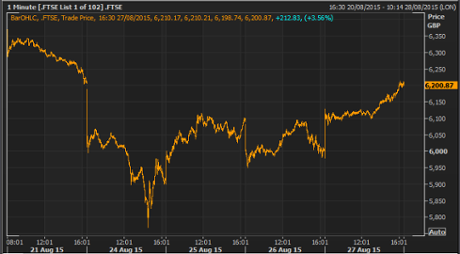
Britain’s FTSE 100 index had clawed back almost all its losses from earlier this week, as world stock markets rebound today.
The blue-chip index surged by 212 points by the close of trading, up 3.5% to 6192. That’s only 14 points shy of the close last Friday night.
Investors have been swooping for bargains, driving mining stocks such as Antofagasta, BHP Billiton and Anglo American up by 9% each today.
BHP shares rally 9.2 percent in London trading. Biggest 1-day gain since 2009 - adds $5bln to market cap pic.twitter.com/lwixhwCKEW
— Jesse Riseborough (@JP_Riseborough) August 27, 2015
The rally appears to have three drivers:
- The US economy is growing faster than expected, thanks to today’s GDP revisions
-
The rout in China’s stock market ended today, after Beijing authorities intervened in the market
- Investors believe the US Federal Reserve will take a more dovish approach to interest rate hikes, given recent market turbulence.
But can it last? Investors will surely be watching Wall Street nervously tonight, and then checking Asia out on the phones when they wake up tomorrow.
As Tony Cross of Trustnet explains, serious bouts of volatility rarely end quickly; especially as Monday is a bank holiday.....
With the long weekend in the UK, volumes could well thin out tomorrow afternoon, exaggerating any moves in the market – we’re over 400 points up from the week’s lows so some short term profits could be taken.
European stock markets have all posted very strong gains today. More in a moment...
European Closing Prices: #FTSE 6192.03 +3.56% #DAX 10315.62 +3.18% #CAC 4658.18 +3.49% #MIB 22201.24 +3.39%
— IGSquawk (@IGSquawk) August 27, 2015
Europe’s stock markets are spiking higher, up 3% to 4%, as the trading session approaches its end....
Following today's rally, the #FTSE is surprisingly on track for its best week in August. TM pic.twitter.com/qzveyFDWGy
— IGSquawk (@IGSquawk) August 27, 2015
Wall Street is holding onto its early gains. After an hour’s trading, the Dow is up 206 points, or 1.3%, as calm returns to the markets.
But as US business editor Dom Rushe tweets, the calm might not last:
Today's stock market emoticon: 。(⌒∇⌒。) of course this may change (个_个) http://t.co/wVMN2v6j7P
— dominic rushe (@dominicru) August 27, 2015
Greece is about to get its first female prime minister.
Vassiliki Thanou, the Supreme Court president, will be sworn in at 8pm local time (6pm BST, 1pm EDT), to head a caretaker government until elections are held next month.
#Grecia: Vassiliki #Thanou premier ad interim - alle 20.00 (ora locale) il suo giuramento pic.twitter.com/hF4txuIwJf
— Danai Dasopoulou (@d_daso) August 27, 2015
As explained earlier, snap elections are imminent as opposition parties failed to form a government, following Alexis Tsipras’s resignation a week ago.
Updated
Dow Jones surges at the open
Shares are rallying in New York at the start of trading, led by technology stocks.
The Dow Jones has gained by 209 points at the open, up 1.3%, adding to yesterday’s 619-point gain.
If the Dow maintains that rise (and that’s a BIG if), it would be the best two-day gain since 2009.
The Nasdaq has turned positive for the year, too.
Traders appear to be welcoming today’s growth data, and the rally in Asia and Europe earlier today.
Updated
Wall Street trading is underway, so we’re about to find out whether yesterday’s rally still has legs....
Nancy Curtin, chief investment officer of Close Brothers Asset Management, believes Wall Street should cheer these new growth figures:
“A healthy upwards revision to US GDP should act as a much needed soothing balm for investors after the turbulence of this week. Yes, the Chinese slowdown is making its mark on the performance of US manufacturing, and the natural resource sector is still reeling from lower commodity prices. However, today’s figures should underline the resilience of the US economy in light of global headwinds. Even amid falling investment spend in mining, investment was a pleasant surprise. Consumer spending remains robust, sentiment is climbing, while the labour market showing sign of rude health.
“Whether this economic performance is enough to sway the Fed to raise rates remains to be seen - the recent mayhem in global markets and fears over a slowing global growth will cast a long shadow on the decision.”
Economics professor Justin Wolfers urges caution over the growth figures:
Q2 GDP was revised to a cracking 3.7%, compared with an advance estimate of 2.3%. Market had expected 3.1%. Sounds like good news, but...
— Justin Wolfers (@JustinWolfers) August 27, 2015
Many people prefer Gross Domestic Output -- an average of the income- and expenditure-based measures of GDP. That grew at 2.1% last quarter.
— Justin Wolfers (@JustinWolfers) August 27, 2015
Encouraging sign - every component of the US economy grew in the last quarter:
As goes the consumer, so goes the US economy. Q2 growth revised up to 3.7%q/q annualised. pic.twitter.com/XCmM9PEhz9
— RBS Economics (@RBS_Economics) August 27, 2015
America’s economy has now grown for the last five quarters -- showing it’s ready for higher borrowing costs?
Is this the picture of an economy needing zero interest rates? http://t.co/qlrqva76aZ pic.twitter.com/064tyGlcEU
— MarketWatch Economy (@MKTWeconomics) August 27, 2015
Why has the US growth rate been revised up?
The US Commerce department reports that ‘fixed investment’ by US firms was stronger than first estimated. They also stocked up their inventories by more than expected -- $121.1bn, not $110bn.
Exports rose strongly, while imports fell, compared with the first quarter.
And consumer spending was revised up to 3.1%, from 2.9% originally.
The full report is online here.
Q2 GDP growth by component http://t.co/3w20eBM9xY pic.twitter.com/15vyRjcnu3
— BI Markets (@themoneygame) August 27, 2015
US economic growth revised up to 3.7%
Important news from the US: America’s economy grew much faster than first estimated in the second quarter of the year.
Annualised growth has been revised up to 3.7% for the April-June period (or more than 0.9% on a quarterly basis), beating expectations.
That’s a sharp increase on the first estimate of 2.3% annualised growth, and means the US outpaced other advanced nations (Britain grew by 0.7% during Q2).
That may put more pressure on the Federal Reserve to raise interest rates soon, despite the turbulence in the global economy. But it also suggests the US is better prepared handle such a hike.
More detail and reaction shortly...
Updated
For an insight into China’s economy, you must read Tom Phillips’ latest dispatch about how conditions have worsened.
He travelled to a community 45 minutes’ drive from Tiananmen Square, where conditions are tough, and getting tougher.
For example:
“It’s the worst we’ve seen it. It’s even worse than 2008,” said Liu Weiqin, who like most of the village’s residents hails from Xinyang in south-eastern Henan province, one of China’s most deprived corners.
SUMMARY

A quick recap of the main points
- China’s stock market has rebounded today, jumping more than 5% by the close of trading and sparking a break-out of smiles across trading floors.
- It appears that the Beijing authorities intervened, in an attempt to stop the rout raining on their World War 2 celebration parade next week.
-
Europe’s stock markets are also rallying, clawing back much of their losses on ‘Black’ Monday and Wednesday. The FTSE 100 is up 140 points, or 2.35%, now at 6119.
-
A senior ECB policymaker has called for closer union to reinforce the single currency, and slay the ‘evil genie’ of Grexit.
-
Greece is moving closer to snap elections, after opposition parties failed to form a government following the resignation of prime minister Alexis Tsipras last week.
Updated

Speaking of Grexit...former finance minister Yanis Varoufakis has argued that, bad through the eurozone is today, Greece shouldn’t try to get out.
That’s one highlight from an interview with Varoufakis by The Conversation, who asked nine economists to put questions to him.
For instance:
Mark Taylor, University of Warwick - Would you agree that Greece does not fulfil the criteria for successful membership of a currency union with the rest of Europe? Wouldn’t it be better if they left now rather than simply papering over the cracks and waiting for another Greek economic crisis to occur in a few years’ time?
Varoufakis: The eurozone’s design was such that even France and Italy could not thrive within it. Under the current institutional design only currency union east of the Rhine and north of the Alps would be sustainable. Alas, it would constitute a union useless to Germany, as it would fail to protect it from constant revaluation in response to its trade surpluses.
Now, if by “criteria” you meant the Maastricht limits, it is of course clear that Greece did not fulfil them. But then again nor did Italy or Belgium. Conversely, Spain and Ireland did meet the criteria and, indeed, by 2007 the Madrid and Dublin governments were registering deficit, debt and inflation numbers that, according to the official criteria, were better than Germany’s. And yet when the crisis hit, Spain and Ireland sunk into the mire. In short, the eurozone was badly designed for everyone. Not just for Greece.
So should we cut our losses and get out? To answer properly we need to grasp the difference between saying that Greece, and other countries, should not have entered the eurozone, and saying now that we should now exit. Put technically, we have a case of hysteresis: once a nation has taken the path into the eurozone, that path disappeared after the euro’s creation and any attempt to reverse along that, now non-existent, path could lead to a great fall off a tall cliff.
Varoufakis also denied bluffing during the months of negotiations, and revealed he was once accused of ‘lecturing’ the eurogroup....
.@yanisvaroufakis explains what happened during the Troika negotiations. Read in full here: http://t.co/OnXqljGdU3 pic.twitter.com/clZcZeOwKt
— The Conversation (@ConversationUK) August 27, 2015
ECB's Cœuré: Evil genie of euro exit must be slain

Benoît Cœuré, an executive board member of European Central Bank, has taken a stinging swipe at those who allowed Greece to almost crash out of the eurozone this summer.
In a speech to ambassadors in Paris, Cœuré demanded that eurozone leaders achieve closer unity, to avoid the single currency splintering.
In what looks rather like an attack on Germany’s finance minister Wolfgang Schäuble, Cœuré said the euro was “an irreversible project, not simply a fixed exchange rate system”.
This statement is all the more necessary as the recent negotiations concerning Greece have let the evil genie of a country exiting the euro area (even temporarily) out of the bottle. The exit of a member country would inevitably lead economic actors to wonder who would be next, with all the potential destabilising effects that such speculation could entail. The genie will not be put back in its bottle once and for all until it is clear that such a risk will not rear its head again.
We need to use the confidence in the single currency to build institutions that will reinforce the cohesion of our economic and political union.
Readers may recall that, last month, Schäuble proposed allowing Greece to temporarily exit the eurozone, allowing debt restructuring.
Cœuré’s speech is well worth a read; his conclusion urges today’s politicians to match the achievements of their predecessors:
There is nothing inevitable about the status quo, but, to go beyond it, we need to rediscover the spirit of Robert Schuman. In 1950, this French Foreign Minister had the political courage to propose to Germany that the two countries pool their economic resources and share sovereignty within a common institution. This gave birth to European integration.
Let’s not forget that shared ambition is a powerful driving force. Herbert Blankenhorn, then Adenauer’s diplomatic advisor, recorded in his diary the Chancellor’s words of 24 May 1950 and the optimism inspired in him by Schuman’s plan: “Wenn Furcht beseitigt werde, werde Europa wie ein genesender Kranker seine Kräfte wiederfinden” [“Once fear has been overcome, Europe, like a convalescing patient, will find its strength again”].
Important speech by ECB's Coeuré on future of #Eurozone. Standing still not an option in his view http://t.co/leXZInaGqR
— Open Europe (@OpenEurope) August 27, 2015
Updated

Luxury jeweller Tiffany has just given Wall Street a reminder not to get too optimistic.
Tiffany is cutting its earning forecast for the year, after posting the second straight quarter of lower sales.
It has been hit by the strong dollar, which has deterred tourists from visiting the US and also dented the value of overseas sales.
Despite capital controls and bank closures, Greeks managed to withdraw almost €1.5bn from the banking sector during the wild weeks of July.
New data shows that deposits hit a new 12-year low last month, to €120.8bn from €122.2bn in June.
Greek bank deposits by businesses and households fell to €120.8bn in July from €122.2bn in Jun despite cap controls. pic.twitter.com/UrkZV6wnCS
— Holger Zschaepitz (@Schuldensuehner) August 27, 2015
If China’s market wobble does ease, investors can go back to worrying about Greece.
The next Greek election will move a step closer today, when the left-wing Popular Unity party hands back the ‘mandate’ to form a government.
That means president Prokopis Pavlopoulos will then gather all party leaders to see if a coalition government can be formed (highly unlikely), or move on to the next stage -- a caretaker government and an election date.
That election may leave Greece as unstable as ever. Last night, outgoing prime minister Alexis Tsipras ruled out forming a coalition with any of the centrist opposition parties: center-right New Democracy, the socialist Pasok party or the small centrist To Potami party.
AP reports:
“I think that all three parties essentially express the old political system,” he said in an interview with private Alpha TV Wednesday evening.
Not that Tsipras is guaranteed to win power again. His Syriza party has been hit by defections, since the leftist wing split off to form Popular Unity.
#greece seems @tsipras_eu wins every ballot troika wants him to lose but may lose the only one it wants him to win
— Ian Traynor (@traynorbrussels) August 27, 2015
Photos: Chinese investors perk up
China’s army of small investors were all smiles today, as the Shanghai index rallied by over 5% by the close of trading today:


The Shanghai Composite Index is now 40% below its June peak, but still 40% higher than it was 12 months. #GreatFallofChina
— Guy Harding (@GuyHardingSky) August 27, 2015

After three days of wild swings, London’s stock market is a calmer place this morning.
Every share on the FTSE 100 is up, meaning the blue-chip index has recovered most of the losses earlier this week.
Mining shares are doing well, along with chipmaker ARM and Standard Chartered, the bank. They’re all particularly exposed to China’s economy.
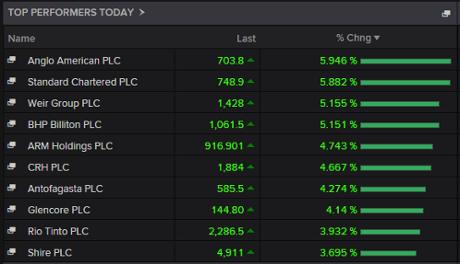
Augustin Eden at Accendo Markets says the City is shaking off Black Monday, and going bargain-hunting:
“Equity markets are positive this morning, as a perceived recovery continues following Monday’s flash crash. Encouraging news from the US Fed finally giving markets something other than ‘buy it ‘cos it’s cheap’ to bite on while China continues to engage in some wild volatility.
Still, the developed world appears to be getting on with things.
Bloomberg: Beijing intervened to push up shares
China’s government intervened to boost the stock market today, says Bloomberg:
China wants the market to stabilize ahead of a Sept. 3 military parade celebrating the World War II victory over Japan, said the people, who asked not to be identified because the move wasn’t publicly announced.
The government bought blue-chip stocks, according to one of the people.
This would explain that late rally in Shanghai, in which the index jumped over 5%. It also suggests Beijing will keep propping up the market, if needed, until the WW2 commemoration is over.
Chinese shares surged today because authorities wanted a rally before a big military parade. http://t.co/WD19vgyNI2
— Joseph Weisenthal (@TheStalwart) August 27, 2015
Germany’s stock market has now recovered all the losses made earlier this week.
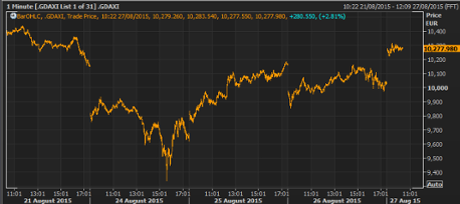
The DAX is now up almost 3% today, outpacing the rest of Europe.
German companies are benefitting from the weaker euro. It has dropped below $1.13 after the European Central Bank hinted it could ease monetary policy, should inflation remain too low.
There’s a suspicion that the Chinese authorities intervened today, to push the Shanghai market higher after it had a late wobble.
Zhang Gang, a strategist at Central China Securities in Shanghai, says:
“Heavyweight stocks like banks and insurance companies helped pull up the index, and it’s possibly China Securities Finance entering the market again to shore up stocks.”
China Securities Finance are part of the ‘National Team’ of state-directed investors.
Shanghai rockets up 6% in the final hour to be up 5.3% on the day. Sure looks like the national team wanted to cross the 3,000 level.
— Matt O'Brien (@ObsoleteDogma) August 27, 2015
Financial markets remain “messy, but also somewhat less volatile” today, says Kit Juckes of Société Générale.
China is obviously a worry; the other issue remains the timing of the first US interest rate hike.
Right now, the Federal Reserve seems unlikely to act in September, which is helping to push shares higher.
Kit writes:
Markets are a mixture of nervousness (about Fed policy, PBOC policy and the economy) and dovish Fed expectations.
Positioning for the Fed to be more dovish than you think is likely (or even possible) has not been a bad trading strategy for the last decade or so, and partly explains why market pricing of Fed moves is for them to act later and go slower than most economists believe they will.
Here’s a reminder of why we shouldn’t get carried away:
8 days in the life of the #China stock market.... pic.twitter.com/jFeyFxSE30
— Mark Barton (@markbartontv) August 27, 2015
Some cutting-edge technical analysis of the Chinese stock market’s rally:
Shanghai Composite. Arises like the Loch Ness monster pic.twitter.com/hFugi8Rgfv
— Richard Frost (@frostyhk) August 27, 2015
@LorcanRK @frostyhk The rarely-seen but highly-prized Loch Ness pattern appears pic.twitter.com/bPitJ9BQtJ
— Daniel Lin (@DLin71) August 27, 2015
Updated
As FastFT points out, we don’t really know, yet, why the Chinese stock market jumped today.
Have China’s mom-and-pop investors rediscovered faith in Beijing’s leaders, or has Beijing itself just directed its state-owned enterprises, or its margin-lending arm, to buy more shares? Impossible to say, for now....
Updated
Many Chinese stocks had to be suspended today because they jumped 10%, the maximum allowed in one session.
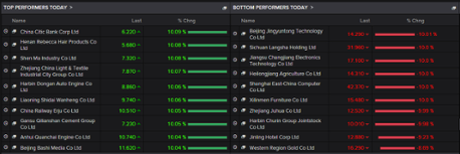
It was another volatile day, though, with the index flirting with another loss before that late surge:
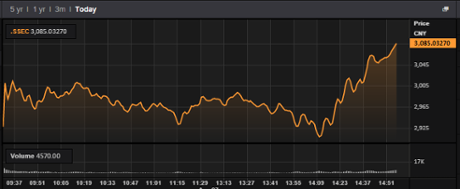
Dead dragon bounce? RT: @AP: BREAKING: China's main stock market index closes up 5.3 percent for biggest one-day gain in 8 weeks
— David Jones (@JonesTheMarkets) August 27, 2015
Today’s rally in China was partly driven by reports that Beijing is taking new steps to prop up the market:
BREAKING: China will hold press briefing 10am Friday to announce details of pension fund investments, incl "up to 1/3 of capital" for stocks
— George Chen (@george_chen) August 27, 2015
*CHINA STOCKS RALLY ON POSSIBLE STATE BUYING: CENTRAL CHINA SEC.
— lemasabachthani (@lemasabachthani) August 27, 2015
Chinese stock market surges 5%
China’s stock market has just posted its biggest one-day jump since July 9th, ending five days of heavy losses.
A late surge drove the Shanghai stock market up by around 5.4% by the close of trading.
After several panicky days, calm returned to the markets today.
Here’s Reuters take:
Sentiment was aided by comments from New York Fed President William Dudley on Wednesday who said the prospect of a September rate hike “seems less compelling” than it was only weeks ago.
“From today, I’m no longer pessimistic,” Jiang Chao, a strategist at Haitong Securities, who correctly predicted China’s stellar bull run which ended in mid-June, wrote on Thursday.
It’s only one day, of course, and it only makes a small dent in the rout that began two months ago:
China’s Stocks rise after worst five-day decline in two decades http://t.co/MH00VdfClc; Dudley cools Sept. prospects pic.twitter.com/iNpzud0H5k
— Francine Lacqua (@flacqua) August 27, 2015
And it doesn’t mean China has suddenly solved its big economic challenges - including a slowing economy, rising bad debts, capital outflows. But still, a reassuring sign.
Updated
FTSE 100 bounces back
European stock markets are surging at the open.
The FTSE 100 index jumped by around 150 points at the start of trading, a gain of over 2%.
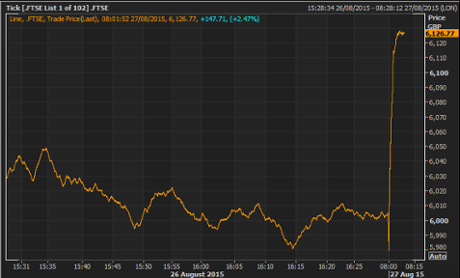
The relief rally that began on New York last night, when the Dow jumped almost 4%, is pushing other European markets up over 2% too.
Traders are relieved that the Federal Reserve is now unlikely to raise interest rates next month, which means the era of ultra-cheap money will last longer.
Ian Williams of Peel Hunt explains:
Yesterday’s more dovish comments by NY Fed President Dudley, who had previously been one of the FOMC members pushing for an rate increase but now views the case as “less compelling”, appear to have reassured investors that the Fed is unlikely to add further to current market volatility.
China’s stock market is surging higher in late trading, rather than suffering its now-traditional late sell-off.
A flood of buy orders is pushing Shanghai’s index up by 5%, having been down just 30 minutes ago...
No market does "Crazy half-hour" like the Shanghai Composite does "crazy half-hour"
— Lorcan Roche Kelly (@LorcanRK) August 27, 2015

Japan’s stock market has closed, up more than 1%, as traders in Tokyo rediscovered their appetite for riskier assets.
The Nikkei gained 196 points to 18,574, after last night’s rally on Wall Street calmed fears.
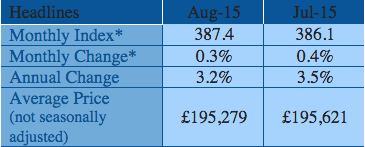
We can’t blame China for this, but it appears Britain’s housing boom is cooling off.
Nationwide, the building society, reports that annual growth slowed to 3.2% in August, the weakest since mid 2013.
Robert Gardner, Nationwide’s chief economist, says:
“This month’s data provides further evidence that annual house price growth may be stabilising close to the pace of earnings growth, which has historically been around 4%.”
Even so, you’ll still need almost two hundred grand to secure the average property (in London, the average is now over £500k....)
Good morning from London. After Wednesday’s wobble, City traders are expecting a turnaround today.
Shares are tipped to push higher across Europe, following yesterday’s surge on Wall Street which ended six days of losses.
Today’s recovery in Asia may also calm the nerves, after several wild days. Although China hasn’t closed yet, so there’s still time for late drama in Shanghai....
IG are predicting triple-digit gains on most of the European indices, which would reverse yesterday’s selloff.
Our European opening calls: $FTSE 6090 up 111 $DAX 10231 up 233 $CAC 4595 up 94 $IBEX 10188 up 204 $MIB 21880 up 406
— IGSquawk (@IGSquawk) August 27, 2015
SUMMARY
I’m handing over to Graeme Wearden in London now so a quick summary of where we are.
- Markets are closing in Japan, Australia and Seoul where they’ve had a pretty good day. The Shanghai Composite has flirted with negativity but is now up 0.82%.
- European and US futures point to early gains
- One reason for the market turbulence in China could be the recent exodus of skilled regulators, Reuters reports. It says many experienced Chinese market professionals brought back to China from overseas after the GFC have quit in recent months after becoming disillusioned with owrking for the state-party machine, leaving serious skill gaps.
- Bank of Japan chief Haruhiko Kuroda has played down the impact of the China turmoil, saying that Japanese exports are competitive and could withstand a weakening of the yuan.
- Mixed Australian business investment figures have raised questions about the country’s Q2 growth number next week. The Australian economy is as good a proxy for China as any in the world.
- After the Fed’s Bill Dudley hinted on Wednesday that there would be no rate rise in September, rune readers are shifting attention to the Fed’s annual symposium in Jackson Hole starting tonight.
Updated
The business investment figures for Australia published earlier today have prompted Goldman Sachs and UBS to say that their Q2 GDP predictions might be wrong on the downside.
Chris Weston of IG asking if the figure could even be negative...
On China, Angus Nicholson makes the point that many others have made that China might have avoided this week’s shenanigans if they’d taken some action over the weekend instead of leaving it to Tuesday night.
The stock market seems to be responding positively to these [stimulus] moves. One wonders if the record losses seen globally on Monday could have been avoided had the RRR cuts come over the weekend as some called for.
Jackson Hole symposium starts tonight
It looks like the Fed’s annual symposium of economists and central bankers in Jackson Hole, Wyoming this week will be closely watched by the markets for smoke signals as to where policy might be heading.

Angus Nicholson at IG in Melbourne writes:
Attention will be keenly focussed on the speeches at the Jackson Hole symposium, which begins tonight. However, I think the market will largely be looking towards December as the most likely date if a [Fed] rate hike happens this year.
Michael Hewson at CMC Markets in London agrees:


Europe and US markets seen opening higher
European and US markets look set to open higher with futures pointing to a 0.3% rise in London and the Dow up 0.13%
Updated
The Chinese markets are about to resume after their lunch break but they’ve had a decent day so far.
The Shanghai Composite rose as much 3% in early trade but ended the morning up 1.55% at 2,972 points.
The Hang Seng in Hong Kong was up 2.28% at 21,560.
And that strange thing sentiment might have turned a bit.
“From today, I’m no longer pessimistic,” Jiang Chao, a strategist at Haitong Securities.
He reckons China’s central bank will cut interest rates further.
'China surprised by reaction to yuan devaluation' – reports
Another interesting take from Reuters and some of the factors behind the China turmoil.
It is reporting that China’s policy makers were surprised at the adverse world reaction to its moves to devalue the yuan two weeks ago, quoting an unnamed economist at the cabinet’s think-tank.
Any plans that might have existed to weaken the currency by up 10% (it’s so far off about 4%) have faded, Reuters says, because of anxiety about how such a move could fuel further capital outflows (see the Guardian’s Phillip Inman on this subject).
Government economists and policy advisers say the PBoC will now try to stop the yuan weakening much past 6.5 per dollar, which is 4.5% below its pre-devaluation levels. On Thursday morning, the yuan traded as low as 6.4162 per dollar.
The economist says:
The global reaction was bigger than expected. The global economy is very fragile. Competitive currency devaluations could in turn affect China’s own economy - undermine its exports and investment.
[We] chose the timing as the economy weakened and the stock market plunged, sending out a wrong signal to foreign countries that you want to spur the economy through devaluation and leading to competitive devaluations.
This put us on the defensive; it looks like China is the trigger.
Updated
The Aussie dollar is having a tough afternoon and heading back towards lows of US70.70 touched overnight.
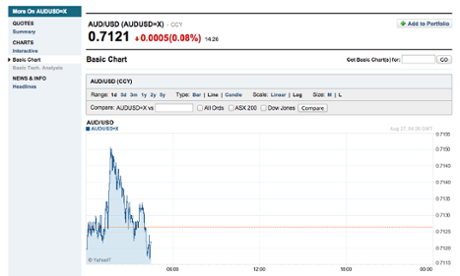
It’s buying US71.18c at the moment or 2.18 of your British pounds. Good time for holidays Down Under, I’d say.
Thailand exports down 3.6% year-on-year and imports down 12.7%
China market woes blamed on exodus of regulators
Interesting piece on Reuters about how some of the problems could be down to the loss of key regulatory personnel.
After the GFC, it says, Beijing poached top Chinese talent from overseas banks to come home and overhaul the country’s financial system. But by June this year, they’d become disillusioned and headed back to the private sector:
The best and brightest returnees, known in China as “sea turtles”, had already left for the private sector, disillusioned and disappointed.
A former official at the China Securities Regulatory Commission, one of a group of 20 high-profile returnees, recalled the CSRC’s appeal to make “sacrifices for the motherland”.
“We moved our families back to China and gave up high-paying jobs, because we wanted to contribute,” he said.
He said the group was sent for special training at Jinggangshan, a former revolutionary base used by Mao Zedong during the Chinese civil war.
Their idealism soon turned to cynicism. Their pay was a fraction of what they could earn in the private sector, and the CSRC didn’t seem to value them.
Several years passed, and none of us got promoted,” said the official. “Some of us didn’t even obtain a concrete position.”
“Just at the time they needed people with both domestic and international experience, those most internationally experienced people were forced out,” said Liu Li-Gang, China economist at ANZ.
Reuters notes that the CSRC did not reply to requests for comment.
Fairly steady on the markets still. Tokyo is well-placed at lunch having put on 1.89% without loss, while in Australia the ASX is batting through the break at +1.28%.
In China, the Shanghai Comp has played a riskier knock but is up 1.55% for the day so far despite nearly falling into the trap earlier in the session.
Elsewhere:
- Hang Seng 2.47%
- Kospi up 1.04%
Updated
Grogonomics analysis
More great writing from the Guardian on the China business, this time from our resident Australian economics commentator Greg Jericho.
His take is that the plunge in Chinese markets isn’t that bad per se – it’s more what it says about demand for Australian exports that is the problem.
Deconstructing Joe Hockey’s analysis of the Chinese economy this week that the fundamental were improving – a triumph of the “she’ll be right” school of philosophy – Greg writes that Beijing wouldn’t have cut rates four times this year if they weren’t worried:
Of course the Chinese government is only doing such things because it is worried that the “fundamentals” are not actually “gradually improving”.
It's the Fed, stupid
Quite a good one-sentence analysis from Shigemitsu Tsuruta, senior strategist at SMBC Friend Securities in Tokyo, on Reuters referring to speculation that the Fed will not raise rates in September:
The market has started to price in this prospect while the current level provides a good short-term rebound opportunity.
Updated
LUNCHTIME SUMMARY
OK, trading is looking quite serene today.
Here’s what’s happened so far:
- Asian markets are all on the up and up. The Nikkei is up nearly 2%, the ASX200 is up 1,43%, the Hang Seng 2.47%, the Kospi 1.25% and even the Shanghai Composite is going along well in positive territory, up 1.47%.
-
MSCI’s broadest index of Asia-Pacific shares outside Japan rose 1.8%, pulling away from a three-year low hit earlier in the week.
- The yuan has weakened to a four-year low
- BOJ governor says China slowdown won’t affect Japan too badly
- Australian business investment fell in the second quarter but looks like it will grow for the second part of the year
- Commodity prices are stabilising a little
- And we have an excellent piece from Tom Phillips on the wider economic picture for China’s poor migrant workers
Updated
Tom’s excellent piece also includes some fascinating insights from China expert Fraser Howie, author of Red Capitalism, who talks about what the struggles of working people tell us about the country’s governing class:
Much of the party’s legitimacy comes from the economy and from the Faustian bargain of limited political freedoms and social freedoms against economic prosperity. Any time there is a slowing economy the government is concerned about it for exactly those reasons – the people lose their jobs, there will not be the wage growth, people will not be able to enjoy the benefits of prosperity.
The fear has to be … that party stability is on the line if the economy doesn’t work.”
Intra-party battles are already going on thick and fast. The Chinese Communist party is more worried than almost any outside observer about the stability of the party. Foreigners always say: ‘Oh, yes, it will be fine’. But I think the Chinese communists are far better aware of how they could be toppled or how their party could collapse from the inside relatively quickly.
Tom Phillips, our correspondent in Beijing, has filed a terrific piece on how poor migrant workers are feeling the effects of the economic slowdown in China.
He met Liu, a scrap metal dealer whose business on the hardscrabble outskirts of Beijing has dried up, forcing her to return to her home village in south-east China with her two young children.

Abandoning Beijing was her family’s only option, she said.
It’s natural. We came here for work. We lost 200,000 yuan. We can’t afford to live here any more. Maybe one day we’ll return - but I don’t know when.
China slowdown won't harm Japan too badly – Kuroda
Haruhiko Kuroda, the governor of the Bank of Japan, has been speaking in New York about the China situation (still not sure there’s a consensus on crisis).
He said China’s economy is likely to slow further although he predicted growth in its GDP will remain at 6-7% this year and next, Reuters reports:
Already exports to China have been affected, but I do not think that Japan exports in coming years will be (very) negatively affected ... partly because China will maintain growth and Japanese capital goods are... quite competitive.
Kuroda said China’s monetary easing was an appropriate step to mitigate any impact on its economy, adding that some market players have become “too pessimistic” on the Chinese economy given its growth is “still quite robust”.
On US monetary policy, Kuroda said he expected the Federal Reserve to raise interest rates sometime this year, which would be a strong positive signal for the global economy.
Updated
Those poor investment numbers took a bit of bite out of the ASX200 – it fell to around 5240 – but it’s back up again now because the stats are actually more promising than the headline number suggests.
While capex fell in the second quarter to the end of June, businesses are planning to invest more than previously thought in the rest of the year to the tune of about 10% more.
Australian business investment falls
Business investment fell 4% in the June quarter, the Australian Bureau of Statistics said on Thursday.
The figures, which cover investment in capital goods and include such things as buildings and equipment, was worse than market forecasts, Australian Associated Press reports.
Businesses expect to invest $114.8bn this financial year, which is 23.4% lower than the corresponding estimate made at the same time last year.
The final estimate for business investment in 2014/15 is $150.58bn – 4.7% lower than investment in 2013/14.
Poor figures for a government banking on selling a growth story.
Yuan weakens
China’s stock markets may have risen today but the yuan has weakened on hints from the US about the Fed delaying a rate hike.
The People’s Bank of China set the reference rate for the yuan at 6.4085 per dollar prior to market open, its lowest level since 2011 and firmer than the previous day’s closing market quote of 6.4105.
Updated
Interactive
Great work by the graphics team in London to produce this interactive on how a China meltdown could affect different countries.
Hang Seng in Hong Kong is also up with a rise of 2.43%.
Chinese markets open up
Looking good for Shanghai.
Just waiting for the first prices to come through from China but the Australian market is purring away nicely, up 1.5%.
IG Market analyst Angus Nicholson reckon whatever happens in China won’t have too much impact today:
The Chinese stock market is having less of an influence on the Aussie stocks at the moment.
The Chinese economy is still a concern for the world economy at the moment but we’re seeing the Shanghai Composite bottom a bit, so I don’t think we’re going to see as much influence today when the Chinese stock market opens.
The plunge in commodities prices this year – especially oil – has been astonishing.
Despite a rise on Thursday because of an unexpected fall in inventory last week, US crude was still under $40 a barrel at $39.19. Brent, the global oil benchmark, gained 64 cents to $43.78 a barrel.
Seriously though, does anyone remember peak oil? I guess it could still turn around sharply again with a wider Middle East conflict or some such black swan event, but the idea that economies might be broken by sky-high oil prices has been replaced by the one that says certain countries could be broken by low prices.
Check out how Russia and even Saudi Arabia are struggling with the falling price.
Updated
What he really means is, will China’s chart go more like Thunderbirds 3 or Thunderbirds 4, the one that went underwater?
We’ll find out when trading starts at 11.30am Sydney time, ie in about 22 minutes.

But with Wall Street back on song and the Asia pacific markets up again today, what can possibly can wrong?
Well, investors are still not convinced about what’s going to happen in China where the weak stock market is seen as being important more because it suggests all is not well with the wider economy, rather than as the root of any systemic problem.

Reuters says a “fresh slide in China’s equities [on Thursday] and worries that China may allow a further depreciation of the yuan risked hampering a recovery in other riskier assets in Asia and beyond”.
It quotes Jasper Lawler, market analyst at CMC Markets:
Rather than getting ahead of the game with a well thought out plan for stabilising the economy, the PBOC appears to be reluctantly easing policy any time there’s a drop in share prices.
The net effect is that markets clamour for more stimulus while at the same time losing faith it will actually work.
It was too late for European bourses though which had struggled on the back of another lacklustre response from the Chinese markets to yet more stimulus – rate cuts and a loosening of reserve requirements – from the People’s Bank of China on Tuesday.
The FTSE was down 102 points to 5,979 on Wednesday. It has now fallen for 11 of the last 12 days (on Tuesday it jumped by 188 points), and is currently 15% off its record high.
Germany’s DAX and Spain’s IBEX both lost 1.3%, and the French CAC dropped 1.4%.
The key plus-point for the American market seemed to be comments from New York Fed president Bill Dudley who said on Wednesday that a September interest rate rise was now “less compelling” than it had been just a few weeks ago.
The decision to begin the normalisation process at the September FOMC [federal open market committee] meeting seems less compelling to me than it was a few weeks ago
He was also keen to play down any systemic risk from the China turbulence.
The stock market has to move a lot – and stay there – to have implications for the US economy. What we’re seeing is not a US problem. This is very different from the financial crisis.”
And with the prospect of more cheap money sloshing around the system for a bit longer than everyone had begin to expect, traders went away happy and the market surged.

Updated
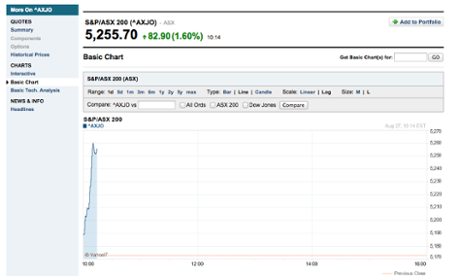
The ASX200 in Australia is up smartly again this morning after a good day on Wednesday saw it recoup a lot of the losses from earlier in the week, rising 35.5 points, or 0.69%, at 5,172.8 points.
This is this morning’s chart, where it resembles roughly half of Thunderbirds 3.

Good morning
Welcome to the Asia leg of the markets live blog. We’ve all had time to pause and reflect in the time zone but now things are under way again and the Australian and Japanese markets are up strongly following a huge 619-point surge on Wall Street on Wednesday.
For full details of how it played out yesterday, here’s the blog.
More of that in a moment – especially some interesting comments from a Federal Reserve rates setter – but here are the main scores on the doors this morning.
Nikkei +1.4%
ASX200 +1.3%
Kospi +0.56%
The yen is also down on the dollar while the Aussie dollar is currently buying US71.24c.
Updated